15 Best Video Editing Software For Every Skill Level
Choosing the best video editing software can make the creative process much easier. Excellent options exist for beginners, experienced creators, and everyone in between.
Video editing software lets you organize, cut, enhance, and combine footage into a complete project. You can also work with images, audio, voiceovers, subtitles, transitions, and visual effects.
Many modern editors include colour correction, templates, captions, and AI-powered features. These tools can simplify repetitive tasks and give you more creative control.
You can create YouTube videos, social media reels, tutorials, presentations, and film projects. Some editors focus on simplicity, while others provide more advanced professional features.
The right software depends on your skill level, device, content style, and creative goals. Understanding your options will help you find an editor that fits your workflow.
What Is Video Editing Software?
Video editing software is a digital tool for arranging, trimming, enhancing, and combining video clips. It helps turn raw footage into a finished production.
Most modern editors also handle images, music, voiceovers, captions, transitions, and visual effects. Many include tools for colour correction and other adjustments.
Editing can be as simple as removing unwanted sections from a family video. It can also involve multi-camera productions, professional colour grading, and detailed sound design.
The right software can make a noticeable difference in a creator’s workflow. Beginners may prefer templates and simple controls that make editing easier to learn.
Experienced editors may need precise keyframes, advanced colour tools, professional audio processing, and flexible media management. These features provide greater control over complex projects.
The best video editing software isn’t necessarily the program with the longest feature list. It offers the right balance of control, performance, usability, and creative flexibility.
15 Best Video Editing Software
Video editing needs vary widely depending on the type of content you create. A simple social media clip requires different tools than a detailed film or multi-camera project.
Some editors are designed for quick, straightforward projects with an easy learning curve. Others provide advanced controls for creators who want greater precision and flexibility.
Your device and operating system also matter when choosing an editor. Some programs work across several platforms, while others are designed specifically for certain devices.
The following 15 options cover a range of editing styles, experience levels, and creative needs. Each offers a different combination of features, usability, and editing capabilities.
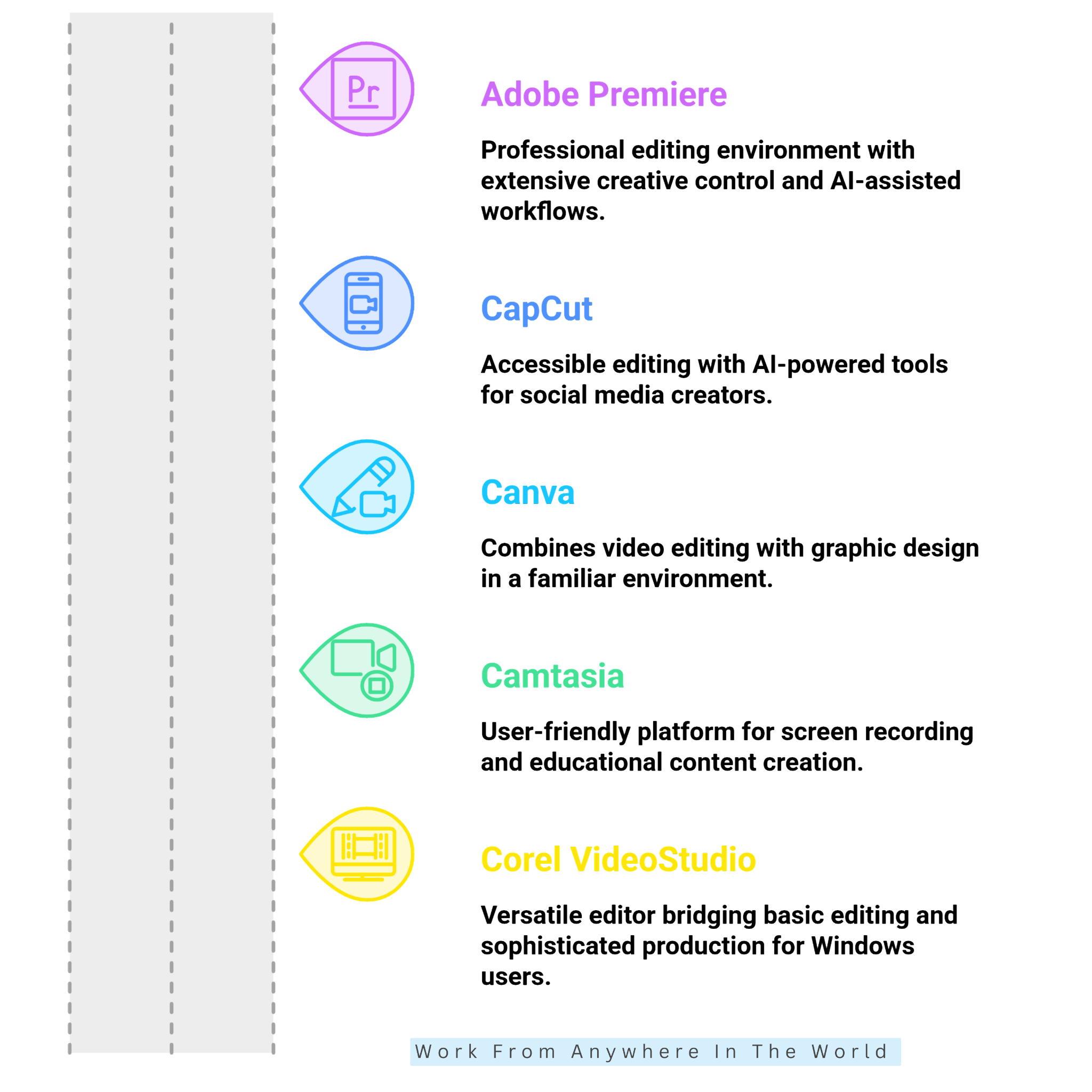
1. Adobe Premiere
Adobe Premiere is a professional video editor with extensive creative control. It works well for everything from online content to complex video productions.
The software includes timeline editing, title animation, visual effects, colour tools, and sound mixing. Its editing and trimming tools provide precise control over individual clips and complete projects.
Adobe has also added several AI-assisted editing tools. These include Text-Based Editing, Object Mask, Media Intelligence, and Generative Extend, which adds frames or extends ambient sound.
Another advantage is its connection with the wider Adobe Creative Cloud ecosystem. Creators can incorporate applications such as Photoshop, After Effects, Audition, and Illustrator into their production workflow.
Premiere is available for desktop and mobile, giving creators more flexibility when working across devices. Adobe offers several plan options, so check its official website for current availability and pricing.
Best for: Professional editors, YouTubers, agencies, filmmakers, and creators who already use Adobe applications.
Pricing: View current pricing
Key Strengths
- Professional timeline editing
- Advanced audio and visual tools
- AI-assisted editing features
- Strong Adobe ecosystem
- Desktop and mobile editing
2. CapCut
CapCut is popular among social media creators because it combines accessible editing with a wide range of creative tools. Its straightforward interface also makes it approachable for people with limited editing experience.
The editor includes Auto Captions, Auto Reframe, Script to Video, templates, effects, and other AI-assisted features. These tools can reduce some of the manual work involved in creating and adapting videos.
CapCut is particularly well suited to short-form content. Creators can produce Reels, TikToks, YouTube Shorts, promotional clips, tutorials, and other social media videos.
Templates provide another useful starting point for creators who don’t want to build every visual element from scratch. Creators can then customize videos with text, audio, effects, transitions, and other editing tools.
CapCut offers free and paid features, with availability varying by platform and region. Some AI tools, including Auto Reframe, may require a paid plan.
Best for: Social media creators, beginners, short-form video creators, influencers, and marketers.
Pricing: View current pricing information
Key Strengths
- Beginner-friendly workflow
- AI-assisted editing
- Auto Captions
- Auto Reframe
- Script-to-Video tools
- Strong short-form content focus
3. Canva
Canva is particularly useful for creators who combine video editing with graphic design. Its familiar drag-and-drop environment makes creating polished visual content approachable.
The platform brings videos, graphics, presentations, thumbnails, text, animations, and branded elements together. Creators can work on different types of content without continually switching between programs.
Canva includes tools to trim and combine clips, add transitions, work with audio, and create captions. It also offers AI-powered tools and features for creating and editing visual content.
Its extensive template library can make production easier for marketing teams and social media managers. Videos can also complement other campaign materials and maintain consistent branding.
Canva works particularly well for promotional videos, social media posts, presentations, advertisements, educational content, and branded clips.
Our Canva Review explores the platform’s features, tools, and uses in more detail. More advanced video editors may still be better for complex productions that require detailed timeline control.
Best for: Social media managers, marketers, small businesses, educators, and creators who prioritize visual branding.
Pricing: View current pricing
Key Strengths
- Drag-and-drop editing
- Extensive template library
- Text and animation tools
- Brand-focused design
- Social media content creation
- Video and graphic design in one platform
4. Camtasia
Camtasia is a user-friendly video editor and screen recorder. It is designed for creating demonstrations, tutorials, presentations, training videos, and other educational content.
One of its biggest advantages is its integrated screen-recording workflow. You can capture your screen, webcam, microphone, and system audio, then bring the recording directly into the editor.
Camtasia includes cursor effects, annotations, transitions, animations, captions, templates, and audio editing tools. These features can make instructional videos clearer and easier to follow.
You can also add interactive features such as quizzes and hotspots to suitable projects. This makes Camtasia particularly useful for training, courses, and other learning materials.
The straightforward timeline provides plenty of editing control without the complexity of a professional filmmaking application. This can appeal to creators who mainly want to teach, demonstrate, or explain a process.
Best for: Educators, trainers, course creators, software demonstrators, marketers, and tutorial-focused YouTubers.
Pricing: View current plans
Key Strengths
- Built-in screen recording
- Webcam and microphone capture
- Cursor and annotation effects
- Templates and animations
- Interactive learning features
- Straightforward timeline editing
- Excellent for tutorials and training videos
5. Corel VideoStudio
Corel VideoStudio is a versatile Windows video editor with an approachable editing environment. It combines everyday editing tools with features for more creative and detailed projects.
The familiar timeline lets you trim footage, arrange clips, add titles, adjust audio, and apply transitions and visual effects. Templates can also provide a starting point for quicker projects.
VideoStudio includes motion tracking, chroma key effects, screen recording, colour correction, and multi-camera editing. These tools give creators more flexibility as their editing skills and projects develop.
More advanced tools include colour grading and video masking, although some features vary between the Pro and Ultimate editions. This gives creators room to choose the version that better matches their editing needs.
For Windows users who want more than a basic editor without immediately moving to a complex professional application, VideoStudio offers a useful middle ground. Our Corel VideoStudio Review explores the software and its features in more detail.
Best for: Beginners, intermediate creators, YouTubers, educators, and Windows users.
Pricing: View current pricing
Key Strengths
- Beginner-friendly interface
- Motion tracking
- Chroma key editing
- Screen recording
- Multi-camera editing
- Creative effects and transitions
- Colour correction tools
6. DaVinci Resolve
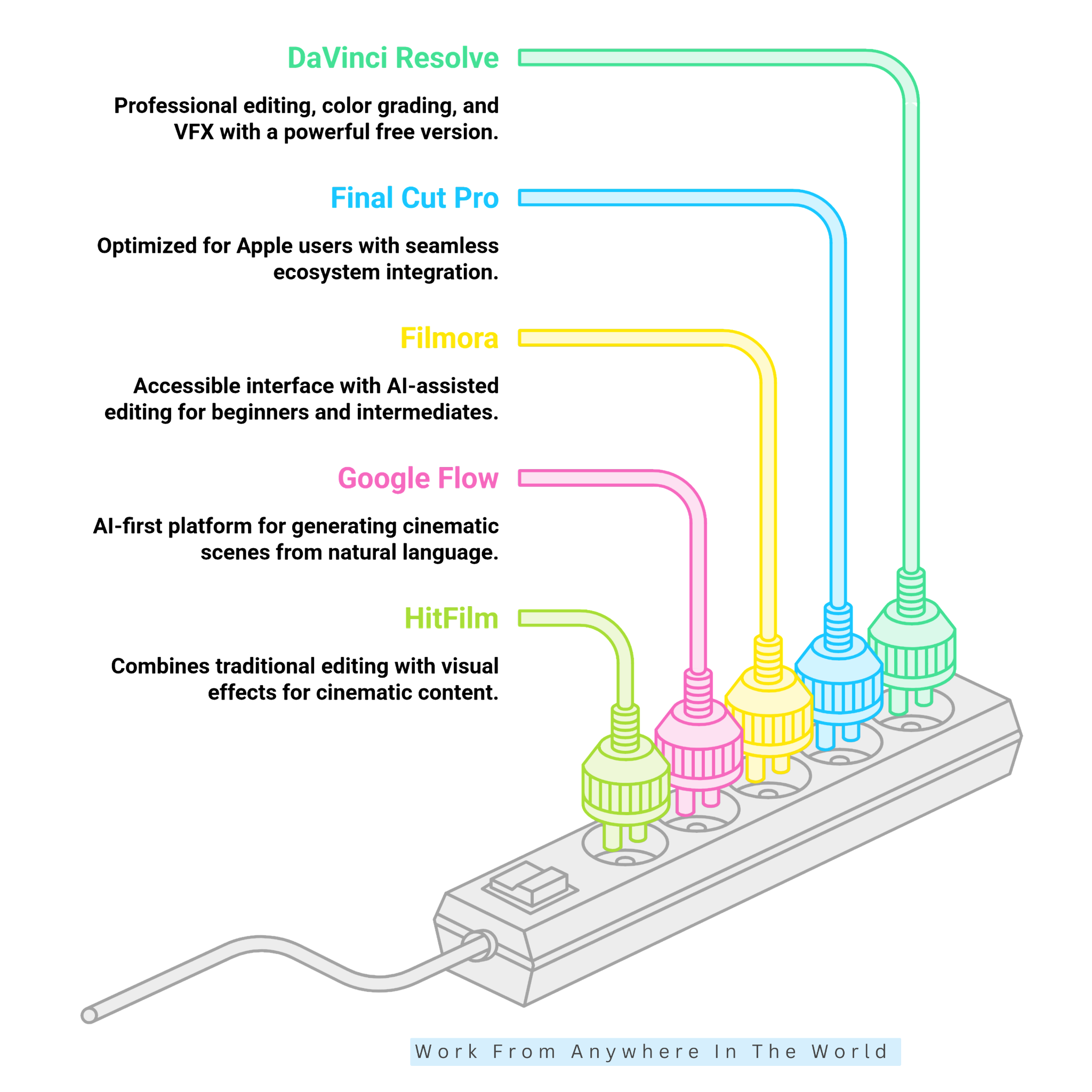
DaVinci Resolve has built a strong reputation for combining professional video editing with colour grading. It also includes visual effects, motion graphics, and audio production in one application.
Its free version is particularly attractive for creators who want powerful editing tools without an ongoing subscription. It supports editing and finishing up to Ultra HD 3840 × 2160 at up to 60 frames per second.
The free version also includes extensive colour-grading tools, visual effects, audio capabilities, and multi-user collaboration. This makes it unusually capable for software available without a purchase.
DaVinci Resolve Studio expands the platform with additional AI tools, effects, advanced noise reduction, and higher-resolution workflows. It also supports additional professional formats and features.
The interface can take longer to learn than simpler video editors. However, its extensive capabilities give creators plenty of room to develop their skills and take on more complex projects.
Best for: Serious creators, filmmakers, colourists, advanced YouTubers, and editors who want a powerful free option.
Pricing: View current pricing
Key Strengths
- Excellent colour-grading tools
- Powerful free version
- Editing, VFX, motion graphics, and audio in one application
- Professional workflow
- Strong upgrade path to Studio
7. Final Cut Pro
Final Cut Pro is designed for Apple users who want a professional video editing environment. It provides powerful editing tools for both Mac and iPad.
The software combines video editing, audio tools, motion graphics, and colour grading. It also includes intelligent features that can simplify demanding editing tasks.
Tools include object tracking, automatic colour enhancement, intelligent slow motion, and automatic reframing. These features can save time while giving creators greater control over their footage.
The iPad version adds touch-based editing, Apple Pencil support, and Live Multicam. You can also transfer projects between iPad and Mac when you need more advanced editing.
Final Cut Pro is particularly appealing to creators who already use Apple hardware. Its close integration with the Apple ecosystem can create a streamlined workflow across compatible devices.
Best for: Mac and iPad users, YouTubers, filmmakers, content creators, and professional editors.
Pricing: View current pricing
Key Strengths
- Professional editing capabilities
- Strong Apple ecosystem integration
- Mac and iPad support
- Advanced tracking and colour tools
- Touch-focused editing on iPad
Wealthy Affiliate – Mini Review
If you’ve ever thought about turning your blog, passion, or niche into an online business,
Wealthy Affiliate (WA) is one of the most beginner-friendly platforms I’ve used.
It combines step-by-step training, website hosting, AI-powered tools,
keyword research, and an active community all in one place.
What I like most is that you can start for free (no credit card needed), explore the platform,
test the tools, and connect with other entrepreneurs before upgrading.
WA isn’t a “get rich quick” scheme — success comes from consistent effort
and applying what you learn over time.
8. Filmora
Filmora sits comfortably between beginner-friendly video editing and more advanced creative work. It offers an approachable environment while giving creators enough tools to build more sophisticated projects.
Its interface makes common editing tasks easy to find and use. Creators can trim and arrange clips, add transitions and effects, work with audio, adjust colours, and create titles and subtitles.
Filmora also includes a growing collection of AI-assisted editing tools. Features include AI Copilot Editing, text-based editing, smart masking, object removal, speech-to-text, text-to-speech, and AI video generation.
These tools can help with time-consuming tasks such as locating footage sections, creating captions, removing unwanted objects, and working with spoken content. Creators can still make manual adjustments when they want greater control.
Filmora also provides colour-grading tools, screen recording, subtitle editing, creative effects, and project-management features. This combination makes it suitable for many types of online and business content.
It can be a useful middle ground for creators who have outgrown very basic editors but aren’t ready for a complex professional workflow. This gives beginners room to develop their editing skills without immediately changing software.
Best for: Beginners, intermediate creators, YouTubers, marketers, and small businesses.
Pricing: View current pricing
Key Strengths
- Accessible editing interface
- AI-assisted editing tools
- Text-based editing
- Smart masking and object removal
- Colour-grading and creative effects
- Subtitle and voice tools
- Built-in screen recording
9. Google Flow
Google Flow takes video creation in a different direction from traditional timeline-based editors. It is an AI creative studio designed to help creators develop, generate, and refine visual ideas.
Creators can work with text, images, and video inputs to develop scenes and visual sequences. Natural-language controls also let creators refine and edit generated content without relying entirely on conventional editing tools.
Flow includes tools for text-to-video, frames-to-video, video extension, and video-to-video editing. Its Scenebuilder also helps creators develop and organize generated scenes as part of a larger visual project.
The platform uses Google’s generative models, including Veo, to create video. This makes it particularly interesting for experimenting with characters, environments, camera ideas, and visual styles before or during production.
Flow can complement traditional video editing software rather than necessarily replace it. Creators can use it to develop AI-generated material and then incorporate that content into a broader video-production workflow.
Best for: AI filmmakers, creative storytellers, marketers, visual creators, and experimental video producers.
Pricing: View current pricing
Key Strengths
- AI-assisted video creation
- Text-to-video generation
- Video-to-video editing
- Natural-language creative controls
- Scene-building tools
- Rapid concept development
- Experimental filmmaking capabilities
10. HitFilm
HitFilm is designed for creators who want to combine traditional video editing with visual-effects production. Its creative workflow brings editing, compositing, motion graphics, and effects together, making it particularly interesting for independent filmmakers and digital creators.
One of HitFilm’s standout features is its focus on visual storytelling. Editors can work with layered compositions, green-screen footage, effects, transitions, and animated elements while building a complete project within the same environment.
The platform can also help creators experiment with cinematic techniques. Motion graphics, visual effects, compositing, and creative transitions can help transform ordinary footage into more stylized productions.
HitFilm is a strong option for creators who want to explore both editing and effects rather than relying on separate applications for every stage of production.
Best for: Independent filmmakers, YouTubers, visual-effects enthusiasts, and creators producing cinematic content.
Key Strengths
- Video editing and compositing
- Visual-effects tools
- Green-screen workflows
- Motion graphics
- Creative transitions
- Layer-based editing
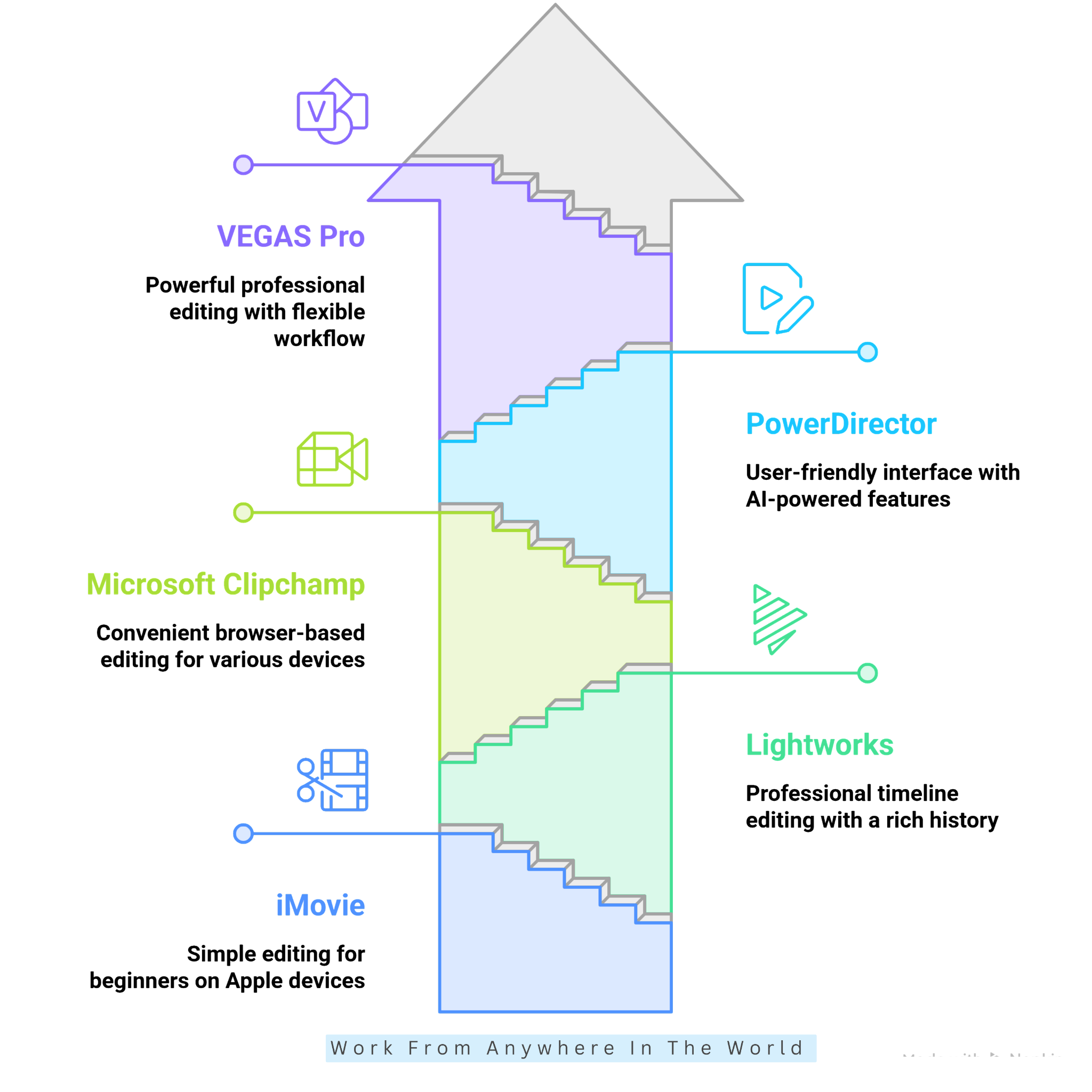
11. iMovie
iMovie is a practical starting point for Apple users who want an approachable video editor. Its straightforward tools make it easy to create polished videos without learning a complex professional workflow.
The software includes trimming, transitions, audio adjustments, titles, filters, and other everyday editing tools. Creators can also use picture-in-picture, split-screen effects, and green-screen editing for more creative projects.
iMovie supports 4K video and works across compatible Apple devices. You can transfer projects started on an iPhone or iPad to a Mac when a larger workspace is more convenient.
Another advantage is its connection to Final Cut Pro (see #7 above for details). Creators can send iMovie projects to Final Cut Pro on Mac when they need more advanced editing tools.
iMovie works particularly well for family videos, school projects, tutorials, travel videos, and straightforward online content. Its simplicity lets beginners focus on their footage instead of navigating complicated controls.
Best for: Beginners, students, families, casual creators, and Apple users.
Pricing: Free for compatible Apple devices.
Key Strengths
- Simple editing workflow
- 4K video support
- Apple device integration
- Green-screen effects
- Picture-in-picture and split-screen effects
- Easy transition to Final Cut Pro
12. Lightworks
Lightworks is a long-established video editing platform with roots in professional film and television production. Its timeline-based workflow gives editors detailed control over footage while supporting a wide range of video projects.
The software provides tools for trimming, timeline editing, effects, colour correction, audio work, and media organization. Creators can manage footage and build projects within a flexible editing environment.
Lightworks can handle everything from YouTube videos and promotional content to independent films and more complex productions. Its workflow lets you start with straightforward editing and gradually explore more advanced techniques.
The software also includes visual effects, transitions, titles, and audio tools for refining a finished production. Proxy workflows can help editors work more efficiently with demanding footage and larger projects.
Lightworks is available in different versions, including a free option and paid plans with additional capabilities. This gives new users an opportunity to explore the editing environment before deciding whether they need more advanced features.
Best for: Filmmakers, independent creators, YouTubers, editors, and users interested in professional-style workflows.
Pricing: View current pricing
Key Strengths
- Professional timeline editing
- Flexible media management
- Colour correction and effects tools
- Audio editing capabilities
- Free version available
- Support for advanced workflows
- Long-standing professional heritage
13. Microsoft Clipchamp
Microsoft Clipchamp is a convenient video editor for creators who want straightforward tools without learning a complex professional application. Its accessible interface makes everyday editing relatively easy to manage.
Clipchamp is built into Windows 11 and can also be used through supported web browsers. This gives creators flexibility when working across Windows, macOS, Linux, and Chromebook devices.
The editor includes trimming, cropping, transitions, filters, text, templates, and audio tools. Creators can also record their screen and webcam directly within the platform.
Clipchamp includes several AI-assisted features, including automatic captions, text-to-speech voiceovers, and tools that can help simplify video creation. Templates provide another useful starting point for creators who want to produce content quickly.
The software works particularly well for presentations, tutorials, social media videos, school projects, internal business content, and promotional clips. More advanced editors will offer greater control for complex productions, but Clipchamp covers many everyday editing needs.
A free version is available, with additional features and assets in paid options. Microsoft also includes Clipchamp with certain Microsoft 365 plans.
Best for: Beginners, Windows users, educators, businesses, students, and casual creators.
Pricing: View current pricing
Key Strengths
- Simple editing interface
- Windows 11 integration
- Browser-based editing
- Templates and stock assets
- Screen and webcam recording
- Automatic captions
- AI voiceover tools
14. PowerDirector
PowerDirector combines an approachable editing environment with a broad collection of professional-style tools. It offers enough flexibility for everyday projects while giving creators room to develop more advanced editing skills.
The software includes multi-camera editing, chroma key, motion tracking, keyframes, video stabilization, colour tools, and audio editing. Screen recording also makes it useful for tutorials, demonstrations, and other instructional content.
PowerDirector has expanded considerably into AI-assisted video editing. Its tools can help with tasks such as object and background removal, automatic reframing, speech enhancement, and other time-consuming parts of the editing process.
Text-based editing and AI-assisted creation tools provide additional ways to work with footage and develop new content. These features can streamline production while still letting creators make manual adjustments.
PowerDirector also provides templates, effects, transitions, titles, and access to stock media. This combination makes it suitable for YouTube videos, social media content, marketing materials, tutorials, and other creative projects.
Its balance of accessibility and more advanced features can be useful for creators who want an editor they can continue using as their skills develop.
Best for: Content creators, YouTubers, marketers, intermediate editors, and creators who want AI-assisted editing tools.
Pricing: View current pricing
Key Strengths
- User-friendly editing environment
- AI-assisted editing tools
- Multi-camera editing
- Motion tracking and keyframes
- Screen recording
- Video stabilization and colour tools
- Large collection of templates and effects
15. VEGAS Pro
VEGAS Pro is a powerful video editing platform for creators who want professional control without an unnecessarily complicated workflow. It combines detailed timeline editing with audio, colour, effects, and AI-assisted tools.
One of its biggest strengths is its flexible timeline. Editors can arrange multiple video and audio tracks, fine-tune transitions, adjust keyframes, and build detailed sequences while maintaining precise control over individual elements.
VEGAS Pro also includes colour grading, compositing, motion tracking, chroma key effects, and video stabilization. These tools support more sophisticated productions without requiring creators to move between several applications.
Audio production is another important part of the platform. Editors can work with detailed audio controls and effects alongside their video footage, making it easier to manage both parts of a production within the same environment.
The software incorporates AI-assisted editing features. These tools can simplify repetitive or time-consuming editing tasks while giving creators more control over their workflow.
Depending on the version, they can assist with transcription, subtitles, masking, and other editing processes. They can even support content repurposing strategies across different platforms.
VEGAS Pro is particularly appealing to Windows users who have moved beyond beginner-focused editors. Its customizable environment gives creators plenty of room to develop more advanced editing techniques.
Best for: Professional editors, YouTubers, filmmakers, content creators, and Windows users seeking advanced editing control.
Pricing: View current pricing
Key Strengths
- Professional timeline editing
- Advanced audio production
- Colour grading and visual effects
- Motion tracking and compositing
- AI-assisted editing features
- Video stabilization
- Flexible Windows-based workflow
Frequently Asked Questions
Q1: Is Professional Video Editing Software Difficult To Learn?
Professional video editing software usually includes more tools and can take longer to learn. However, you don’t need to master every feature before creating good videos.
Start with basic cuts, audio adjustments, transitions, titles, and colour correction. Once those skills become comfortable, you can gradually explore effects, keyframes, multi-camera editing, and other advanced workflows.
Q2: Can AI Replace Video Editors?
AI can automate many repetitive video editing tasks, including captions, transcription, reframing, masking, and object removal. These tools can make production more efficient and reduce manual work.
However, storytelling, pacing, visual judgment, and brand decisions still benefit from human direction. AI works best as a tool that supports the editor rather than replacing the decisions behind a finished video.
Q3: What Is The Best Video Editing Software For Beginners?
Beginners should look for video editing software with an intuitive interface, straightforward controls, and helpful templates. iMovie, Clipchamp, Canva, CapCut, and Filmora are approachable options to explore.
The best choice depends on your device and the type of videos you want to create. Starting with simpler software can help you learn essential editing skills before moving to more advanced tools.
Q4: Is Free Video Editing Software Good Enough?
Free video editing software can be more than sufficient for many projects. Some free editors provide impressive tools for trimming, colour correction, audio editing, effects, captions, and high-quality video production.
Your needs may eventually require features available only with paid software. However, starting with a free editor is an excellent way to learn which features matter most to your workflow.
Q5: What Features Should I Look For In Video Editing Software?
Look for essential tools such as trimming, transitions, audio editing, titles, colour correction, and suitable export options. Your priorities will depend on the type of content you create.
Screen recording, automatic captions, multi-camera editing, motion tracking, templates, and AI-assisted tools may also be valuable. Choosing features you will actually use is more important than finding software with the longest feature list.
Q6: Do I Need A Powerful Computer For Video Editing?
Your computer requirements depend on the software, video resolution, effects, and project complexity. Basic editing generally requires fewer resources than working with high-resolution footage and advanced effects.
Adequate RAM, storage, processing power, and a capable graphics system can make editing smoother. Always check the software developer’s current system requirements before installing a video editor.
Conclusion
Choosing the best video editing software starts with understanding your needs. The right program should support your projects without unnecessarily complicating the editing process.
Beginners may prefer approachable options such as iMovie, Clipchamp, CapCut, or Filmora. More experienced creators can explore advanced platforms such as DaVinci Resolve, Adobe Premiere, Final Cut Pro, PowerDirector, or VEGAS Pro.
Your device, experience level, and content style should also influence your decision. Features such as screen recording, colour grading, automatic captions, multi-camera editing, and AI-assisted tools will matter more for some creators than others.
Free versions can be an excellent place to start, especially when you’re still figuring out which editing features you actually need. As your skills and projects develop, you can move to more advanced tools when they genuinely help.
Ultimately, the most useful editor is the one that fits naturally into your workflow and helps you turn raw footage into polished content. Start with your objectives, compare the tools that support them, and choose software you will feel comfortable using regularly.
I trust you enjoyed this article on the 15 Best Video Editing Software for Every Skill Level. Please stay tuned for more insightful blogs on affiliate marketing, online business, and working from anywhere in the world.
Take care!
— JeannetteZ 🌍✨
💬 Your Opinion Is Important To Me
Do you have thoughts, ideas, or questions? I’d love to hear from you. Please leave your comments below or email me directly at Jeannette@WorkFromAnywhereInTheWorld.com.
📚 More Work From Anywhere Reads
🚀 Ready to Build a Business You Can Run from Home
Or from Anywhere in the World?
Imagine creating income on your terms — from home, a cozy café, or wherever life takes you.
With the right tools, training, and community support, it’s entirely possible.
Start your own online business for free — no credit card needed.
Disclosure
This post may contain affiliate links. As an Amazon Associate and participant in other affiliate programs, I earn from qualifying purchases at no extra cost to you. Please read my full affiliate disclosure.