
Best Advice For Non-Native English Bloggers
Best Advice For Non-Native English Bloggers can make a big difference when building confidence and improving writing skills. Writing in a language that is not your first can feel challenging, especially when worrying about grammar, vocabulary, or sounding natural.
The good news is that many successful bloggers are non-native English speakers. Clear communication, consistency, and valuable content often matter far more than perfect grammar.
Blogging is a skill that improves with practice. By focusing on progress instead of perfection, non-native English bloggers can build confidence and connect with readers around the world.
In this guide, you’ll discover practical advice to help you write more naturally, improve your blogging skills, and grow your confidence step by step.
What Are Non-Native English Bloggers?
Non-native English bloggers are people who write blog posts in English, even though it is not their first language. They usually speak another language in daily life, but choose English to reach a wider global audience online.
These bloggers write about many topics, including freelancing, digital marketing, education, lifestyle, travel, and personal experiences. Their writing style is often simple, clear, and easy for international readers to understand.
Most non-native English bloggers focus more on sharing useful information than writing perfect grammar. With regular practice, they strengthen their English skills and become more confident and successful over time.
16 Powerful Writing Tips For Non-Native English Bloggers
One of the biggest mistakes non-native English bloggers make is trying to write perfect English. This can slow down the writing process and make blogging feel stressful. Spending too much time rewriting the same sentence often results in less content and reduced motivation.
A simple mindset shift can help: focus on communication rather than perfection.
Readers do not expect flawless English. They want clear, helpful, and valuable information. If your message is easy to understand, they are more likely to stay on your blog and keep reading. Even native English speakers make grammar mistakes from time to time.
Instead of asking, “Is this sentence perfect?” ask yourself, “Is this sentence clear?”
This small change in perspective can improve writing speed, confidence, and consistency over time.
2. Use Short Sentences For Better Readability
Long sentences can be difficult to read, even for native English speakers. Non-native bloggers may feel even more confused, increasing the likelihood of grammatical mistakes.
Using shorter sentences makes writing clearer and easier to understand. It also helps readers stay focused and engaged.
For example, instead of writing:
“If you want to improve your blog writing skills quickly, you need to focus on grammar, vocabulary, sentence structure, readability, and consistency at the same time.”
Try this:
“If you want to improve your blog writing, focus on a few things first. Improve grammar. Learn simple vocabulary. Write shorter sentences. Stay consistent.”
The second version is easier to read and sounds more natural. It also feels less overwhelming for readers.
If a sentence feels too long or complicated, try breaking it into two or three shorter sentences. Clear writing is often the most effective writing.
3. Build A Small But Strong Vocabulary
You do not need thousands of English words to become a successful blogger. Using a smaller vocabulary confidently is often more effective than trying to use complicated words that feel unfamiliar.
Focus on learning words and phrases you can use regularly, such as:
- Common verbs: make, build, grow, improve, create, help
- Simple adjectives: easy, useful, strong, clear, fast, helpful
- Everyday expressions: for example, in fact, because of this, in simple words
Learning a smaller group of words well can make writing feel more natural and confident. Overcomplicated vocabulary often makes sentences harder to understand and less authentic.
A helpful habit is to learn a few useful words each day and practice using them in your writing. Over time, small improvements can make a big difference.
4. Read Blogs Written In Simple English
If you want to improve your English writing, reading regularly can make a big difference. However, it helps to start with content that feels clear and easy to understand rather than overly academic or complicated.
Simple blogs are often a great place to learn. Pay attention to how ideas are explained, how sentences are structured, and how short paragraphs and clear headings improve readability.
Reading English regularly also helps you become more familiar with natural sentence patterns, vocabulary, and tone. Over time, this can make writing feel smoother and more confident.
Try reading at least one blog post a day. Even a few minutes of reading can help build stronger writing habits over time.
5. Write As You Speak
Many non-native English bloggers try to sound formal because they believe it appears more professional. However, blogging is very different from academic writing. In many cases, readers respond better to content that feels natural and conversational.
Strong blog posts often feel like a direct conversation with the reader.
For example, instead of writing: “One must understand the importance of maintaining consistency in blog writing.”
Try: “You need to stay consistent if you want your blog to grow.”
The second version feels clearer, friendlier, and easier to understand. Readers often connect more with bloggers who sound genuine rather than overly formal.
A simple tip is to imagine explaining something to a friend. Writing in a natural, conversational style can make your blog more engaging and easier to read.

6. Create A Simple Writing Process
Writing becomes much easier when you follow a simple process. Without a system, it is easy to spend too much time thinking about what to write next.
A simple writing method can help:
Start With A Clear Idea
Begin by deciding what you want to write about. Write the topic in one simple sentence and focus on the main idea rather than grammar.
List Your Main Points
Write down 8–10 simple ideas related to your topic. Short notes are enough. This step helps organize your thoughts before writing full paragraphs.
Turn Ideas Into Short Paragraphs
Take one point at a time and expand it into a short paragraph. Keep sentences clear and easy to understand. Focus on explaining the idea rather than sounding perfect.
Edit After Finishing
Once the first draft is complete, go back and improve grammar, spelling, and sentence clarity. Avoid editing while writing, as it can slow down the process.
Following a simple system reduces pressure and helps blogging feel more manageable. Progress matters more than perfect English in the beginning.
7. Use AI Tools Wisely
AI writing tools can be helpful for non-native English bloggers. They can improve grammar, suggest clearer sentence structures, and help explain ideas more naturally.
However, relying entirely on AI may slow improvement in writing over time. AI works best as a support tool rather than a replacement for your own ideas and voice.
A simple way to use AI effectively is to:
- Write the first draft yourself
- Use AI to improve grammar or clarity
- Compare the original and edited versions
- Learn from the suggested changes
This approach helps bloggers improve their writing skills while still developing a natural and personal style.
Wealthy Affiliate – Mini Review
If you’ve ever thought about turning your blog, passion, or niche into an online business,
Wealthy Affiliate (WA) is one of the most beginner-friendly platforms I’ve used.
It combines step-by-step training, website hosting, SEO research tools,
and an active community all in one place.
What I like most: you can start free (no credit card needed),
explore lessons, test the tools, and connect with other entrepreneurs
before upgrading. WA isn’t a “get rich quick” scheme — it’s a platform where success comes
from consistent effort and applying what you learn.
8. Stop Worrying About Grammar Mistakes
Fear of grammar mistakes can hold many non-native English bloggers back. Worrying too much about mistakes or what others might think often makes writing feel stressful and discouraging.
The good news is that most readers care more about useful, clear content than perfect grammar. If a blog post solves a problem or provides helpful information, readers are more likely to focus on the content’s value.
Writing skills also improve with practice. The more you write, the more natural English tends to feel over time. Waiting for perfect grammar before publishing may only slow progress and reduce confidence.
Mistakes are part of learning. Writing consistently, improving gradually, and staying focused on communication can help build confidence over time.
9. Write Regularly, Even If It Is Short
Consistency matters more than perfection. Writing a little each day often leads to better progress than writing a large amount only occasionally.
Regular writing can help you:
- Think more naturally in English
- Improve sentence structure over time
- Build confidence in your writing
- Become more comfortable expressing ideas
You do not need perfect conditions to practice. Even a few minutes of writing each day can make a difference. Writing about simple topics, daily experiences, or blog ideas is often enough to build momentum.
Over time, regular practice can improve both writing confidence and speed.
10. Focus On Basic Grammar First
Learning every grammar rule is not necessary to become a successful blogger. Trying to master advanced grammar too early can feel overwhelming and slow progress.
Instead, focus on a few essential basics, such as:
- Present tense (I write, I work, I create)
- Past tense (I wrote, I worked, I created)
- Basic sentence structure (subject + verb + object)
- Simple punctuation (full stop, comma, question mark)
Understanding these fundamentals can make writing feel clearer and more confident. For most blog posts, simple grammar and clear communication matter far more than perfect technical accuracy.
Strong blogging often comes down to a simple combination: clear ideas and easy-to-understand writing.

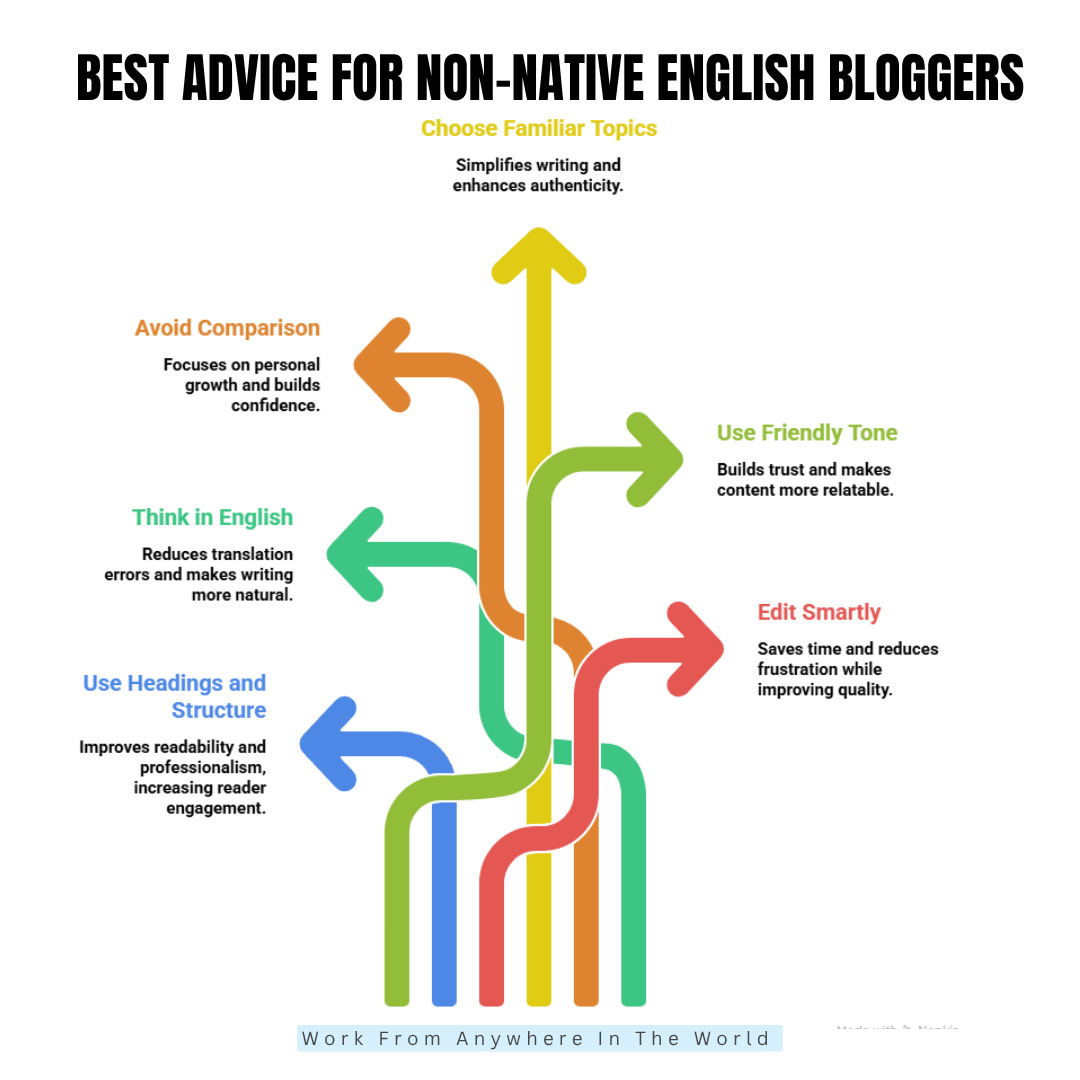
11. Use Headings And Structure Effectively
Good structure makes a blog easier to read and understand. Even if your English is still improving, a well-organized post can feel more professional and easier for readers to follow.
Helpful formatting includes:
- Clear headings
- Short paragraphs
- Bullet points
- Simple sections
Well-structured content helps readers find information quickly and stay engaged. It can also make blog posts feel less overwhelming and easier to follow.
Think of your blog as a conversation broken into small, simple parts. Each heading should introduce one clear idea and guide the reader naturally through the content.
12. Practice Thinking In English
Many non-native English bloggers first translate ideas from their native language before writing. While this is completely normal, it can sometimes make sentences feel longer or less natural.
Over time, it can help to practice thinking in simple English while writing. This often makes ideas flow more smoothly and helps sentences feel clearer and more natural.
At first, this may feel slow or unfamiliar. That is perfectly normal. Like any skill, it becomes easier with regular practice.
Start with simple thoughts, such as:
- I want to write a blog today.
- This topic feels easy to explain.
- I will write five points first.
Even small moments of thinking in English can help improve confidence and sentence flow over time. The goal is not perfection — just gradual progress.
13. Focus On Your Own Progress
Improving writing skills takes time, especially when blogging in a second language. It can be easy to compare your writing to more experienced bloggers, but every writer develops at a different pace.
Many successful bloggers are non-native English speakers. What often matters most is creating clear, helpful content and continually improving over time.
Instead of comparing yourself to others, focus on your own progress. Small improvements can add up quickly.
Questions like these can help track growth:
- Is my writing clearer than before?
- Am I writing more confidently?
- Does blogging feel easier than it did a few months ago?
Strong blogging skills develop gradually. Consistency, practice, and patience often matter more than perfect grammar or flawless writing.
14. Choose Topics You Know Well
Writing often feels easier when you choose topics you already understand and feel comfortable explaining. Familiar topics can make it easier to express ideas clearly and write with more confidence.
For example, you might write about:
- Job skills or professional experiences
- Social media tips or strategies you have tried
- Freelancing lessons or challenges
- Blogging tools, platforms, or experiences
- Simple tutorials on topics you understand well
Writing about familiar subjects often reduces the pressure of coming up with ideas. Instead, you can focus more on clear communication, sentence structure, and improving your writing skills.
Over time, confidence grows naturally when writing about topics you know well. Readers are also more likely to connect with content that feels authentic and genuinely helpful.
15. Use A Friendly And Natural Tone
Many non-native English bloggers try to sound very formal because it feels more professional. However, blog posts often work better when the tone feels warm, clear, and easy to follow.
Try writing as if you are helping someone understand a topic. Simple words and a conversational style usually feel more natural than overly formal language.
For example, instead of writing: “This article will provide essential guidance for individuals who wish to improve their blogging skills.”
Try: “This article will help you improve your blogging skills step by step.”
The second version feels clearer and easier to understand.
A friendly tone can help readers feel more connected to your content. When blog posts sound natural and approachable, readers are often more likely to stay engaged and return for more helpful information.
16. Edit In Small, Smart Steps
Editing is important, but it does not have to feel overwhelming. Instead of trying to fix everything at once, edit your blog post in small, focused steps.
A simple editing process can help:
- Check spelling and correct obvious mistakes
- Review sentence clarity
- Make sure ideas are easy to understand
- Fix grammar and punctuation
- Read the full post once more for flow
This step-by-step approach saves time and reduces frustration. It also helps you learn from your own writing over time.
With regular practice, editing becomes easier. Your writing will feel smoother, your confidence will grow, and each blog post will become stronger.
FAQs
1. Can Non-Native English Bloggers Become Successful Online?
Yes, non-native English bloggers can become very successful online. What matters most is clear communication, useful content, and consistency. Many readers prefer simple English because it is easier to understand.
2. How Can Non-Native Bloggers Improve Their English Writing Skills?
Non-native bloggers can improve by writing daily, reading simple English blogs, learning basic grammar rules, and focusing on short sentences. Regular practice helps build confidence and naturally improves writing skills.
3. Do Readers Care About Grammar Mistakes In Blogs?
Most readers do not mind small grammatical mistakes if the content is helpful and easy to understand. Clear ideas and useful information are more important than perfect English in blogging.
4. What Type Of Topics Should Non-Native English Bloggers Write About?
Non-native English bloggers should write about topics they understand well, such as personal experiences, skills, freelancing, blogging tips, or simple tutorials. Familiar topics make writing easier and more natural.
Conclusion
Being a non-native English blogger is not a weakness. In many ways, it can be an advantage. Writing clearly and simply often makes content easier for global readers to understand and connect with.
Focus on communication rather than perfection. Write consistently, keep sentences clear, and allow yourself time to improve. Little progress adds up, and writing becomes easier with regular practice.
Confidence grows through action. The more you write, learn, and improve, the more natural blogging will begin to feel over time.
I trust you enjoyed this article on the Best Advice For Non-Native English Bloggers. Please stay tuned for more insightful blogs on affiliate marketing, online business, and working from anywhere in the world.
Take care!
— JeannetteZ 🌍✨
💬 Your Opinion Is Important To Me
Do you have thoughts, ideas, or questions? I’d love to hear from you. Please leave your comments below or email me directly at Jeannette@WorkFromAnywhereInTheWorld.com.
📚 More Work From Anywhere Reads
🚀 Ready to Build a Business You Can Run from Home
Or from Anywhere in the World?
Imagine creating income on your terms — from home, a cozy café, or wherever life takes you.
With the right tools, training, and community support, it’s entirely possible.
Start your own online business for free — no credit card needed.
Disclosure
This post may contain affiliate links. As an Amazon Associate and participant in other affiliate programs, I earn from qualifying purchases at no extra cost to you. Please read my full affiliate disclosure.