Online Business Mistakes To Avoid When Working From Anywhere
Working from anywhere offers freedom, flexibility, and global opportunity—but it also comes with hidden challenges. Many entrepreneurs rush into remote work without clear strategies, systems, or boundaries. As a result, growth slows, and avoidable errors pile up.
This guide on online business mistakes to avoid when working from anywhere highlights the most common pitfalls digital entrepreneurs face and shows how to build a sustainable, location-independent business the smart way.
20 Online Mistakes To Avoid When Working From Anywhere
1. Treating Work From Anywhere Like Work Anytime
When location flexibility appears, time discipline often disappears. Many remote entrepreneurs work in scattered blocks throughout the day. A little work in the morning.
Emails late at night. Tasks are squeezed between personal obligations. This creates constant mental switching, which drains focus faster than long hours ever would.
Your brain never enters deep work mode, and rest never feels complete or deserved. Over time, work begins to feel endless and overwhelming, even when actual output is low.
Productivity drops, motivation weakens, and burnout creeps in quietly—mainly because there’s no clear “off” switch separating work from personal life anymore.
What To Do Instead
Create intentional working hours and protect them daily. Decide when your workday starts and when it ends, even if the schedule is flexible.
Clear time boundaries help your brain focus intensely during work and fully relax afterward, reducing stress and mental exhaustion.
2. Working Without A Dedicated Workspace
Many people begin remote work casually. The couch. The bed. The kitchen table. While this feels comfortable at first, it slowly damages focus and discipline. Your brain connects environments with behaviours.
When your workspace constantly changes, your mind struggles to switch into professional mode. Distractions multiply. Simple tasks take longer than necessary. Motivation weakens over time.
Eventually, work starts to feel mentally heavy even when tasks are easy, because your environment never signals structure, seriousness, or purpose. Comfort replaces intention, and productivity quietly declines.
What To Do Instead
Set up one consistent workspace used only for work. It doesn’t need to be large or expensive. A desk, chair, or quiet corner is enough. This consistency trains your brain to associate that space with focus, productivity, and professional behaviour.
3. Ignoring Time Zone Planning
Working from anywhere usually means working with people everywhere. Clients, teams, partners, and customers may live across multiple time zones. Without clear planning, communication becomes chaotic.
Meetings are scheduled at inconvenient hours. Messages feel delayed or ignored. Deadlines slip unintentionally. Over time, this creates frustration and damages trust.
Even strong skills can’t compensate for poor coordination. Many online businesses appear disorganized or unprofessional simply because time expectations were never clearly defined or communicated.
What To Do Instead
Choose one primary business time zone and communicate it clearly across emails, contracts, and scheduling tools. Set response-time expectations and use calendar software so everyone knows when you’re available, offline, or unavailable.
4. Trying To Do Everything Alone
Remote work can feel isolating, so many entrepreneurs try to handle everything themselves.
- Marketing
- Content creation
- Tech issues
- Admin work
- Customer support
- Finances
At first, this feels efficient and cost-effective. Over time, it becomes exhausting. Growth slows because energy is scattered. Creativity suffers because mental space is limited. Mistakes increase as the workload expands.
The business becomes fragile because everything depends on one person. What once felt like independence slowly turns into overwhelm and constant pressure.
What To Do Instead
Delegate earlier than you feel comfortable. Outsource repetitive, technical, or low-impact tasks. Use freelancers, automation tools, or virtual assistants.
Freeing your time allows you to focus on strategy, creativity, and revenue-generating activities that actually move the business forward.
5. Ignoring Legal And Tax Responsibilities
Many remote entrepreneurs believe online work means fewer rules. This is a dangerous assumption. Taxes, registrations, contracts, and compliance requirements still apply—sometimes across multiple regions or countries. Ignoring these responsibilities doesn’t make them disappear. It only delays problems.
Fines, penalties, frozen payment accounts, or legal notices often show up later, when fixing the issue becomes stressful, expensive, and time-consuming. These problems can derail an otherwise successful online business.
What To Do Instead
Consult a professional familiar with online and remote businesses. Register properly. Track income and expenses consistently. Handling legal and tax responsibilities early protects your business, builds confidence, and removes unnecessary long-term stress.

6. Chasing Every New Tool Or Trend
The online world constantly promotes new tools, platforms, and strategies. Every week, there’s a new app promising faster growth, easier automation, or instant results.
Many remote entrepreneurs jump from one tool to another, hoping to find a shortcut. This creates scattered focus and wasted money. Instead of mastering one system, they restart repeatedly.
Progress stalls because nothing is followed long enough to work. Confidence drops as results feel inconsistent. Over time, the business lacks stability, direction, and a repeatable process that supports sustainable growth.
What To Do Instead
Choose a reliable and straightforward tech stack that supports your core business needs. Commit to proven strategies and tools long enough to see results.
Focus on mastering one platform at a time. Long-term consistency builds skill, confidence, and momentum far better than constant experimentation.
7. No Backup Plan For Internet Or Technology
An online business depends entirely on technology to function. Internet outages, power failures, device crashes, or software issues can stop work instantly.
Many people assume these problems won’t happen or will be rare. Unfortunately, they’re inevitable. Without backups, deadlines are missed, communication breaks down, and trust is damaged.
Stress rises quickly when you can’t access files, platforms, or clients. One unexpected technical failure can undo weeks of effort and even cost long-term business relationships.
What To Do Instead
Prepare simple backup systems in advance. Use cloud storage for all essential files. Keep a mobile hotspot or alternative internet option available.
Store passwords securely with a manager. Having contingency plans ensures technical issues don’t interrupt your income or credibility.
8. Weak Communication Habits
Remote work removes facial expressions, tone, and immediate feedback. Short messages can sound harsh. Delayed replies can feel personal.
Assumptions grow quickly when communication isn’t clear. Poor communication leads to misunderstandings, frustrated clients, and unnecessary conflict.
Many online businesses struggle not because of skill gaps, but because expectations were never clearly explained. Over time, trust erodes, relationships weaken, and simple issues turn into larger problems that could have been avoided.
What To Do Instead
Communicate clearly, consistently, and intentionally. Document processes and agreements in writing. Clarify expectations early around timelines, responsibilities, and communication channels.
Over-communicating important details helps everyone feel informed, aligned, and confident in the working relationship.
9. Not Tracking Time Or Results
Many remote workers feel busy all day but struggle to explain what they actually achieved. Without tracking time or results, inefficiencies hide easily. Hours disappear into low-impact tasks, distractions, or unnecessary work.
Progress feels slow and confusing because nothing is measured. Guesswork replaces strategy, making improvement nearly impossible.
Without visibility into where time goes, it’s hard to optimize workflows, increase output, or grow the business intentionally.
What To Do Instead
Track your time and outcomes weekly. Identify tasks that produce real results and eliminate or reduce low-value activities.
Focus on measurable progress rather than hours worked. Tracking creates clarity, accountability, and smarter decision-making.
10. Mixing Personal And Business Finances
Using one account for both personal and business expenses creates confusion quickly. Transactions blur together. Profit feels unclear.
Financial decisions become emotional instead of data-driven. Tax season turns stressful because records are disorganized.
This habit also makes your business feel less legitimate and harder to scale. Without financial clarity, it’s challenging to plan, invest, or confidently assess whether your business is actually growing.
What To Do Instead
Separate personal and business finances completely. Open a dedicated business bank account. Track income and expenses consistently. Use simple accounting tools to maintain clarity, professionalism, and full control over your business finances.

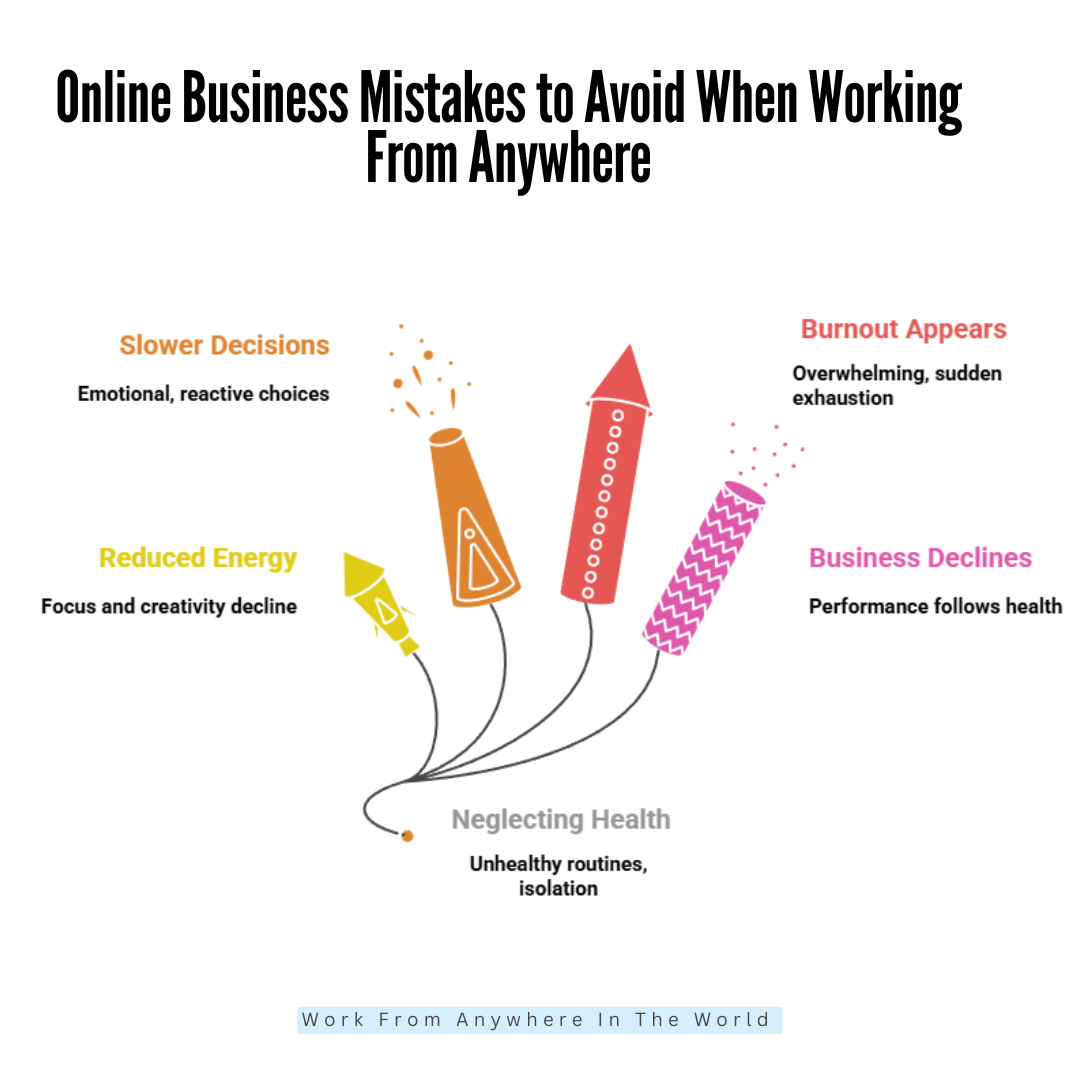
11. Neglecting Physical And Mental Health
Remote work often creates unhealthy routines without immediate warning signs. Long sitting hours replace movement. Meals become irregular. Sleep schedules drift. Isolation increases.
Many online entrepreneurs ignore health, believing productivity matters more. Over time, energy drops. Focus weakens. Creativity suffers. Decision-making becomes slower and more emotional.
Burnout appears quietly, then suddenly feels overwhelming. When physical and mental health decline, business performance follows quickly.
Ignoring well-being does not save time. It gradually reduces capacity, motivation, consistency, and long-term sustainability across every area of your remote business.
What To Do Instead
Schedule movement breaks daily. Eat proper meals consistently. Protect your sleep routine. Stay socially connected outside work.
Treat health as a business asset. Strong energy, focus, and emotional stability support better decisions, creativity, and sustainable performance long-term.
12. Working Without Clear Goals
Freedom without direction leads to scattered effort. Many remote entrepreneurs stay busy but lack defined goals. Without milestones, progress feels invisible.
Motivation slowly fades. Daily tasks become reactive instead of intentional. You may work long hours yet feel unsatisfied. Busy work replaces meaningful action.
Over time, confusion builds. Confidence weakens. Frustration grows because results feel inconsistent. Without clear goals, measuring success becomes impossible.
Direction disappears. Growth slows. Lack of structure eventually creates burnout, doubt, and the feeling of moving constantly while getting nowhere professionally.
What To Do Instead
Set clear monthly and quarterly goals. Break them into weekly tasks. Track progress visually. Review results regularly. Clear goals create focus, motivation, and direction. They turn effort into measurable outcomes and prevent wasted energy on low-impact activities.
Wealthy Affiliate – Mini Review (2025)
If you’ve ever thought about turning your blog, passion, or niche into an online business,
Wealthy Affiliate (WA) is one of the most beginner-friendly platforms I’ve used.
It combines step-by-step training, website hosting, SEO research tools,
and an active community all in one place.
What I like most: you can start free (no credit card needed),
explore lessons, test the tools, and connect with other entrepreneurs
before upgrading. WA isn’t a “get rich quick” scheme — it’s a platform where success comes
from consistent effort and applying what you learn.
13. Relying On A Single Income Source
Depending on one income source creates a serious risk. One client. One platform. One traffic channel. Algorithms change without warning. Clients leave unexpectedly. Accounts get restricted or shut down.
Many online businesses collapse overnight because their income lacks diversification. Financial stress increases quickly. Decision-making becomes reactive. Fear replaces strategy. Growth slows because survival takes priority.
Remote work offers flexibility only when revenue is stable. A single income stream limits freedom and creates constant anxiety that undermines confidence, planning, and long-term business sustainability.
What To Do Instead
Build additional income streams gradually. Develop multiple offers. Grow an email list you control. Expand traffic sources over time.
Diversification stabilizes income, protects against sudden losses, and reduces financial stress while supporting confident, long-term decision-making.
14. Weak Branding And Positioning
Many online businesses appear generic and forgettable. No clear message. No personality. No differentiation. When working remotely, branding replaces physical presence and trust-building interactions.
Weak positioning makes attracting the right audience difficult. Marketing feels forced and inconsistent. You compete on price instead of value. Opportunities feel limited.
Without clear branding, people struggle to understand who you help or why you matter. This confusion slows growth, reduces conversions, and weakens credibility in competitive online environments where attention is limited.
What To Do Instead
Define your niche clearly. Identify your ideal audience. Communicate your value consistently across platforms. Use clear language and tone.
Strong positioning builds trust, attracts aligned opportunities, and makes marketing easier, more focused, and more effective long-term.
15. Saying Yes To Everything
Remote work creates endless opportunities. New clients. New projects. Global access. Saying yes feels exciting initially. Over time, overload appears. Too many commitments stretch focus thin. Quality declines. Stress increases.
Boundaries disappear. Workdays become chaotic. Instead of freedom, pressure grows. Growth without limits leads directly to burnout. You lose control of your schedule. Energy drains.
Saying yes too often prevents deep work, strategic thinking, and sustainable progress. Without boundaries, success becomes exhausting rather than fulfilling or manageable.
What To Do Instead
Choose opportunities intentionally. Say no to misaligned work. Protect your time and energy. Focus on projects that support long-term goals. Clear boundaries improve quality, reduce stress, and allow sustainable growth without sacrificing health or focus.
16. Lack Of Systems And Documentation
Many remote businesses rely heavily on memory instead of systems. Tasks are repeated each time. Knowledge lives inside one person’s head. This creates confusion, inconsistency, and unnecessary stress.
Mistakes increase as the workload grows. Training others becomes difficult. Time is wasted reinventing processes repeatedly. Without documentation, scaling becomes nearly impossible.
The business stays fragile and dependent on constant attention. Freedom decreases instead of increasing. Systems are not restrictive. They create clarity, stability, and structure that allow remote businesses to grow smoothly without chaos.
What To Do Instead
Document processes early, even if they feel small. Create simple checklists and templates. Automate repetitive tasks using tools. Clear systems reduce errors, save time, support delegation, and create consistency that allows your business to scale without constant supervision.
17. Avoiding Marketing Because It Feels Uncomfortable
Many online entrepreneurs avoid marketing because it feels awkward or self-promotional. They wait for referrals or hope content performs naturally. This severely limits visibility.
Even strong businesses remain hidden without promotion. Silence does not equal professionalism. Without consistent marketing, growth becomes unpredictable.
Income fluctuates. Confidence drops. Opportunities pass unnoticed. Marketing is not manipulation. It is communication.
Avoiding it creates stagnation and frustration. Long-term success requires being seen, heard, and remembered by the right audience consistently over time.
What To Do Instead
Learn basic marketing skills gradually. Choose one platform and show up consistently. Share helpful content and real experiences. Marketing builds trust over time. Visibility creates opportunities, stability, and growth for any sustainable online business.
18. Forgetting Why You Started
Many people begin online businesses seeking freedom, flexibility, or balance. Over time, pressure increases. Work expands. Stress returns. The business starts controlling life instead of supporting it.
Original goals fade into the background. Without reflection, success feels empty and exhausting. Achievement loses meaning. Motivation weakens. You may reach milestones yet feel disconnected.
Forgetting your original purpose leads to misaligned decisions. Growth without intention creates burnout. A business should enhance life, not replace one stressful structure with another.
What To Do Instead
Revisit your original reasons regularly. Reflect on what freedom means to you now. Adjust your business model when necessary—design systems, schedules, and goals that support your life, values, and long-term well-being intentionally.
19. Poor Client Or Customer Boundaries
Remote businesses often blur professional boundaries unintentionally. Clients message at all hours. Requests expand beyond agreements. Response expectations grow silently. Without boundaries, work becomes reactive and stressful.
You feel constantly available. Resentment builds. Quality suffers. Personal time disappears. Many entrepreneurs believe flexibility requires constant access. In reality, unclear boundaries reduce respect and trust.
Over time, burnout replaces enthusiasm. Healthy boundaries protect energy, focus, and professionalism. They allow you to deliver better results while maintaining balance, control, and sustainability in a remote work environment.
What To Do Instead
Set clear communication rules from the beginning. Define response times, availability, and scope clearly. Use contracts or written agreements.
Strong boundaries increase respect, improve client relationships, protect personal time, and prevent burnout while supporting long-term professional success.
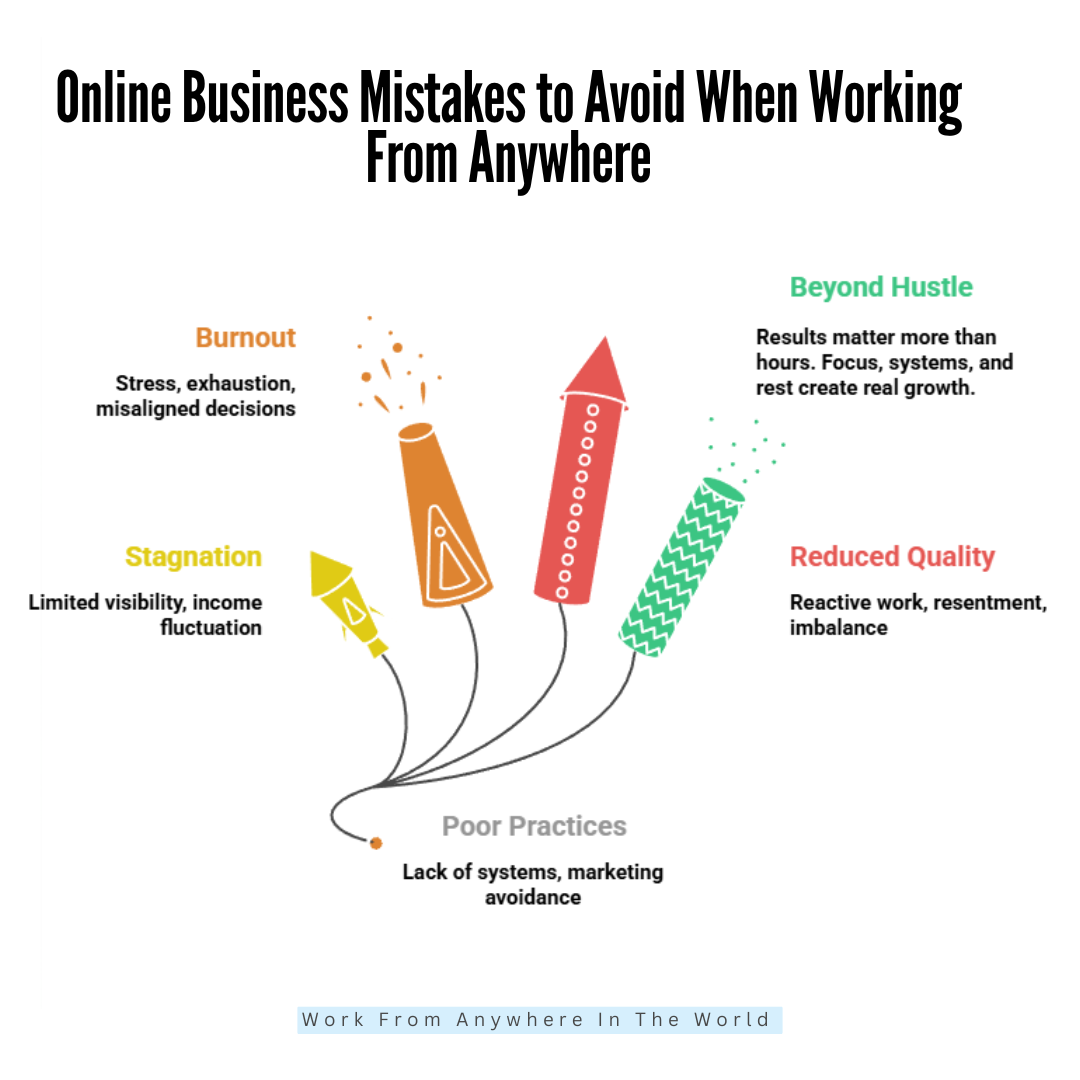
20. Measuring Success Only By Hustle
Many remote entrepreneurs equate success with constant activity. Long hours feel productive. Rest feels guilty. Hustle becomes a badge of honour. However, busyness does not equal progress.
Overworking reduces creativity, clarity, and decision-making quality. Results become inconsistent. Health suffers quietly. Measuring success only by effort ignores outcomes and sustainability.
Actual progress comes from effectiveness, not exhaustion. Hustle without reflection creates burnout, not freedom. A remote business should reward innovative systems, focused work, and balanced performance over constant strain.
What To Do Instead
Measure success by results, not hours. Focus on outcomes, efficiency, and sustainability. Build systems that reduce workload. Prioritize rest and recovery.
A healthy balance supports better decisions, stronger creativity, consistent performance, and long-term business growth.
Conclusion
Success in remote entrepreneurship is not about working harder from different locations—it’s about working smarter. By understanding these online business mistakes to avoid when working from anywhere, you can create stronger systems, better habits, and more consistent growth.
Learn from these mistakes early, refine your processes, and build a business that supports freedom, income stability, and long-term success—no matter where you choose to work.
I trust you enjoyed this article on the Online Business Mistakes To Avoid When Working From Anywhere. Please stay tuned for more insightful blogs on affiliate marketing, online business, and working from anywhere in the world.
Take care!
— JeannetteZ 🌍✨
💬 Your Opinion Is Important To Me
Do you have thoughts, ideas, or questions? I’d love to hear from you. Please leave your comments below or email me directly at Jeannette@WorkFromAnywhereInTheWorld.com.
📚 More Work From Anywhere Reads
🚀 Ready to Build a Business You Can Run from Home
Or from Anywhere in the World?
Imagine creating income on your terms — from home, a cozy café, or wherever life takes you.
With the right tools, training, and community support, it’s entirely possible.
Start your own online business for free — no credit card needed.
Disclosure
This post may contain affiliate links. As an Amazon Associate and participant in other affiliate programs, I earn from qualifying purchases at no extra cost to you. Please read my full affiliate disclosure.