
How To Observe A New Global Business Model
Observe a new global business model carefully, and you may discover changes in the way companies operate, reach customers, and create value. Understanding these developments can help businesses recognize opportunities before they become widely established.
New business models often emerge as customer expectations, technology, and global markets change. Studying these shifts can provide useful insights without requiring businesses to follow every new trend.
The goal is to understand what is changing, why it is happening, and whether those developments are relevant to your own business. Careful observation can support better planning and more informed decisions.
This guide explores practical ways to study emerging business models, understand the characteristics that drive their success, and learn from companies operating across different markets and industries.
What Is A Global Business Model?
A global business model explains how a company creates value, serves customers, generates revenue, and operates across multiple countries or markets. It provides the framework for how the business functions beyond its original location.
Unlike a business that focuses primarily on one local market, a global company must consider different customer needs, regulations, technologies, distribution systems, and competitive environments.
Several elements can shape a global business model:
- Customer value proposition
- Revenue generation
- Distribution channels
- Digital technology
- Strategic partnerships
- Supply chain management
- Customer experience
- Market expansion strategy
These elements often need to evolve as the company enters new markets and customer expectations change. A flexible business model can help the organization adapt while maintaining a consistent overall direction.
Characteristics Of Successful Modern Global Business Models
Successful global business models are designed to operate across different markets while remaining responsive to change. They combine a clear business direction with enough flexibility to adapt to different customers, technologies, and economic conditions.
Companies operating internationally often need to balance consistency with local requirements. Products, marketing strategies, payment options, or customer service may need to change depending on the market being served.
Technology also plays an important role in modern global operations. Digital tools can help businesses communicate, manage data, reach customers, coordinate teams, and expand into new markets more efficiently.
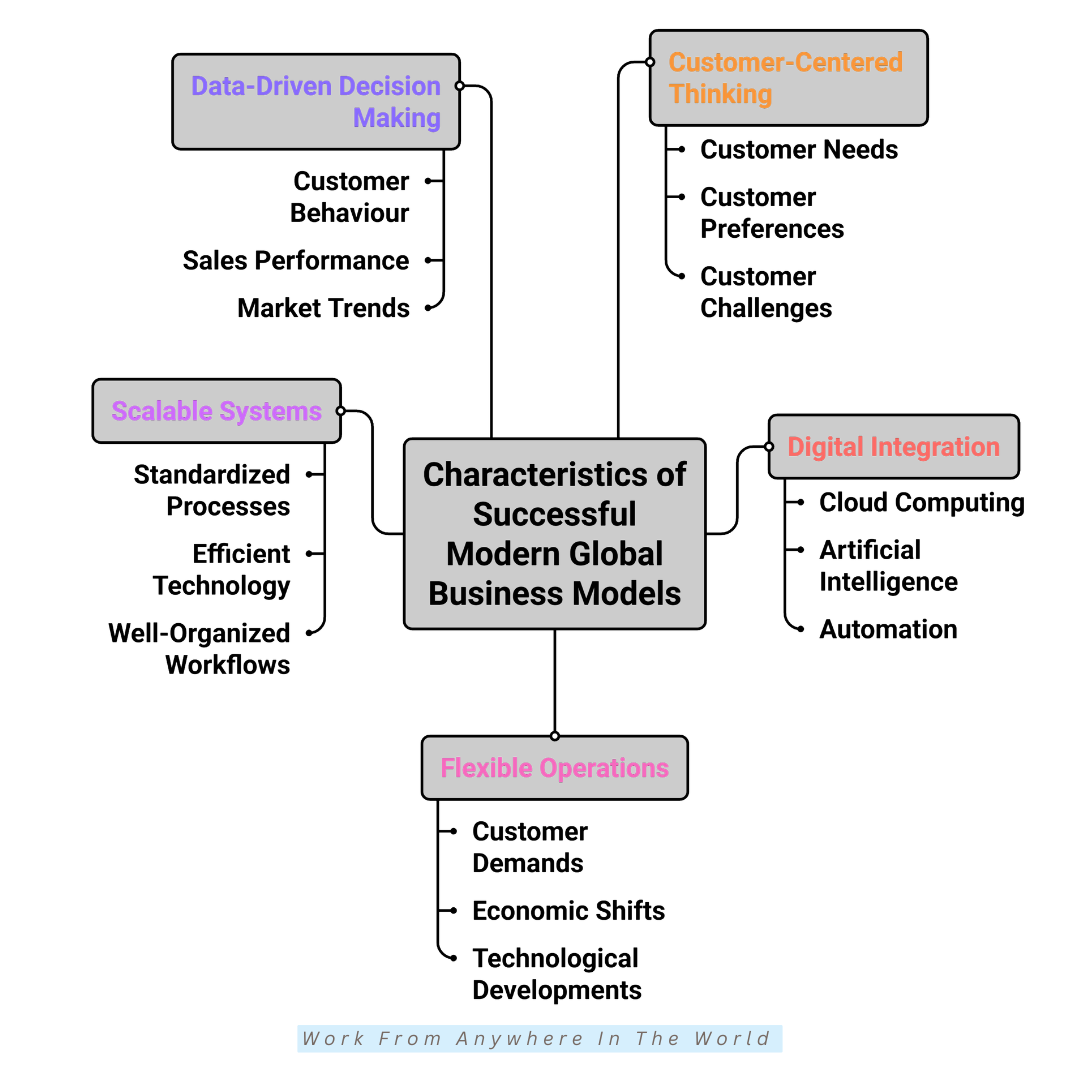
Although every company operates differently, successful global business models often share several characteristics. The following five demonstrate how businesses can remain adaptable while pursuing international growth.
1. Customer-Centered Thinking
Successful global businesses begin by understanding their customers' needs, preferences, and challenges. Their products, services, and business decisions should deliver meaningful value and support a positive customer experience.
Companies can collect feedback, study purchasing behaviour, and monitor changing expectations across different markets. These insights help them understand what their customers value rather than relying on assumptions.
Customer needs can also vary considerably between countries and regions. Businesses may need to adapt their products, communication, marketing, or services while maintaining a recognizable brand.
A strong customer-focused strategy can encourage loyalty and repeat business while helping companies remain relevant as markets evolve. Listening to customers also provides valuable information for future business decisions.
2. Digital Integration
Digital technology plays an important role in modern global business models. Companies can use cloud computing, artificial intelligence, automation, digital marketing, and data analytics to manage operations and serve customers across different markets.
These technologies can reduce repetitive tasks and provide information that supports data-informed-decision-making. They can also make it easier for teams in different locations to communicate and collaborate.
Digital marketing gives businesses additional ways to reach customers beyond their local markets. Online channels can support international visibility while allowing companies to tailor their marketing to different audiences.
As technology evolves, businesses can review which tools genuinely improve their operations rather than adopting every new development. Thoughtful digital integration can help companies remain flexible as their needs and markets change.
3. Flexible Operations
Global markets can change quickly, making flexibility an important part of modern business operations. Companies need systems that can adapt to changing customer expectations, economic conditions, and new technologies.
Rather than relying on rigid processes, businesses can regularly evaluate how they operate and make improvements when needed. This allows them to respond to change without completely rebuilding their business strategy.
Flexible operations can also support innovation. Teams have more room to test new approaches, improve workflows, and respond to opportunities in different markets.
This adaptability can help businesses manage unexpected challenges while continuing to serve customers. It also makes it easier to adjust operations as the company expands into new markets.
4. Scalable Systems
Scalable systems allow a business to grow without creating unnecessary complexity as operations expand. Processes, technology, and workflows should be able to support increasing demand without requiring the company to continually rebuild its operations.
Standardized processes can help businesses maintain consistency as they serve more customers or enter additional markets. ERP systems can also help growing companies manage information and processes across different areas of the business.
Scalability is especially important for global businesses because expansion can introduce new customers, locations, currencies, regulations, and distribution requirements. Systems that can adapt make these changes easier to manage.
Building scalability into a business model can provide a stronger foundation for sustainable business growth. It allows the company to expand while continuing to manage its resources, customer experience, and daily activities effectively.
5. Data-Driven Decision Making
Global businesses can use reliable data rather than assumptions when making important decisions. Customer behaviour, sales performance, website traffic, market trends, and operational data can all provide valuable insights.
Data-driven decision-making can help companies understand what is working and where improvements may be needed. These insights can support planning, resource allocation, and future business strategies.
Data can also help businesses identify opportunities, recognize potential problems, and measure progress across different markets. Comparing results over time provides a clearer picture of business performance.
However, data doesn't need to replace human judgment. Combining reliable information with experience and careful analysis can lead to more balanced decisions and stronger long-term strategies.
10 Ways To Observe A New Global Business Model
Observing a new global business model requires more than watching which companies are growing. The goal is to understand how and why their approach works across different markets.
Start by looking at how companies create value, reach customers, generate revenue, and use technology. Changes in customer behaviour, distribution methods, partnerships, and digital platforms can also reveal how a business model is evolving.
It is equally important to consider the wider market. Economic conditions, emerging technologies, cultural differences, and changing customer expectations can influence whether a particular model succeeds internationally.
You don't need to copy another company's approach. Instead, study what works, identify patterns, and consider which ideas could be relevant to your own business.
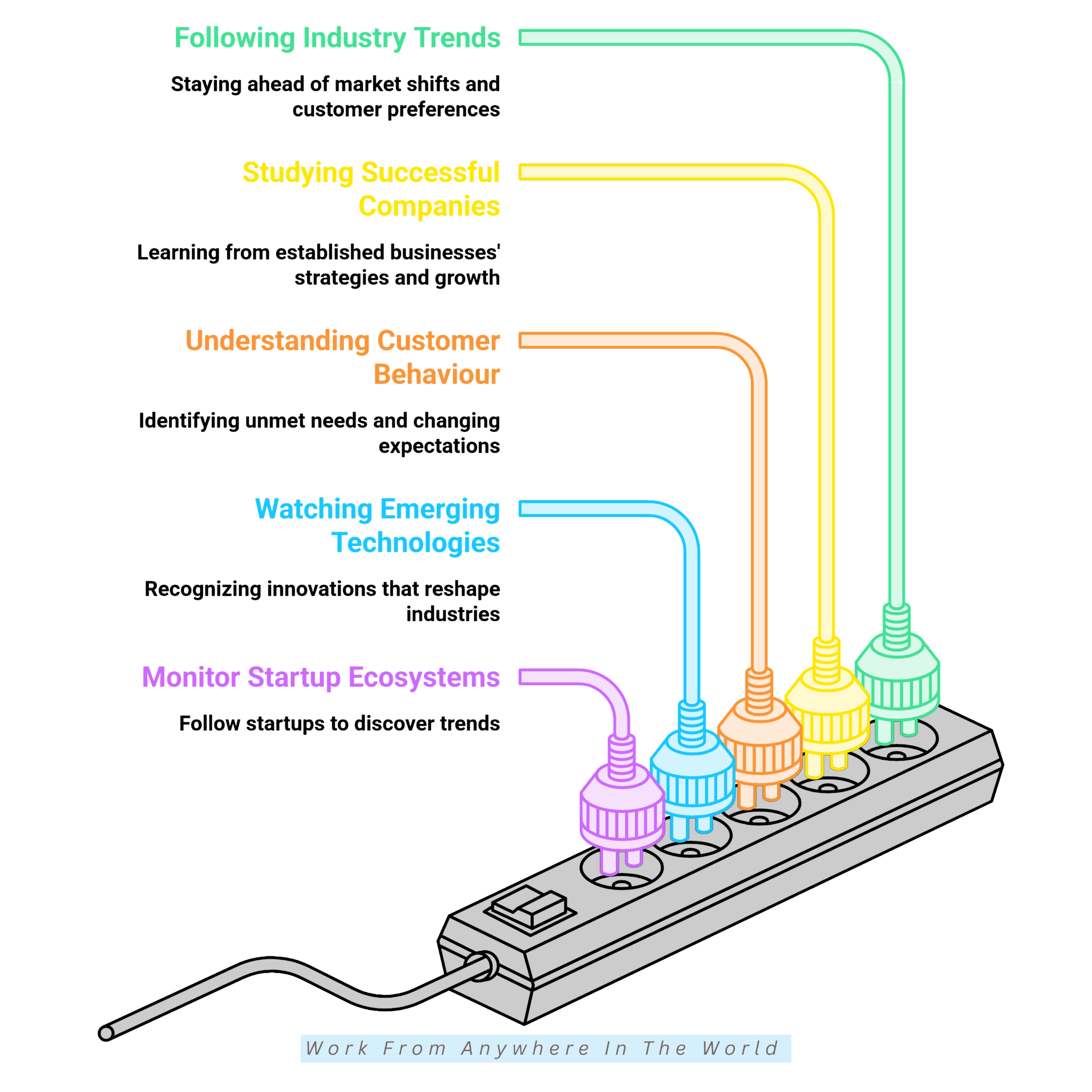
The following 10 steps provide a practical way to observe a new global business model and learn from companies operating worldwide.
1. Follow Global Industry Trends
Following global industry trends can help you recognize how markets are changing and where new business opportunities may be developing. Look beyond individual headlines and pay attention to patterns that continue appearing across industries and countries.
Changes in technology, customer behaviour, regulations, and purchasing habits can all influence the development of new business models. When several companies begin responding to the same change, it may indicate a broader shift rather than a temporary trend.
Industry publications, market research, business reports, and company announcements can provide useful information. Comparing several sources helps you understand market trends without relying too heavily on one prediction or statistic.
The goal isn't to chase every emerging trend. Instead, look for changes that could influence how businesses create value, reach customers, generate revenue, or operate across different markets.
2. Study Successful Global Companies
Successful global companies can provide useful lessons about how business models develop and expand. Look beyond the products they sell and examine how they create value, generate revenue, reach customers, and enter new markets.
Studying successful eCommerce businesses can reveal how different companies use technology, customer service, distribution, partnerships, and marketing to compete. Their approaches can also show how business models adapt as markets and customer expectations change.
It is useful to examine how a company's strategy has evolved. Some businesses expand into new products or services, while others enter different markets or develop additional revenue streams.
The goal isn't to copy a successful company. Instead, identify the principles behind its growth and consider whether any of those ideas could strengthen your own business strategy.
3. Understand Customer Behaviour
Understanding customer behaviour can reveal changes that aren't always obvious from sales figures alone. Pay attention to how people search for products, compare alternatives, make purchasing decisions, and interact with businesses online.
Reviews, comments, search behaviour, and customer feedback can provide clues about changing expectations. Recurring complaints or requests may also reveal needs that existing products or services aren't meeting.
Businesses can use these insights to improve products, adjust services, refine marketing, or identify new opportunities. Studying behaviour across different markets is particularly useful because customer expectations may vary between countries and cultures.
Regular target audience analysis can help businesses understand who their customers are and what influences their decisions. These insights can make it easier to adapt a business model as customer needs and buying habits change.
4. Watch Emerging Technologies
Emerging technologies can reshape existing industries and create new ways for businesses to operate. Artificial intelligence, cloud computing, automation, blockchain, and the Internet of Things are examples of technologies influencing modern business models.
You don't need to become a technology expert to recognize these changes. Instead, observe how companies are using new technologies to improve processes, communicate with customers, develop products, or deliver services.
Pay attention to emerging technologies that continue to gain practical use rather than those receiving only temporary attention. Adoption across several industries can be a useful indication that a technology may have broader business applications.
Watching technology trends can help you recognize changes that may influence future business models. The goal is to understand how technology is being applied and whether similar developments could eventually affect your own industry.
5. Monitor Startup Ecosystems
Startups can provide an early look at new ideas, technologies, and business models before they become widely adopted. Watching how these companies develop can reveal changes that may eventually influence larger industries.
Entrepreneurial ecosystems can provide clues about where innovation is occurring. Startup accelerators, funding activity, and venture capital investments can reveal which ideas are attracting attention.
Pay attention to the problems new companies are trying to solve and how they plan to generate revenue. These details can reveal new approaches to familiar customer needs.
It can also be useful to study which startups continue growing after the initial excitement fades. Their progress may reveal whether customers genuinely value the product or service and whether the underlying business model has long-term potential.
Monitoring startup ecosystems can help you identify emerging opportunities and understand how entrepreneurs are approaching familiar problems in new ways. These observations may also inspire ideas that can be adapted to your own business or industry.
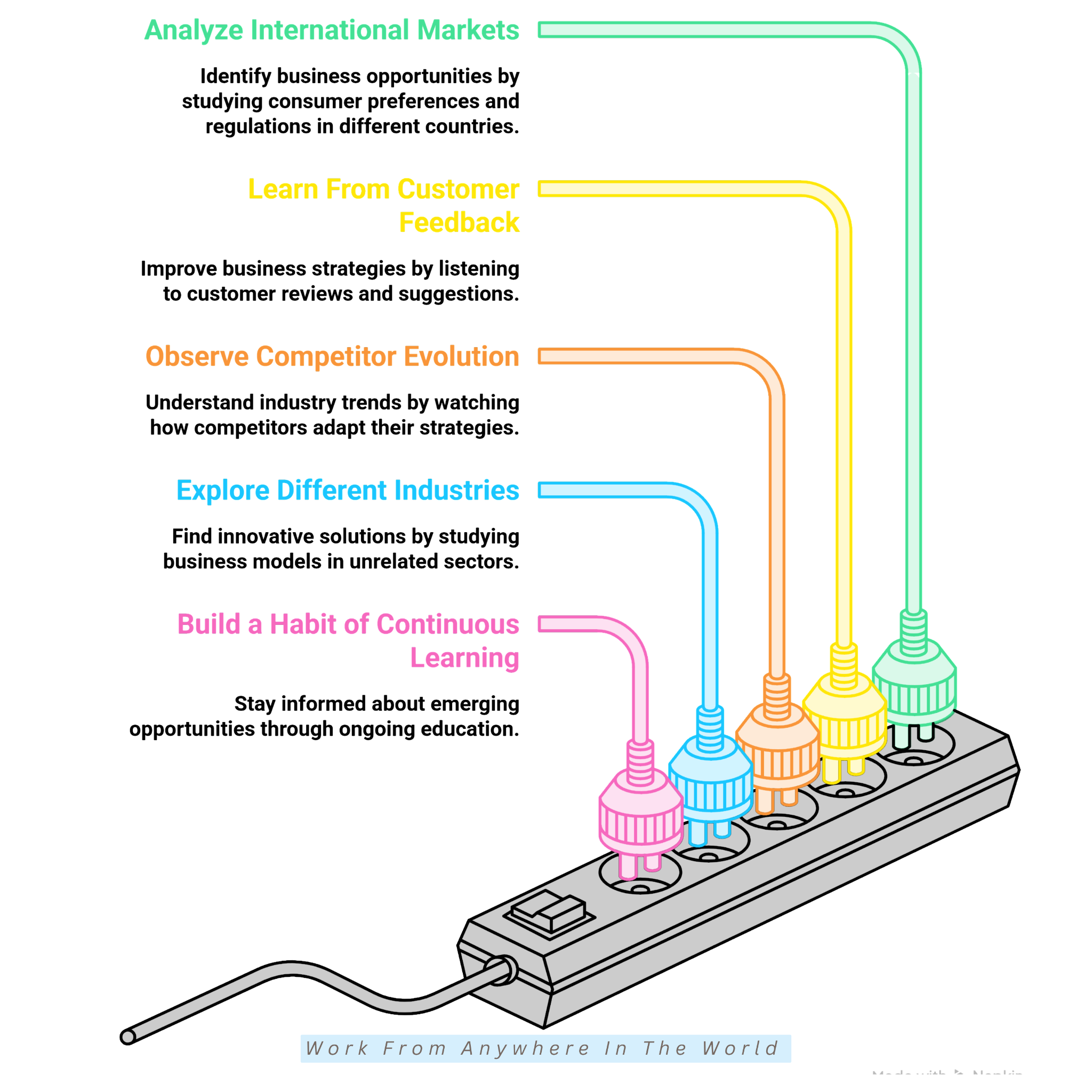
6. Analyze International Markets
Studying international markets can help you discover business ideas and strategies that may not yet be common in your own country. Customer preferences, regulations, payment methods, and purchasing habits can vary considerably between regions.
Compare how companies operate across different countries and look for patterns in the strategies they use. A product, service, or business model that succeeds in one market may need to be adapted before it works well somewhere else.
Cultural differences are also important. Businesses may adjust their products, marketing messages, payment options, or customer service while maintaining a consistent overall brand.
Analyzing international markets can help you recognize opportunities while understanding the challenges of operating across borders. These insights can be valuable when considering whether a business model has the flexibility to succeed globally.
7. Learn From Customer Feedback
Customer feedback can reveal what people value about a business and where they believe improvements are needed. Reviews, surveys, social media comments, and customer support conversations can all provide useful insights.
Look for recurring patterns rather than reacting to individual opinions. When several customers mention the same problem, request, or positive experience, it may point to an area worth investigating.
Feedback can help businesses improve products, refine services, adjust communication, and identify needs they may have overlooked. It can also reveal differences in customer expectations across markets.
The goal is not to act on every suggestion. Instead, combine customer feedback with other business data to determine which changes could provide meaningful value and support the company's overall direction.
Wealthy Affiliate – Mini Review
If you’ve ever thought about turning your blog, passion, or niche into an online business,
Wealthy Affiliate (WA) is one of the most beginner-friendly platforms I’ve used.
It combines step-by-step training, website hosting, AI-powered tools,
keyword research, and an active community all in one place.
What I like most is that you can start free (no credit card needed), explore the platform,
test the tools, and connect with other entrepreneurs before upgrading.
WA isn’t a “get rich quick” scheme — success comes from consistent effort
and applying what you learn over time.
8. Observe Competitor Evolution
Competitor analysis is about learning from other businesses rather than copying them. Watching how competitors change their products, services, marketing, or customer experience can reveal how an industry is evolving.
A thoughtful competitive analysis can help you identify patterns in how businesses respond to changing customer needs. Look for significant changes rather than temporary promotions or short-term marketing campaigns.
Pay attention when competitors enter new markets, introduce different revenue models, adopt new technologies, or reposition their brands. Several companies making similar changes may indicate a broader shift within the industry.
Observing competitors can also reveal gaps and opportunities. The goal is to use what you learn to make better-informed decisions while developing an approach that remains distinctive to your own business.
9. Explore Different Industries
Some useful business ideas can come from industries completely different from your own. Healthcare, finance, education, retail, hospitality, and technology may face similar challenges but solve them in very different ways.
Look at how businesses in other industries attract customers, deliver services, generate revenue, and use technology. An approach common in one sector may inspire a different solution to a problem in another.
For example, subscription models now appear across software, education, entertainment, fitness, and other industries. Online booking systems have also expanded far beyond the industries where consumers first became accustomed to using them.
Exploring different industries can broaden your perspective and reveal business model ideas you might otherwise overlook. The objective isn't to duplicate another industry's approach but to consider how its underlying concept could be adapted appropriately.
10. Build A Habit Of Continuous Learning
Observing global business models is an ongoing process. Markets, technologies, customer expectations, and business practices continue to evolve, so there will always be something new to learn.
Industry reports, business publications, books, podcasts, research studies, and expert interviews can expose you to different perspectives. You don't need to follow everything; choose reliable sources that are relevant to your interests and business goals.
Continuous learning can also help you connect ideas from different industries and recognize patterns more easily. The more familiar you become with changing business practices, the easier it becomes to distinguish meaningful developments from temporary trends.
Building a continuous learning habit can strengthen your knowledge and help you make more informed business decisions. Even a small amount of regular learning can provide new ideas to explore and apply when appropriate.
Common Global Business Models Worth Studying
Studying different business models can help you understand how companies create value, reach customers, and generate revenue. It also makes it easier to recognize similarities between businesses operating in very different industries.
Some models rely on recurring payments, while others connect buyers and sellers, provide free and paid service levels, or sell directly to customers. Many global companies also combine several models as they grow.
Understanding these differences can help you recognize how a business model works rather than focusing only on the products or services a company sells.
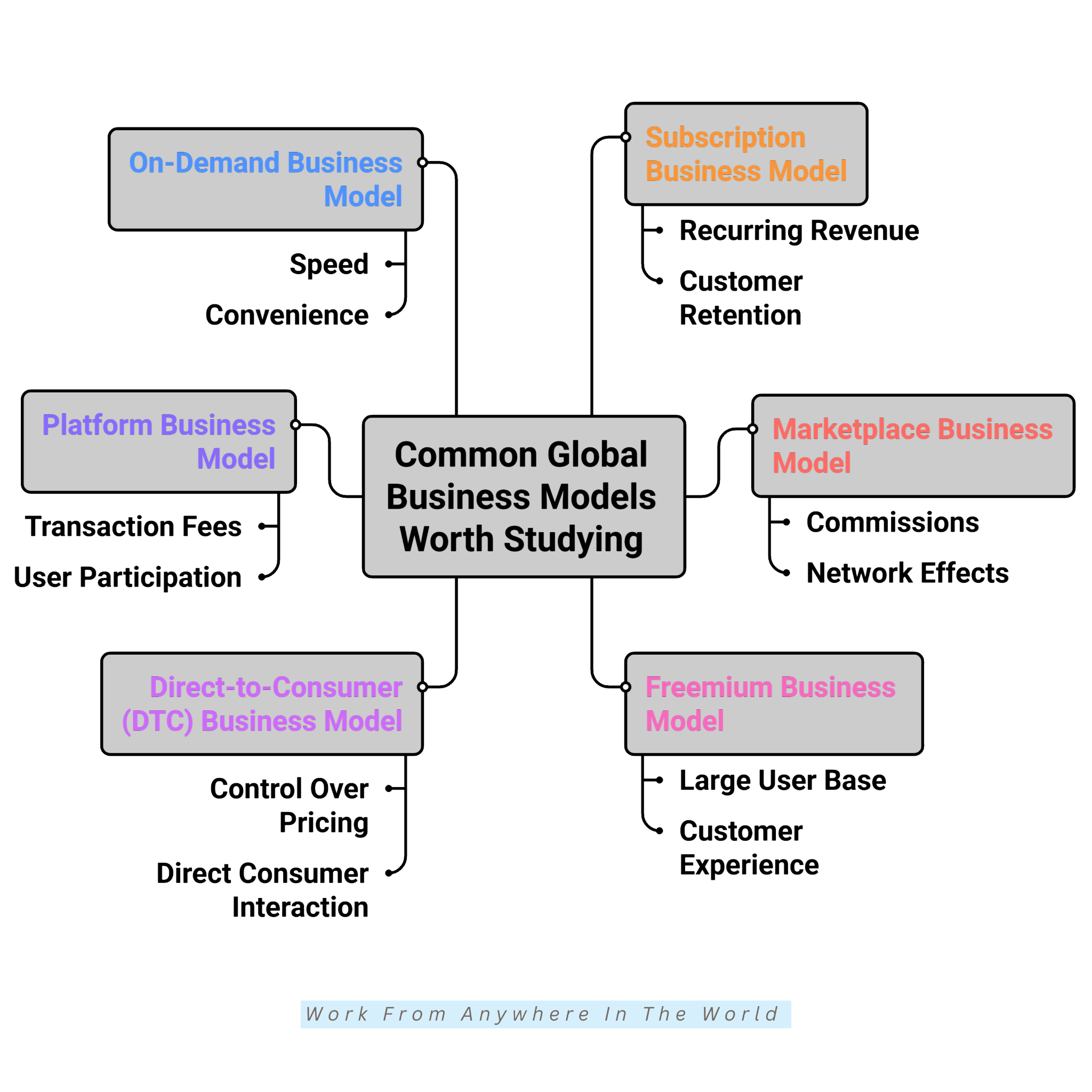
The following six global business models provide useful examples of how companies can structure their operations and expand across different markets.
1. Subscription Business Model
A subscription business model provides customers with continued access to a product or service in exchange for recurring payments. This approach can create more predictable revenue while encouraging longer-term customer relationships.
The model works particularly well when customers receive ongoing value. Businesses may provide new content, product updates, additional features, or personalized services that support customer retention.
Subscription models are used across many industries, including software, entertainment, education, fitness, and eCommerce. Some businesses rely entirely on subscriptions, while others use them alongside additional revenue streams.
Studying the subscription business model can help you understand the importance of recurring revenue, customer retention, and consistently providing value throughout the customer relationship.
2. Marketplace Business Model
A marketplace business model connects buyers and sellers through a platform. Rather than supplying every product or service itself, the marketplace provides the environment where transactions between the two groups can take place.
The business may generate revenue through commissions, transaction fees, listing fees, subscriptions, advertising, or a combination of these methods.
Because independent sellers provide much of the inventory or services, the model can support expansion without the platform owning everything being sold.
Successful marketplaces depend heavily on trust. Secure payments, reviews, seller standards, customer support, and a positive user experience can all influence whether buyers and sellers continue using the platform.
Studying the marketplace business model can show how a company creates value by bringing different groups together. It also demonstrates how growing participation on both sides of a marketplace can strengthen the platform.
3. Freemium Business Model
A freemium business model gives customers access to basic features at no cost while reserving additional features or services for paying customers. This allows people to experience a product before deciding whether an upgrade provides enough additional value.
The free version needs to be useful enough to attract and retain users. At the same time, premium features need to provide a clear reason for some customers to move to a paid plan.
This model is particularly common with software, apps, and other digital services because businesses can serve a large number of free users while converting a smaller percentage into paying customers.
Studying the freemium business model can show how free access, product value, and carefully designed upgrades work together. It also demonstrates why businesses need to balance attracting users with creating a sustainable source of revenue.
4. Direct-to-Consumer (DTC) Business Model
The direct-to-consumer business model allows brands or manufacturers to sell products directly to customers rather than relying on wholesalers or traditional retailers. It is a specific type of B2C commerce that removes some of the intermediaries between the company and the consumer.
Selling directly gives businesses greater control over branding, customer relationships, product information, and the overall purchasing experience. B2C marketing can then help brands communicate directly with those consumers and build stronger relationships.
Websites, eCommerce stores, email marketing, and digital marketing can all support a DTC strategy. These channels allow businesses to communicate directly with customers and build relationships without depending entirely on third-party retailers.
Studying the DTC model can help you understand how direct customer relationships influence marketing, distribution, and brand development. It also demonstrates how businesses can combine digital channels with a traditional B2C approach.
5. Platform Business Model
A platform business model creates value by connecting different groups of users, such as customers, service providers, advertisers, or developers. The platform provides the infrastructure that allows these groups to interact with one another.
Revenue can come from transaction fees, subscriptions, advertising, commissions, or other services offered through the platform. Some platforms combine several revenue streams as their user base and services expand.
A key feature of this model is network effects. As more people participate, the platform may become increasingly useful to other users, although maintaining quality, trust, and a positive experience remains important.
Studying the platform business model can help you understand how technology and user participation work together. It also shows how businesses can facilitate interactions rather than relying solely on selling their own products or services.
6. On-Demand Business Model
The on-demand business model provides customers with access to products or services when they need them. Digital platforms and mobile apps often connect customers with providers and make ordering, scheduling, and payment more convenient.
Convenience and accessibility are important parts of this model. Customers can request a service or purchase a product without following the schedules or processes associated with more traditional business models.
Technology plays a central role by coordinating customers, providers, payments, and other parts of the transaction. However, businesses also need reliable systems to maintain service quality as demand changes.
Studying the on-demand business model can show how companies respond to changing customer expectations. It also demonstrates how technology can make products and services more accessible while creating new ways for businesses to operate.
Frequently Asked Questions
Q1: Why Is It Important To Observe New Global Business Models?
Observing new global business models can help you recognize emerging opportunities, changing customer expectations, and different ways companies create value. It can also provide ideas for improving your own business strategy.
The goal isn't to follow every new development. Instead, studying successful models can help you identify patterns and decide which changes may be relevant to your business.
Q2: How Often Should I Analyze Global Business Trends?
There is no fixed schedule that works for every business. How often you review global trends will depend on your industry, customers, and how quickly your market changes.
Regular observation is more important than following a strict timetable. Industry reports, business publications, and market research can help you stay informed without reacting to every short-term development.
Q3: Which Businesses Should I Study When Observing Global Business Models?
Study a combination of established companies, growing businesses, and innovative startups. Looking at organizations of different sizes can provide a broader understanding of how business models develop.
You can also study companies outside your own industry. Their approaches to technology, customer service, revenue generation, or market expansion may provide ideas you haven't encountered within your own sector.
Q4: Can Small Businesses Benefit From Observing Global Business Models?
Yes. Small businesses can learn from global companies without trying to duplicate their size, resources, or strategies. The underlying ideas are often more valuable than the specific tactics being used.
For example, a small business might learn from the way another company communicates with customers, uses technology, develops recurring revenue, or adapts its services to changing needs.
Q5: What Should I Look For When Studying A Global Business Model?
Look at how the company creates value, reaches customers, generates revenue, uses technology, and responds to changing markets. Consider how these elements work together rather than examining each one separately.
Also pay attention to how the business has changed over time. Its ability to adapt can provide useful insights into which parts of the model support continued growth.
Q6: How Can I Apply A Global Business Model To My Own Business?
Start by identifying ideas that relate to your customers, goals, resources, and market. Consider why a particular strategy works before deciding whether it could be useful for your business.
Avoid copying another company's model exactly. Adapt relevant ideas to your own circumstances and test changes carefully before making them a permanent part of your business.
Conclusion
Observing a new global business model is about understanding the ideas and patterns behind successful businesses rather than following every new trend. Careful observation can reveal how companies respond to changing markets and customer expectations.
Studying customer behaviour, emerging technologies, international markets, competitors, and different industries can provide valuable insights. Together, these areas can help you recognize opportunities that may be relevant to your own business.
Continuous learning is also an important part of the process. Markets will continue to evolve, and regularly exploring new ideas can help you understand which developments have lasting potential.
The goal is not to copy another company's approach. Record what you learn, consider how those ideas fit your own goals and resources, and adapt the most useful insights to build a more flexible and resilient business.
I trust you enjoyed this article on the [Blog Post Title]. Please stay tuned for more insightful blogs on affiliate marketing, online business, and working from anywhere in the world.
Take care!
— JeannetteZ 🌍✨
💬 Your Opinion Is Important To Me
Do you have thoughts, ideas, or questions? I’d love to hear from you. Please leave your comments below or email me directly at Jeannette@WorkFromAnywhereInTheWorld.com.
📚 More Work From Anywhere Reads
🚀 Ready to Build a Business You Can Run from Home
Or from Anywhere in the World?
Imagine creating income on your terms — from home, a cozy café, or wherever life takes you.
With the right tools, training, and community support, it’s entirely possible.
Start your own online business for free — no credit card needed.
Disclosure
This post may contain affiliate links. As an Amazon Associate and participant in other affiliate programs, I earn from qualifying purchases at no extra cost to you. Please read my full affiliate disclosure.