

How To Hire Employees For A Small Business In 12 Steps
Knowing how to hire employees for a small business becomes an important question when you’re ready to grow beyond doing everything yourself. Hiring the right people can give your business the support it needs to move forward.
A dependable team can help you manage a growing workload, serve customers more effectively, and create more time to focus on running and developing your business.
However, hiring involves more than finding someone with the right skills. You also need to define the position, establish a realistic budget, evaluate candidates carefully, and understand your responsibilities as an employer.
Taking a structured approach can make the process much more manageable. It also helps you make thoughtful hiring decisions rather than rushing to fill an immediate need.
This guide explains the hiring process in 12 practical steps, from identifying your needs and writing the job description to making an offer, onboarding your new employee, and supporting long-term retention.
12 Steps On How To Hire Employees For A Small Business
Hiring employees can feel like a major transition, particularly when you’re bringing someone into your business for the first time. A clear process can make each decision easier to manage.
Before advertising a position, you need to understand what help your business actually needs. The role, responsibilities, budget, and required skills should all be clearly defined.
The hiring process also gives you an opportunity to think beyond the immediate workload. The right employee should be able to contribute to the business while fitting the way your team operates.
Taking time to evaluate candidates carefully can reduce rushed hiring decisions. It also gives applicants a clearer understanding of the position and what will be expected of them.
The following 12 steps explain how to hire employees for a small business, from identifying your hiring needs to onboarding and supporting your new team member.
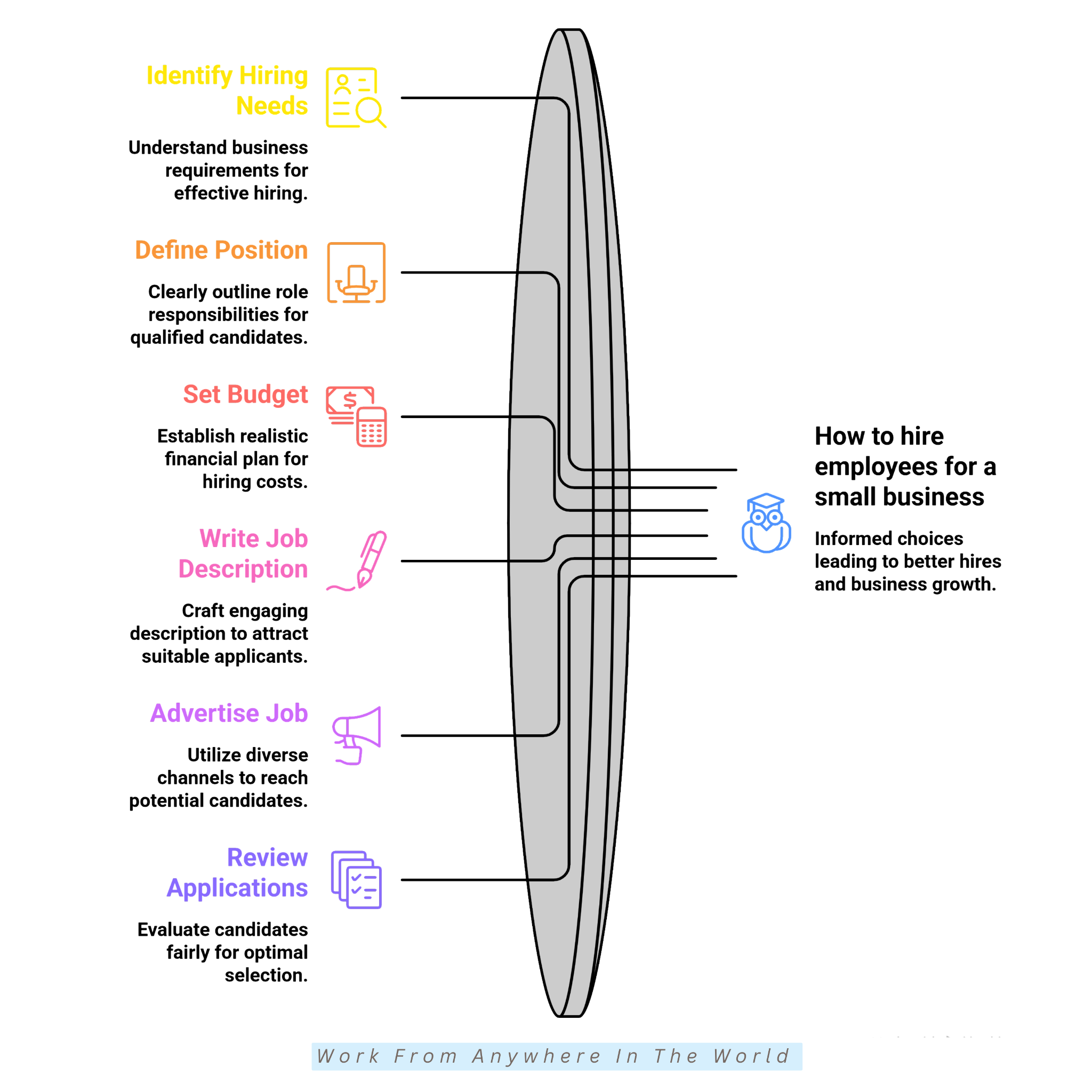
Step 1: Identify Your Hiring Needs
Before hiring anyone, determine what kind of help your business actually needs. Identify the tasks that are taking time away from more important business activities.
You might need help with customer service, administration, content creation, social media, bookkeeping, or another area that has become difficult to manage alone.
For an online or home-based business, this could mean hiring a remote employee, virtual assistant, freelancer, or specialist. Learning how to manage a virtual team successfully can also help when people work from different locations.
Consider whether the workload is temporary, seasonal, part-time, or likely to continue growing. This can help you decide what type of position makes sense for your business.
List the responsibilities you want the new team member to handle and separate essential skills from those that can be learned. A clearly defined need will make the next stages of hiring much easier.
Step 2: Define The Position And Responsibilities
Once you know where help is needed, define exactly what the new team member will be responsible for. A clearly defined role helps you attract candidates whose skills match the work.
List the main responsibilities, required skills, preferred experience, working hours, and who the person will report to. For remote positions, also clarify availability, communication expectations, and whether specific working hours are required.
Think about what successful performance should look like after the first few months. Clear expectations give you useful criteria for evaluating candidates during the hiring process.
Defining the position carefully also helps applicants decide whether the opportunity suits their skills and circumstances. This can reduce misunderstandings before interviews even begin.
Step 3: Set A Realistic Hiring Budget
Before advertising the position, determine how much your business can realistically afford to spend. The cost of hiring can extend beyond the employee’s regular wages or salary.
Depending on the position and location, expenses may include payroll costs, benefits, training, software, equipment, and professional development. Remote employees may also require specific technology or online tools.
Consider whether you need someone full-time, part-time, seasonally, or only for a particular project. A smaller online business may find that starting with limited hours provides the help it needs without taking on a larger commitment.
Compare the expected cost with the value the position can bring to your business. The goal isn’t simply to hire as cheaply as possible, but to choose an arrangement your business can sustain.
A realistic hiring budget helps protect your cash flow while leaving room for other business expenses and future growth.
Step 4: Write A Compelling Job Description
Your job description is often a candidate’s first introduction to the position and your business. Make it clear, informative, and realistic so applicants understand what you’re offering.
Start with a straightforward job title and a brief introduction to your business. Then explain the role, key responsibilities, required skills, preferred experience, and working arrangements.
For remote positions, include details such as expected working hours, time-zone requirements, communication methods, and whether the employee needs specific equipment or software.
Use clear, welcoming language without exaggerating the opportunity. Applicants should be able to quickly determine whether their experience, availability, and expectations match the position.
A well-written job description can attract more suitable candidates and make applications easier to evaluate. It also gives you a useful reference point during interviews and onboarding.
Step 5: Advertise The Job In The Right Places
Where you advertise the position can have a major influence on the candidates you attract. Choose hiring channels that are likely to reach people with the skills and experience your business needs.
Consider job boards, your business website, professional networking platforms, social media, industry-specific communities, and relevant online groups.
If you’re open to hiring freelancers, understanding how to find online freelance jobs can also give you insight into where independent professionals look for new opportunities.
Don’t assume you need to advertise everywhere. A few carefully chosen platforms that match the position can be more useful than spreading the vacancy across unrelated websites.
Referrals can also introduce potential candidates through people who already know your business or industry. However, every applicant should still be evaluated using the same requirements for the position.
Using several relevant channels can help you reach a broader range of candidates while keeping your search focused. The goal is to find people whose skills, availability, and working style suit the role.
Step 6: Review Applications Carefully
Once applications begin arriving, review each candidate using the same basic criteria. This keeps the process organized and makes it easier to compare applicants fairly.
Look at relevant experience, skills, qualifications, and achievements, but don’t rely on an impressive résumé alone. Consider how well each applicant’s background matches the responsibilities you identified earlier.
For remote positions, pay attention to experience working independently, written communication skills, and familiarity with the online tools your business uses.
Reliability, adaptability, problem-solving skills, and a willingness to learn can also be valuable. Some candidates may have strong potential even if they don’t meet every preferred qualification.
Create a shortlist of the applicants who most closely match your requirements. You can then evaluate them more closely during the interview stage.
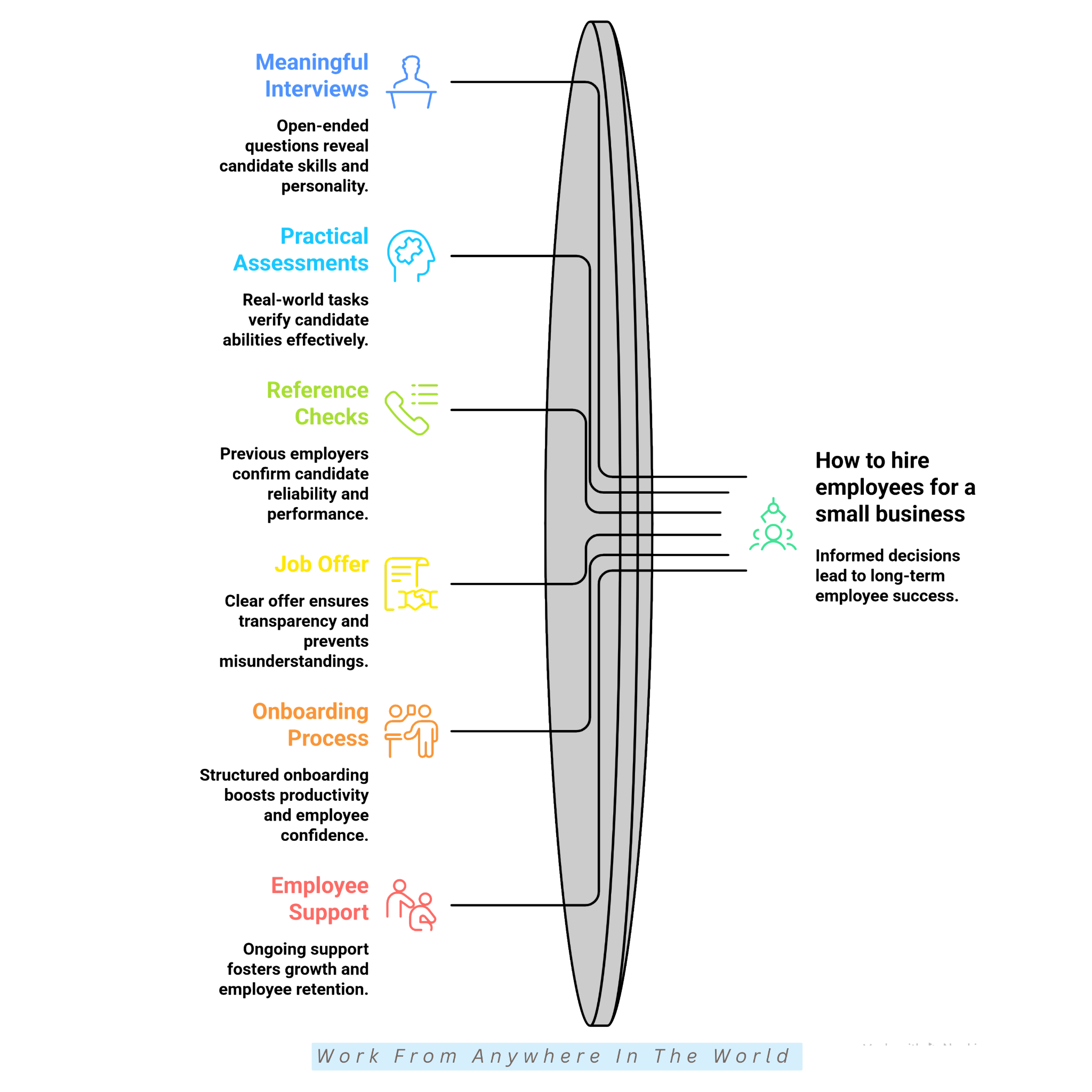
Step 7: Conduct Meaningful Interviews
An interview gives you an opportunity to learn more about a candidate than a résumé or application can reveal. Prepare questions that relate directly to the position and its responsibilities.
Use open-ended questions that encourage candidates to describe how they have handled challenges, solved problems, worked with others, and achieved results in previous roles.
For remote positions, ask about working independently, managing deadlines, communicating online, and staying organized. These questions can help you understand whether the candidate is comfortable working without constant supervision.
Pay attention to how clearly candidates communicate and whether their answers demonstrate the skills and qualities you’re looking for. Give them time to ask questions about the role and your business as well.
A thoughtful interview should help both sides decide whether the position is a good match. The goal is not simply to find someone who interviews well, but someone who can succeed in the role.
Step 8: Evaluate Skills With Practical Assessments
Résumés and interviews can tell you a great deal about candidates, but a practical assessment can show you how they apply their skills to actual tasks.
Choose an assessment that reflects the work involved in the position. This might include a short writing assignment, customer service scenario, spreadsheet exercise, technical task, or problem-solving activity.
For a remote role, you could also use a small online task that reflects how the person would work independently and communicate instructions or results virtually.
Keep assessments focused and reasonable rather than asking candidates to complete substantial unpaid work. The purpose is to evaluate a specific skill, not to receive free work for your business.
Practical assessments can help you compare shortlisted candidates more objectively. They may also reveal strengths that weren’t obvious from a résumé or interview.
Step 9: Check References And Verify Information
Before making a final hiring decision, check the candidate’s professional references and verify important information provided during the application process.
Ask references about the candidate’s previous responsibilities, reliability, communication, teamwork, and overall performance. Keep your questions focused on information that is relevant to the position.
You can also confirm details such as previous employment, qualifications, or certifications when they are important to the role. Requirements and permitted reference-checking practices may vary by location.
For remote employees, references can be particularly useful for learning how well a candidate works independently, communicates from a distance, and manages responsibilities without direct supervision.
Reference checks can provide additional confidence in your decision and help confirm whether the candidate is a good match before you make an offer.
Wealthy Affiliate – Mini Review
If you’ve ever thought about turning your blog, passion, or niche into an online business,
Wealthy Affiliate (WA) is one of the most beginner-friendly platforms I’ve used.
It combines step-by-step training, website hosting, AI-powered tools,
keyword research, and an active community all in one place.
What I like most is that you can start for free (no credit card needed), explore the platform,
test the tools, and connect with other entrepreneurs before upgrading.
WA isn’t a “get rich quick” scheme — success comes from consistent effort
and applying what you learn over time.
Step 10: Make A Professional Job Offer
Once you’ve selected your preferred candidate, provide a clear written job offer. Include the compensation, work schedule, employment status, proposed start date, and any benefits or other important conditions.
For remote employees, clarify where the person will work, expected availability, communication requirements, and whether your business provides equipment or software.
Make sure the candidate understands the position’s responsibilities and any applicable conditions. Employment requirements differ by country and region, so the offer should reflect the rules that apply where your business and employee are located.
Give the candidate reasonable time to review the offer and ask questions before accepting. Clear communication at this stage can prevent misunderstandings later.
A professional offer sets the tone for the working relationship and provides a smooth transition into the onboarding process. It also shows your new employee that your business values clear communication from the beginning.
Step 11: Create A Structured Onboarding Process
A structured onboarding process helps new employees understand their responsibilities and become comfortable in their roles. Start by making sure they have the information, tools, and access they need from the first day.
Introduce them to other team members, explain relevant business policies, review their responsibilities, and show them how your usual systems and processes work.
For remote employees, onboarding may also include setting up communication platforms, shared files, project management tools, and online meetings. Make sure they know where to find information and who to contact when they need help.
Schedule regular check-ins during the first few weeks rather than providing everything at once. This gives new employees opportunities to ask questions, receive feedback, and gradually become more independent.
A thoughtful onboarding process can help new team members feel prepared and supported while establishing clear expectations from the beginning. It also creates a stronger foundation for a productive long-term working relationship.
Step 12: Support Growth And Employee Retention
Hiring the right employee is only the beginning of building a successful team. Continuing to support people after onboarding can help them develop their skills and remain engaged with their work.
Provide regular feedback and recognize good work when it is deserved. Employees should understand what they’re doing well as well as where there are opportunities to improve.
Offer appropriate opportunities to learn new skills, take on additional responsibilities, or develop professionally. Encouraging employees to strengthen relevant online business skills can also help them contribute in new ways as your business grows.
For remote teams, regular communication becomes particularly important. Employees who work from different locations still need opportunities to ask questions, share ideas, collaborate, and feel connected to the business.
Pay attention to what helps good employees remain satisfied in their roles. Fair expectations, open communication, recognition, flexibility, and opportunities to grow can all contribute to a stronger working relationship.
Supporting employees over the long term can help you build a dependable team as your business develops. It also means you aren’t continually returning to Step 1 and starting the hiring process all over again.
Common Hiring Mistakes To Avoid
Even with a clear hiring process, small mistakes can make it harder to find the right person. Some can also lead to misunderstandings after a new employee joins your business.
Rushing the process, overlooking important checks, or failing to explain expectations clearly can create problems that might have been avoided with a little more preparation.
For online and home-based businesses, hiring remotely can introduce additional considerations. Communication, availability, responsibilities, and working arrangements need to be particularly clear when people aren’t working in the same location.
The following common hiring mistakes are worth watching for as you build and support your team. Recognizing them early can help you make more thoughtful decisions throughout the hiring process.
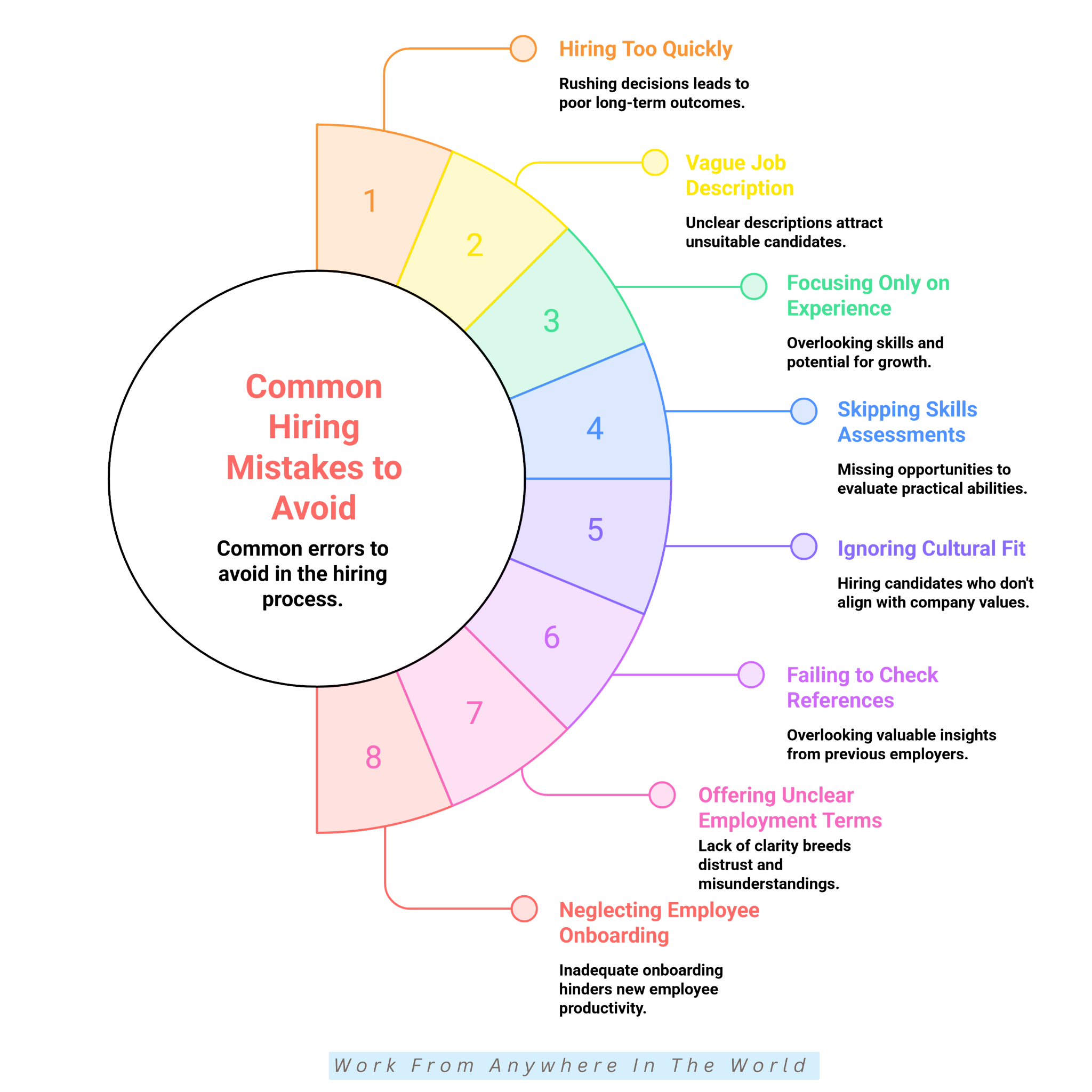
1. Hiring Too Quickly
Hiring under pressure can make it tempting to choose the first promising candidate. However, rushing the decision may result in hiring someone who isn’t well suited to the position or your business.
Take enough time to compare several qualified candidates based on the requirements you established earlier. Consider their skills, experience, communication style, availability, and ability to handle the responsibilities of the role.
This is especially important for remote positions, where independent working habits and clear communication can be just as important as technical skills.
A careful decision can improve your chances of finding someone who contributes positively to your business and is interested in staying for the longer term.
2. Writing A Vague Job Description
A vague job description can confuse applicants and attract people who aren’t well suited to the position. Candidates should be able to understand what the job involves before deciding whether to apply.
Clearly describe the main responsibilities, required qualifications, essential skills, working hours, and employment arrangements. Following a few basic principles for writing an effective job description can help you give applicants the information they need without making the posting unnecessarily complicated.
Avoid broad descriptions that could apply to almost any position. Specific information helps candidates determine whether their experience and expectations match what your business needs.
A clear job description can improve the quality of applications and reduce time spent interviewing unsuitable candidates. It also creates realistic expectations before the hiring process moves forward.
3. Focusing Only On Experience
Years of experience can be valuable, but they shouldn’t be the only factor you consider when hiring. Someone with less experience may still have the qualities needed to succeed in the role.
Look at communication skills, adaptability, problem-solving ability, motivation, and willingness to learn alongside technical qualifications. These qualities can be particularly important in a small business where responsibilities may change as the business grows.
Consider what candidates have accomplished and how they approach new challenges rather than focusing only on how long they’ve worked in a particular field.
Taking a broader view can help you identify talented people with the potential to develop their skills and make a meaningful contribution to your business.
4. Skipping Skills Assessments
Interviews allow candidates to discuss their experience, but practical assessments can show how they apply their skills to real work situations.
Depending on the position, you might use a short writing assignment, customer service scenario, technical exercise, spreadsheet task, or problem-solving activity.
Keep the assessment directly related to the work and reasonable in scope. Candidates shouldn’t be expected to complete substantial unpaid work simply to demonstrate their abilities.
Combining interviews with practical assessments can give you a more complete picture of each candidate and help you make a more informed hiring decision.
5. Ignoring Cultural Fit
Technical skills are important, but candidates should also be comfortable with the way your business operates. Consider whether their communication style, work habits, and approach to collaboration suit the position and your team.
During interviews, ask questions about how candidates have worked with others, handled disagreements, adapted to change, and contributed to shared goals.
For remote teams, fit can also involve communication preferences, independence, reliability, and comfort collaborating with people in different locations or time zones.
Avoid looking for someone who simply thinks or behaves like everyone else. A strong team can include different personalities, experiences, and perspectives while still sharing important workplace values.
Considering these factors alongside skills and experience can help you build a team that works well together and supports your business over the long term.
6. Failing To Check References
Skipping reference checks means losing an opportunity to learn more about how a candidate performed in previous roles. References may provide useful information that isn’t obvious from a résumé or interview.
Ask relevant questions about the candidate’s responsibilities, reliability, communication, work quality, and ability to meet expectations. Keep the conversation focused on information that relates directly to the position.
Reference checks can also help confirm important details provided during the application and interview process. However, what employers may ask or disclose can vary depending on local employment and privacy requirements.
Taking the time to check references adds another layer of information before you make your final hiring decision. It can either reinforce your choice or identify something that deserves further consideration.
7. Offering Unclear Employment Terms
Unclear employment terms can create misunderstandings before a new employee even begins working. Agree on important details before the candidate accepts the position.
Make sure the written offer clearly explains compensation, working hours, responsibilities, employment status, start date, and any other conditions that apply to the role.
For remote positions, clarify expectations around availability, location, equipment, communication, and working arrangements. Leaving these details open to interpretation can cause problems later.
Clear employment terms give both sides a shared understanding of the arrangement and help establish a professional working relationship from the beginning.
8. Neglecting Employee Onboarding
Hiring doesn’t end when a candidate accepts your offer. Without proper onboarding, a new employee may be unsure about responsibilities, procedures, or where to turn when questions arise.
Provide the information, tools, and introductions they need to begin their role with confidence. For remote employees, make sure access to communication platforms, shared files, and other online systems is ready from the start.
Check in regularly during the first few weeks to answer questions and identify any difficulties early. New employees shouldn’t be left to figure everything out on their own.
Neglecting onboarding can make an otherwise good hire more difficult than necessary. A little preparation can help the employee settle into the role and become a productive member of your team.
Qualities To Look For When Hiring Employees
Skills and experience are important when evaluating candidates, but they don’t tell you everything about how someone will perform in a role. Personal qualities can be equally important, particularly in a small business.
The right employee should be able to communicate clearly, take responsibility for their work, adapt when circumstances change, and approach problems thoughtfully.
For online and home-based businesses, qualities such as independence, reliability, and adaptability can become even more important. Remote employees often need to manage their responsibilities without constant supervision.
Looking beyond qualifications can help you identify candidates who are capable of contributing to your business as it develops and changes.
The following qualities can help you evaluate candidates more thoroughly and choose someone who is well suited to the position and your working environment.
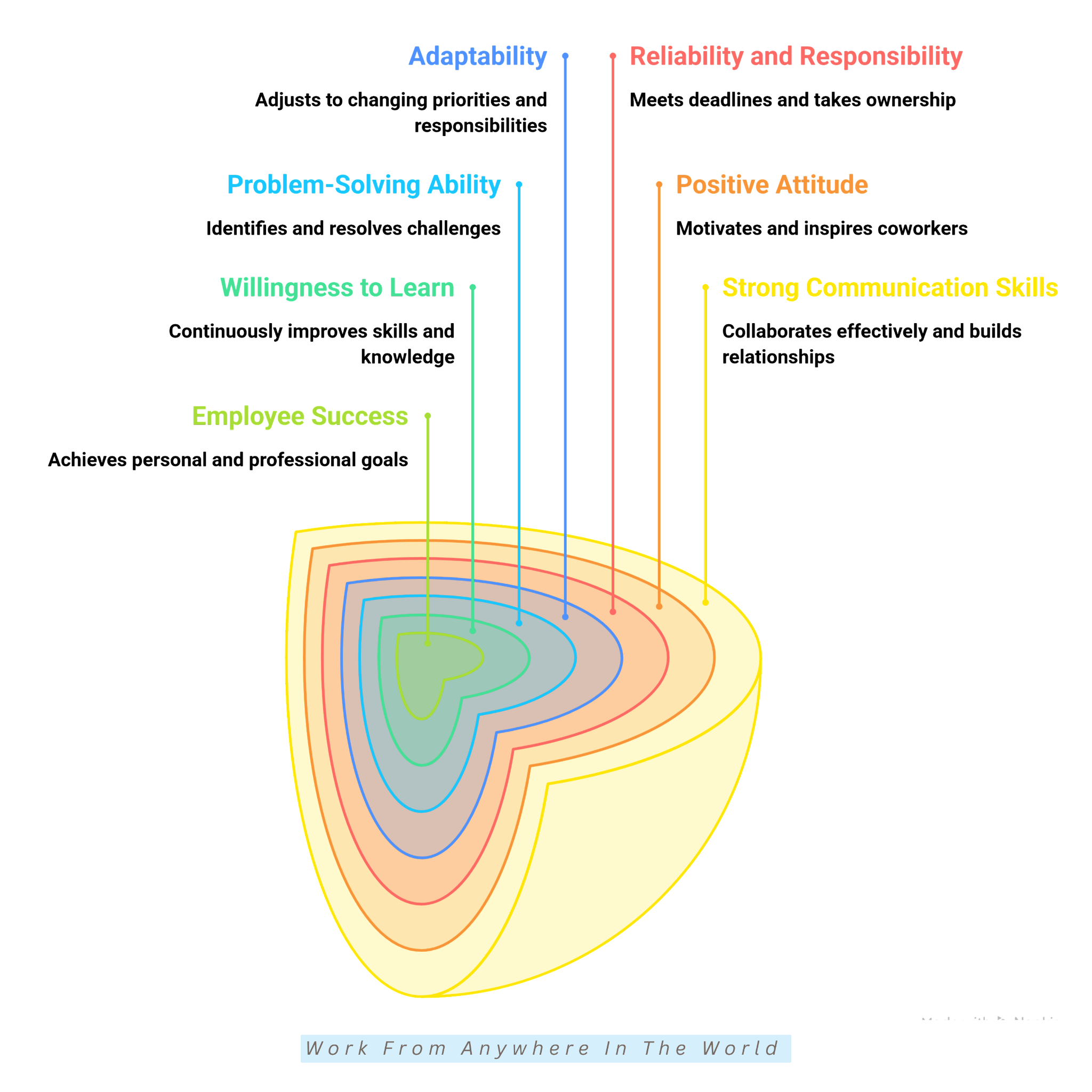
1. Strong Communication Skills
Strong communication skills help employees work effectively with colleagues, customers, and business owners. Look for candidates who can express their ideas clearly while also listening carefully to others.
Good communicators ask questions when they need clarification and provide useful information without creating unnecessary confusion. These qualities can be particularly valuable when responsibilities or priorities change.
Communication becomes even more important in remote roles, where employees may rely heavily on email, messaging platforms, video meetings, and other online tools to stay connected.
During interviews, pay attention to how candidates explain their experiences and respond to questions. Their communication style can provide useful insight into how they may interact with others once they join your business.
2. Positive Attitude
A positive attitude can help employees approach their responsibilities with enthusiasm and remain open to new challenges. It can also make it easier to adapt when priorities or circumstances change.
Look for candidates who demonstrate professionalism, a willingness to learn, and a constructive approach to problems. A positive attitude doesn’t mean ignoring difficulties, but rather being willing to work toward solutions.
In a small business, this quality can be particularly valuable because employees may need to adjust as the business develops. Remote employees may also encounter situations where they need to solve minor problems independently.
Someone who approaches their work positively can contribute to a more supportive working environment and make collaboration easier for everyone involved.
3. Reliability And Responsibility
Reliable employees follow through on their commitments and take responsibility for the work assigned to them. They can be trusted to meet deadlines, communicate when problems arise, and complete tasks carefully.
This quality is particularly important in a small business, where one person’s unfinished work can affect customers, colleagues, and other parts of the business.
Reliability also matters when employees work remotely. Without someone physically nearby to supervise their work, they need to manage their time, stay organized, and take ownership of their responsibilities.
During interviews, ask candidates for examples of situations where they managed deadlines, handled unexpected problems, or took responsibility for an important task.
Past experiences and references can also provide useful clues about consistency and accountability. Together, these can help you identify candidates who are likely to be dependable members of your team.
4. Adaptability
Small businesses often experience changing priorities, making adaptability an important quality in an employee. Look for candidates who are comfortable learning new skills and adjusting when responsibilities change.
Adaptable employees can respond to unexpected challenges without becoming overwhelmed by every change in direction. They may also be more willing to explore new tools, systems, and ways of working.
This can be especially valuable in an online or home-based business, where technology and remote work arrangements may evolve as the business grows.
During interviews, ask candidates about a time when they had to learn something new or adjust to an unexpected change. Their answer can give you insight into how they approach unfamiliar situations.
Employees who adapt well can help a small business remain productive while continuing to develop and take advantage of new opportunities.
5. Problem-Solving Ability
Strong problem-solving skills help employees recognize challenges and consider possible solutions before immediately turning to someone else for direction.
Look for candidates who can assess a situation, think through their options, and make reasonable decisions. Knowing when to ask for help is also an important part of good problem-solving.
This ability can be particularly valuable in a small or remote team, where employees may sometimes need to handle unexpected situations independently.
During interviews, ask candidates to describe a workplace problem they encountered and how they resolved it. Pay attention to how they approached the situation rather than focusing only on the outcome.
Their answers can provide useful insight into critical thinking, creativity, decision-making, and how they may approach future challenges within your business.
6. Willingness To Learn
Employees who are willing to learn can continue developing long after they join your business. Look for candidates who are curious, receptive to feedback, and eager to strengthen their skills.
A willingness to learn can be especially valuable in a small business, where responsibilities, technology, and working methods may change as the business develops.
Candidates don’t need to know everything on their first day. Someone who asks thoughtful questions and is prepared to learn may ultimately be more valuable than someone who is experienced but resistant to change.
During interviews, ask candidates about something they recently learned or a skill they had to develop for a previous role. Their answers can reveal how they approach learning and unfamiliar challenges.
Employees who continue developing their knowledge can take on new responsibilities and contribute in different ways as your business grows.
Frequently Asked Questions
Q1: How Do I Hire My First Employee For A Small Business?
Start by identifying the work you need help with and defining the position clearly. Then establish a realistic budget, write the job description, and advertise the opportunity in appropriate places.
Review candidates carefully, conduct interviews, check references, and make a clear written offer. Once your new employee starts, a structured onboarding process can help them settle into the role.
Q2: What Should A Small Business Include In A Job Description?
A job description should include the job title, main responsibilities, required skills and qualifications, working hours, employment arrangements, and application instructions.
For remote positions, include expectations around availability, time zones, communication, location, and any equipment or software requirements.
Q3: How Long Does The Hiring Process Usually Take?
There is no standard hiring timeline because it depends on the position, number of applicants, and steps involved. Some roles can be filled relatively quickly, while specialized positions may take considerably longer.
Rather than rushing to meet a particular timeframe, allow enough time to review applications, conduct interviews, assess skills, and check references carefully.
Q4: Should Small Businesses Hire Full-Time Or Part-Time Employees?
The right choice depends on your workload, budget, and how consistently you need support. Full-time employment may suit ongoing responsibilities that require regular attention.
Part-time employment can provide greater flexibility when the workload is smaller, seasonal, or doesn’t require someone for a full working week.
Q5: Why Is Employee Onboarding Important?
Employee onboarding helps new team members understand their responsibilities, workplace expectations, and the systems they will use. It also gives them an opportunity to ask questions as they become familiar with the role.
A structured process can make the transition easier for both the employee and the business, particularly when someone is joining a remote team.
Q6: What Interview Questions Should Small Business Owners Ask?
Ask open-ended questions about previous experience, problem-solving, communication, teamwork, adaptability, and situations that relate directly to the position.
You can also ask candidates to describe how they handled a workplace challenge or learned a new skill. For remote roles, include questions about working independently, managing deadlines, and communicating online.
Conclusion
Knowing how to hire employees for a small business can make it easier to build a dependable team as your business grows. The right people can provide valuable support and let you focus on other areas of the business.
Successful hiring starts with understanding what help you need and clearly defining the position. A structured process can help you evaluate candidates carefully rather than making a rushed decision.
Skills and experience matter, but qualities such as communication, reliability, adaptability, and a willingness to learn can be equally important when choosing someone for your team.
Once you’ve made your choice, clear expectations and thoughtful onboarding can help your new employee settle into the role. Ongoing communication and opportunities to develop can strengthen the working relationship over time.
Whether your employees work beside you or remotely from another location, thoughtful hiring can help you build a team that supports your business as it continues to develop.
I trust you enjoyed this article on How To Hire Employees For A Small Business In 12 Steps. Please stay tuned for more insightful blogs on affiliate marketing, online business, and working from anywhere in the world.
Take care!
— JeannetteZ 🌍✨
💬 Your Opinion Is Important To Me
Do you have thoughts, ideas, or questions? I’d love to hear from you. Please leave your comments below or email me directly at Jeannette@WorkFromAnywhereInTheWorld.com.
📚 More Work From Anywhere Reads
🚀 Ready to Build a Business You Can Run from Home
Or from Anywhere in the World?
Imagine creating income on your terms — from home, a cozy café, or wherever life takes you.
With the right tools, training, and community support, it’s entirely possible.
Start your own online business for free — no credit card needed.
Disclosure
This post may contain affiliate links. As an Amazon Associate and participant in other affiliate programs, I earn from qualifying purchases at no extra cost to you. Please read my full affiliate disclosure.