

How To Set SMART Goals At Work
Setting clear objectives is one of the most effective ways to grow professionally, improve productivity, and stay motivated. If you’re wondering how to set SMART goals at work, the SMART framework offers a practical roadmap for turning ideas into measurable achievements. Instead of relying on vague ambitions, you can create goals with purpose, direction, and realistic milestones. Whether you’re starting a new role or aiming for a promotion, SMART goals help you make consistent progress with greater confidence.
What Are SMART Goals At Work?
SMART goals are a structured approach to workplace goal setting that makes objectives clear, achievable, and measurable. The acronym stands for Specific, Measurable, Achievable, Relevant, and Time-bound. Rather than saying, “I want to perform better,” a SMART goal might be, “Increase monthly sales by 15% within six months by improving client follow-ups.” This method removes uncertainty and creates a clear action plan. Employees, managers, and business leaders use SMART goals to improve performance, monitor progress, and stay aligned with company priorities. From my experience, this framework builds focus while making success easier to evaluate and celebrate.
How To Set SMART Goals At Work
1. Make Your Goal Specific
Every meaningful achievement begins with clarity. The first step in learning to set SMART goals at work is to define exactly what you want to accomplish rather than relying on broad intentions. A specific goal answers key questions: What needs to be achieved? Why is it important? Who is involved? Which resources will support success? Clear objectives eliminate uncertainty, making every action more purposeful. For example, instead of saying, “Improve customer service,” you could aim to “Reduce customer response time from 24 hours to 12 hours within the next three months by introducing a structured follow-up system.” The clearer your destination, the easier it becomes to create a realistic path toward success.
2. Make Your Goal Measurable
Progress becomes motivating when you can actually see it. That’s why every SMART goal should include measurable outcomes that allow you to track performance with confidence. Consider using percentages, numbers, deadlines, revenue targets, customer satisfaction scores, or completed projects as indicators of success. For example, increasing monthly website traffic by 20%, completing two professional certifications this year, or improving customer satisfaction from 85% to 92% provides concrete milestones. Regularly reviewing these metrics helps you celebrate achievements, identify challenges early, and make informed adjustments. Measurable goals transform hard work into visible progress, keeping motivation high throughout the journey.
3. Keep Your Goal Achievable
Ambitious goals inspire growth, but realistic goals sustain momentum. When setting workplace objectives, consider your current skills, available resources, workload, and timeline before deciding on a target. Stretching your abilities encourages professional development, while impossible expectations often create unnecessary pressure. For example, expecting to double company sales within one month may not reflect market conditions, but increasing personal sales by 12% over a quarter could be both challenging and realistic. From my experience, achievable goals encourage consistency because every milestone builds confidence. Small victories gradually create the expertise and motivation needed to accomplish much larger career ambitions.
4. Set A Clear Time Frame
Deadlines turn ideas into action. Without a target completion date, even valuable goals can remain unfinished as other priorities take their place. Setting realistic deadlines creates urgency while helping you organize tasks into manageable milestones. Instead of saying, “Improve my leadership skills,” you could aim to “Complete a leadership development course and lead two team projects within the next six months.” Breaking larger objectives into weekly or monthly checkpoints also makes progress easier to monitor. A clear timeline encourages consistent action, improves accountability, and helps you maintain momentum until your goal becomes a completed achievement.
5. Break Large Goals Into Smaller Milestones
Big goals become far less intimidating when they are divided into smaller, manageable steps. Instead of focusing only on the final result, identify milestones that mark meaningful progress along the way. Each completed milestone creates motivation and provides valuable feedback on your performance. For example, if your goal is to earn a professional certification within six months, you could schedule weekly study sessions, complete monthly practice exams, and finish each course module by a specific date. This structured approach reduces overwhelm, improves consistency, and transforms ambitious objectives into achievable daily actions that steadily move you toward success.

6. Write Your Goals Down And Review Them Regularly
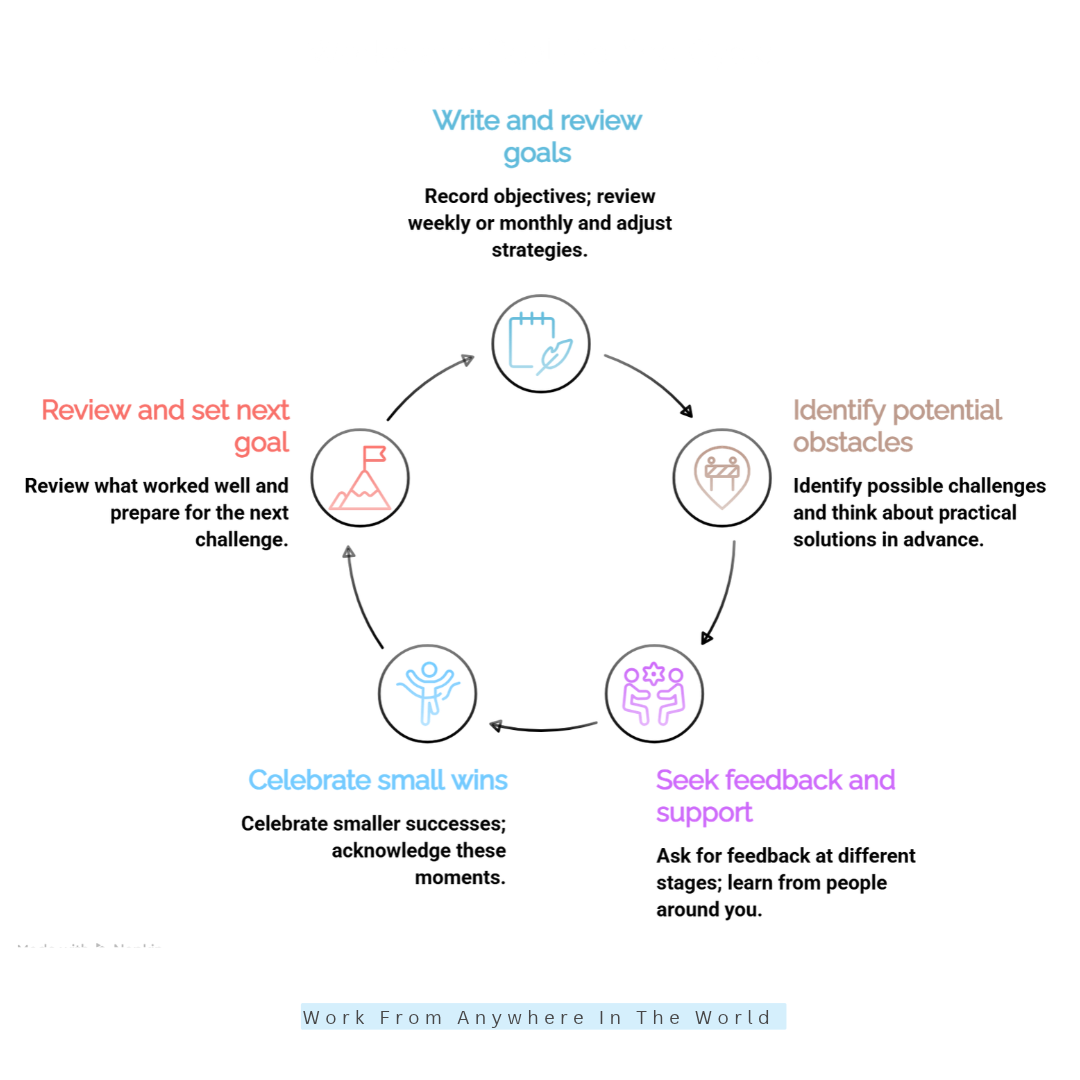
A written goal carries far more commitment than one kept in your mind. Recording your objectives in a notebook, digital planner, or performance management system keeps them visible and reinforces accountability. Reviewing your goals weekly or monthly allows you to evaluate progress, celebrate achievements, and adjust strategies when circumstances change. Workplace priorities often evolve, so regular reviews help ensure your goals remain aligned with current responsibilities. Many successful professionals dedicate a few minutes each week to reflecting on completed tasks and upcoming priorities. This simple habit keeps motivation high while preventing important objectives from being forgotten amid daily responsibilities.
7. Identify Potential Obstacles Before They Slow You Down
Successful professionals rarely assume everything will go according to plan. Before starting your goal, spend a few minutes identifying possible challenges that could affect your progress. These might include limited time, competing priorities, budget restrictions, skill gaps, or unexpected project changes. Once you’ve identified potential obstacles, think about practical solutions in advance. For instance, scheduling a specific time to concentrate on your calendar could help you maintain consistency if your schedule is frequently erratic. Being ready for setbacks doesn’t mean you will fail; rather, it gives you the self-assurance to act quickly and keep moving forward when things change.
8. Seek Feedback And Support Throughout The Process
Reaching workplace goals is often easier when you learn from the people around you. Managers, mentors, colleagues, and industry experts can provide valuable insights that help you improve faster and avoid common mistakes. Instead of waiting until the end of a project, ask for feedback at different stages. Constructive suggestions can highlight strengths, reveal blind spots, and inspire new ideas that improve your results. Regular conversations also demonstrate initiative and a willingness to grow professionally. Continuous learning drives stronger performance and builds meaningful workplace relationships that support long-term career development.
9. Celebrate Small Wins Along The Way
Every milestone deserves recognition because consistent progress is what ultimately leads to major achievements. Celebrating smaller successes keeps motivation high and reminds you that your efforts are producing meaningful results. Recognition doesn’t have to be elaborate. Completing an important project, reaching a monthly sales target, earning positive client feedback, or mastering a new skill are all accomplishments worth appreciating. Taking time to acknowledge these moments reinforces positive habits and builds confidence for the next challenge. Small victories create momentum, making even ambitious workplace goals feel more attainable over time.
10. Review, Learn, And Set Your Next SMART Goal
Completing a SMART goal isn’t the finish line—it’s an opportunity to evaluate your growth and prepare for the next challenge. Take time to review what worked well, which strategies produced the strongest results, and where improvements could make future goals even more effective. Reflecting on your experience helps transform every achievement into valuable professional knowledge. You can also compare your original expectations with the outcome to identify lessons that strengthen future planning. Continuous improvement is one of the greatest benefits of the SMART framework because every completed goal becomes the foundation for even greater success.
SMART Goals For Different Professions
1. Sales Professional
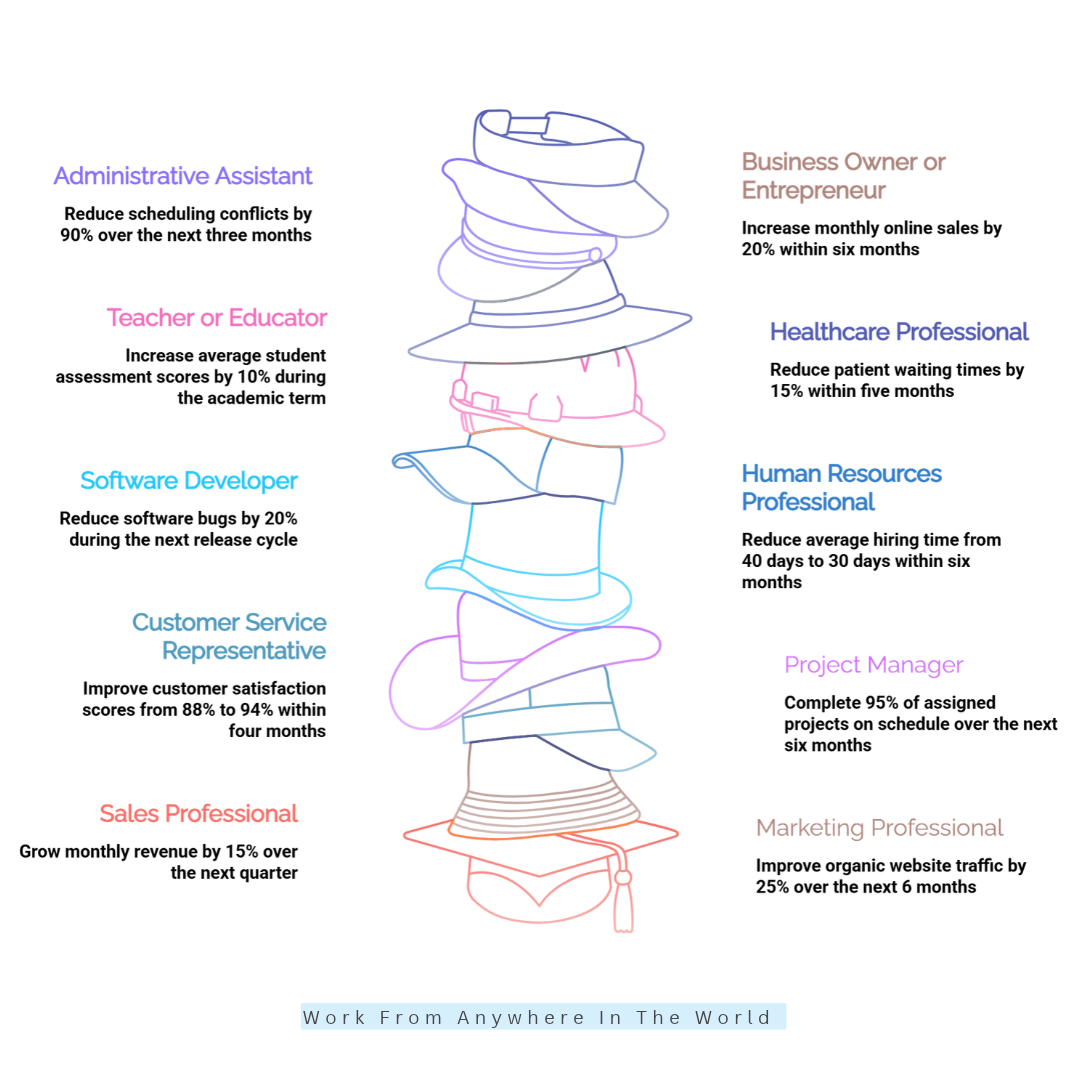
Sales teams thrive on measurable performance, making SMART goals especially effective. By calling 20 new prospects each week and following up with current clients within 24 hours, a sales representative can aim to grow monthly revenue by 15% over the next quarter. This approach creates a clear target while making daily activities easier to prioritize. Tracking conversion rates and customer interactions also helps identify strategies that deliver the strongest results.
2. Marketing Professional
Marketing specialists often manage multiple campaigns, making focused goals essential. A SMART goal may be to write 4 SEO-optimized articles per month, update existing content, and enhance internal linking to improve organic website traffic by 25% over the next 6 months. Measuring traffic, keyword rankings, and engagement helps determine whether the strategy is producing meaningful business growth.
3. Customer Service Representative
Excellent customer service depends on responsiveness and customer satisfaction. A practical SMART goal might be to improve customer satisfaction scores from 88% to 94% within four months by reducing response times, resolving issues during the first interaction whenever possible, and completing advanced customer communication training. This goal improves both employee performance and the overall customer experience.
4. Project Manager
Project managers balance deadlines, budgets, and team collaboration every day. A SMART goal could involve completing 95% of assigned projects on schedule over the next six months by implementing weekly progress reviews, improving risk management practices, and strengthening cross-departmental communication. Regular performance tracking ensures projects remain aligned with organizational objectives.
5. Software Developer
Technology professionals often focus on efficiency, quality, and continuous learning. A SMART goal might be to reduce software bugs by 20% during the next release cycle by increasing automated testing coverage, conducting peer code reviews, and completing an advanced programming course. This objective supports both technical improvement and product reliability.
6. Human Resources Professional
HR professionals contribute to employee satisfaction and organizational success. An effective SMART goal could be to reduce average hiring time from 40 days to 30 days within six months by streamlining the recruitment process, improving candidate communication, and expanding sourcing channels. Faster recruitment helps businesses secure talented candidates while improving the overall hiring experience.
7. Teacher or Educator
Teachers can use SMART goals to improve student outcomes and professional development. For example, an educator may aim to increase average student assessment scores by 10% during the academic term by introducing interactive learning activities, providing weekly progress feedback, and offering additional support sessions. Regular evaluations help measure teaching effectiveness while supporting student success.
8. Healthcare Professional
Healthcare workers often focus on delivering exceptional patient care while maintaining efficiency. A SMART goal might be to reduce patient waiting times by 15% within five months by improving appointment scheduling, enhancing interdepartmental communication, and reviewing daily workflows. Better efficiency contributes to improved patient satisfaction and stronger healthcare outcomes.
9. Administrative Assistant
Administrative professionals are essential to maintaining organizational structure. A SMART goal could be to reduce scheduling conflicts by 90% over the next three months by implementing a centralized calendar system, confirming appointments in advance, and updating schedules daily. Improved organization saves time and increases workplace productivity.
10. Business Owner or Entrepreneur
Entrepreneurs benefit from SMART goals because business growth depends on consistent planning and measurable progress. A practical goal could be to increase monthly online sales by 20% within six months by improving website SEO, launching targeted email marketing campaigns, and expanding social media engagement. Monitoring revenue, conversion rates, and customer retention helps guide future business decisions.
Common Mistakes When Setting SMART Goals At Work
1. Setting Goals That Are Too Vague
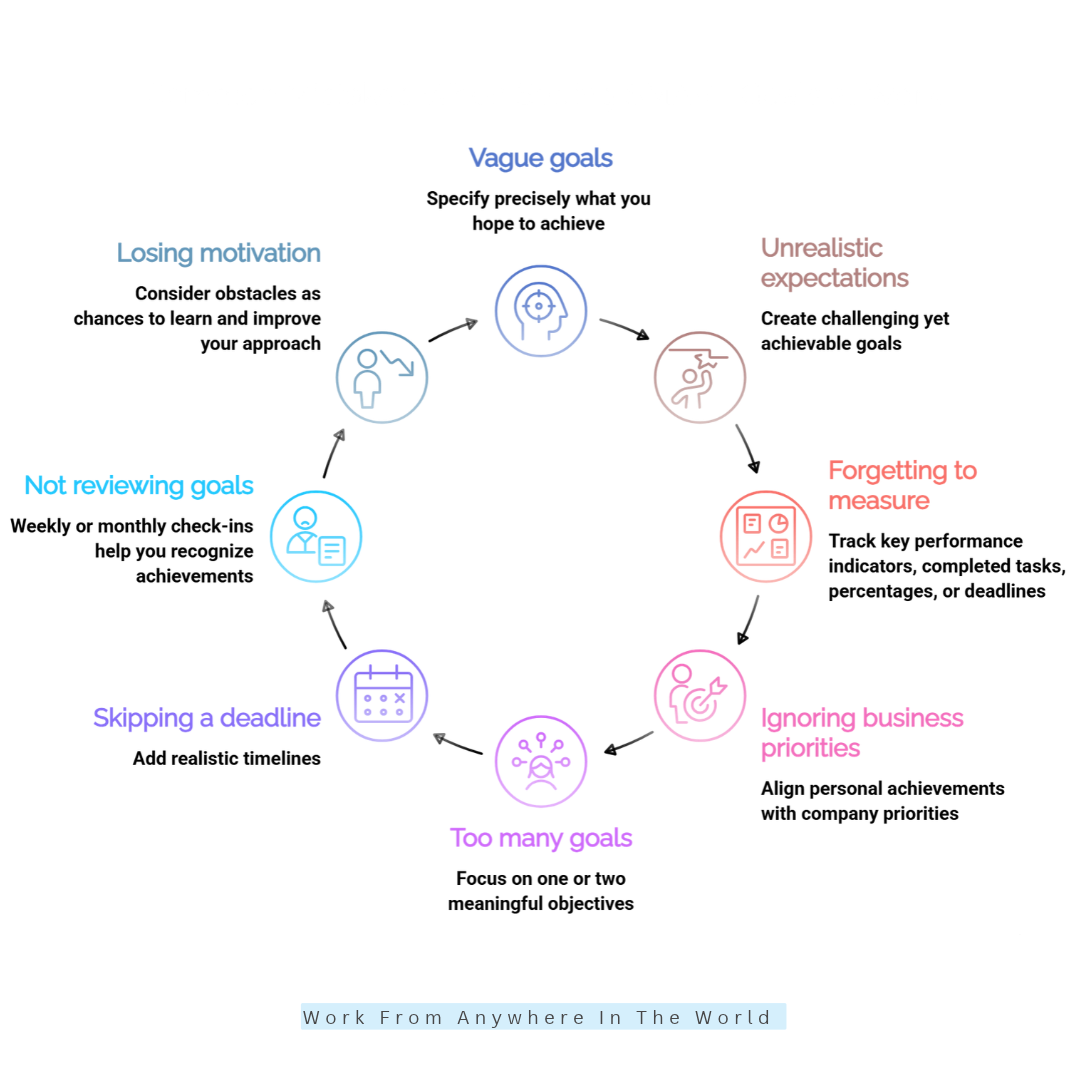
One of the most common mistakes is creating goals without enough detail. Although they sound good, goals like “work harder” or “be more productive” don’t offer much guidance. Rather, specify precisely what you hope to achieve, how you will gauge success, and when you anticipate doing so. Setting clear objectives simplifies planning and removes needless ambiguity.
2. Choosing Unrealistic Expectations
Ambitious goals encourage growth, but unrealistic expectations can quickly become discouraging. Setting objectives that require impossible timelines or unavailable resources often leads to frustration rather than progress. It’s better to create challenging yet achievable goals that stretch your abilities while remaining realistic within your current circumstances.
3. Forgetting To Measure Progress
Without measurable milestones, it becomes difficult to know whether you’re moving closer to your objective. Tracking key performance indicators, completed tasks, percentages, or deadlines provides valuable insight into your progress. Regular measurement also helps you identify areas where small adjustments can improve your results before larger problems develop.
4. Ignoring Business Priorities
A goal may be well written but still produce limited value if it doesn’t support your team’s objectives or your organization’s mission. Before finalizing any SMART goal, consider how it contributes to larger business outcomes. Aligning personal achievements with company priorities increases both your impact and your professional value.
5. Setting Too Many Goals At Once
Trying to achieve several major goals simultaneously often divides your attention and reduces productivity. Focusing on one or two meaningful objectives allows you to dedicate more energy, maintain higher-quality work, and complete important milestones without feeling overwhelmed. Once those goals are achieved, you can confidently move on to new challenges.
6. Skipping A Clear Deadline
Deadlines create momentum and encourage consistent action. Goals without a completion date often lose priority as new responsibilities appear. Adding realistic timelines helps you organize your workload, maintain accountability, and measure progress more effectively throughout the project.
7. Not Reviewing Goals Regularly
Creating a SMART goal is only the beginning. Review progress consistently to ensure you’re moving in the right direction. Weekly or monthly check-ins help you recognize achievements, identify challenges early, and adjust your strategy when necessary. Regular reviews keep your goals relevant as workplace priorities evolve.
8. Losing Motivation After Early Challenges
Every meaningful goal comes with obstacles, and temporary setbacks are a normal part of professional growth. Consider obstacles as chances to learn and improve your approach rather than as failures. Maintaining momentum in the face of changing circumstances is easier when you remain adaptable and committed to long-term advancement.
Frequently Asked Questions
Q1: How Do I Write A SMART Goal For Work?
Start by identifying a specific objective, then make it measurable, achievable, relevant to your role, and supported by a realistic deadline. For example, instead of improving sales generally, aim to increase monthly sales by 15% within six months.
Q2: Can SMART Goals Improve Employee Performance?
Yes. SMART goals encourage accountability, provide measurable targets, and create a structured path for improvement. Employees can track their achievements, identify areas for growth, and make informed adjustments that lead to stronger workplace performance over time.
Q3: How Often Should SMART Goals Be Reviewed?
Reviewing SMART goals every week or month helps you measure progress, identify obstacles, and adjust your strategy when necessary. Regular evaluations also keep goals aligned with changing priorities and maintain motivation throughout the entire process.
Q4: Are SMART Goals Suitable For Every Profession?
Yes. SMART goals can be adapted to almost every industry, including healthcare, education, marketing, finance, sales, information technology, customer service, and project management. The framework works because it focuses on clear, measurable outcomes rather than job titles.
Conclusion
You can change how you approach your profession by learning to set SMART goals at work. This will help you replace ambiguity with clear direction and quantifiable progress. You’ll be more equipped to enhance performance, acquire useful skills, and attain long-term success if you set clear, attainable, and time-bound goals. Start with one meaningful goal today, stay consistent, and allow each milestone to build the confidence needed for even greater professional achievements.
I trust you enjoyed this [Article Topic]. Please stay tuned for more insightful blogs on affiliate marketing, online business, and working from anywhere in the world.
Take care!
— JeannetteZ 🌍✨
💬 Your Opinion Is Important To Me
Do you have thoughts, ideas, or questions? I’d love to hear from you. Please leave your comments below or email me directly at Jeannette@WorkFromAnywhereInTheWorld.com.
📚 More Work From Anywhere Reads
🚀 Ready to Build a Business You Can Run from Home
Or from Anywhere in the World?
Imagine earning income on your terms — from home, a cozy café, or wherever life takes you.
With the right tools, training, and community support, it’s entirely possible.
Start your own online business for free — no credit card needed.
Disclosure
This post may contain affiliate links. As an Amazon Associate and participant in other affiliate programs, I earn from qualifying purchases at no extra cost to you. Please read my full affiliate disclosure.