
How To Get Paid In Affiliate Marketing
“How to get paid in affiliate marketing” is one of the most important questions beginners ask when starting out. While the concept sounds simple, understanding how affiliate marketing pays you is essential if you want to turn your efforts into real income.
On the surface, it seems straightforward. You promote a product, someone makes a purchase, and you earn a commission. However, the process involves more than just sharing links. It requires the right strategy, patience, and a clear understanding of how affiliate systems work.
In this guide, you’ll learn exactly how to get paid in affiliate marketing, what to expect, and how to start earning your first commissions with confidence.
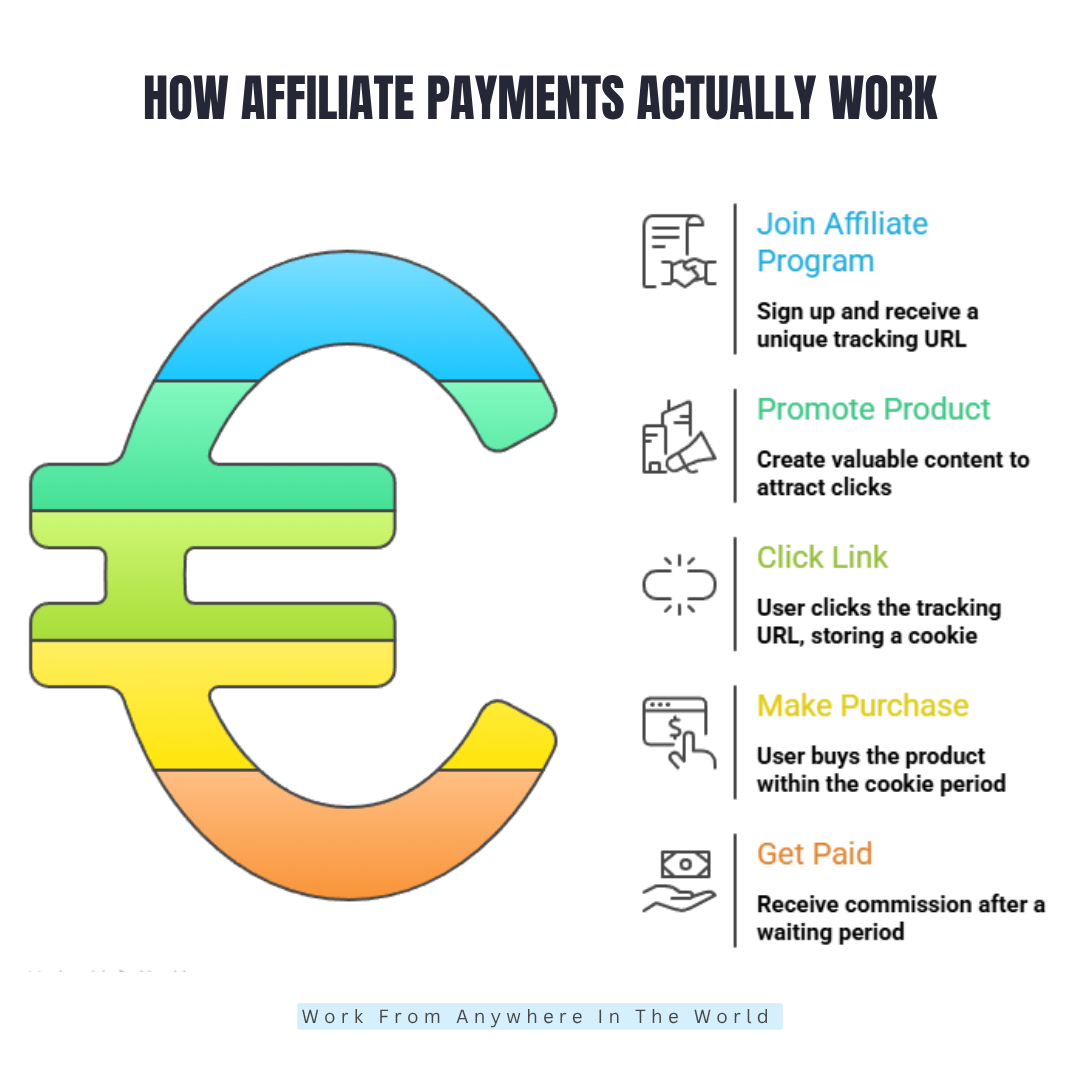
How Affiliate Payments Actually Work
Step 1: You Join An Affiliate Program
Everything starts here. After being accepted into an affiliate program, you are sent a special tracking URL. It feels simple, and honestly, it is—but this link is your entire business. Without it, nothing gets tracked, and you don’t earn anything.
Some programs approve instantly, others take time. Personally, I prefer beginner-friendly programs because waiting days for approval can slow your momentum, especially when you’re just getting started.
Step 2: You Promote A Product
Now comes the real work. You don’t just drop links everywhere—that rarely works anymore. Instead, you create content around the product. Maybe a blog post, a review, or even a quick social media video.
The goal is to help, not just sell. I’ve noticed that when content actually solves a problem, people naturally click. Forced promotion feels obvious, and audiences can tell. So keep it real, even if it’s not perfect.
Step 3: Someone Clicks Your Link
A tiny piece of information called a cookie is stored in the browser of the person who clicks your affiliate link. Sounds technical, but it’s not a big deal. This cookie basically tells the company, “Hey, this person came from you.”
The interesting part? It doesn’t always expire immediately—some last 24 hours, others 30 days or more. So even if they don’t buy right away, you can still earn later—which is kind of amazing.
Step 4: They Make A Purchase
This is the moment that actually matters. If the person makes a purchase within the cookie period, you earn a commission. Not every click turns into a sale, though—and that’s normal. In fact, most won’t.
That used to frustrate me at first, but it’s just part of the process. The key is getting the right people to click, not just more people. Quality traffic always beats random clicks, every single time.
Step 5: You Get Paid
Finally, the part everyone cares about—you get paid. But not instantly. Most affiliate programs have a waiting period, usually 30 to 60 days. This allows time for refunds or cancellations. At first, it feels slow, I won’t lie.
But once payments start coming in regularly, it becomes predictable. You’ll typically get paid through bank transfer, PayPal, or another method, depending on the platform. And that’s when it starts to feel real.
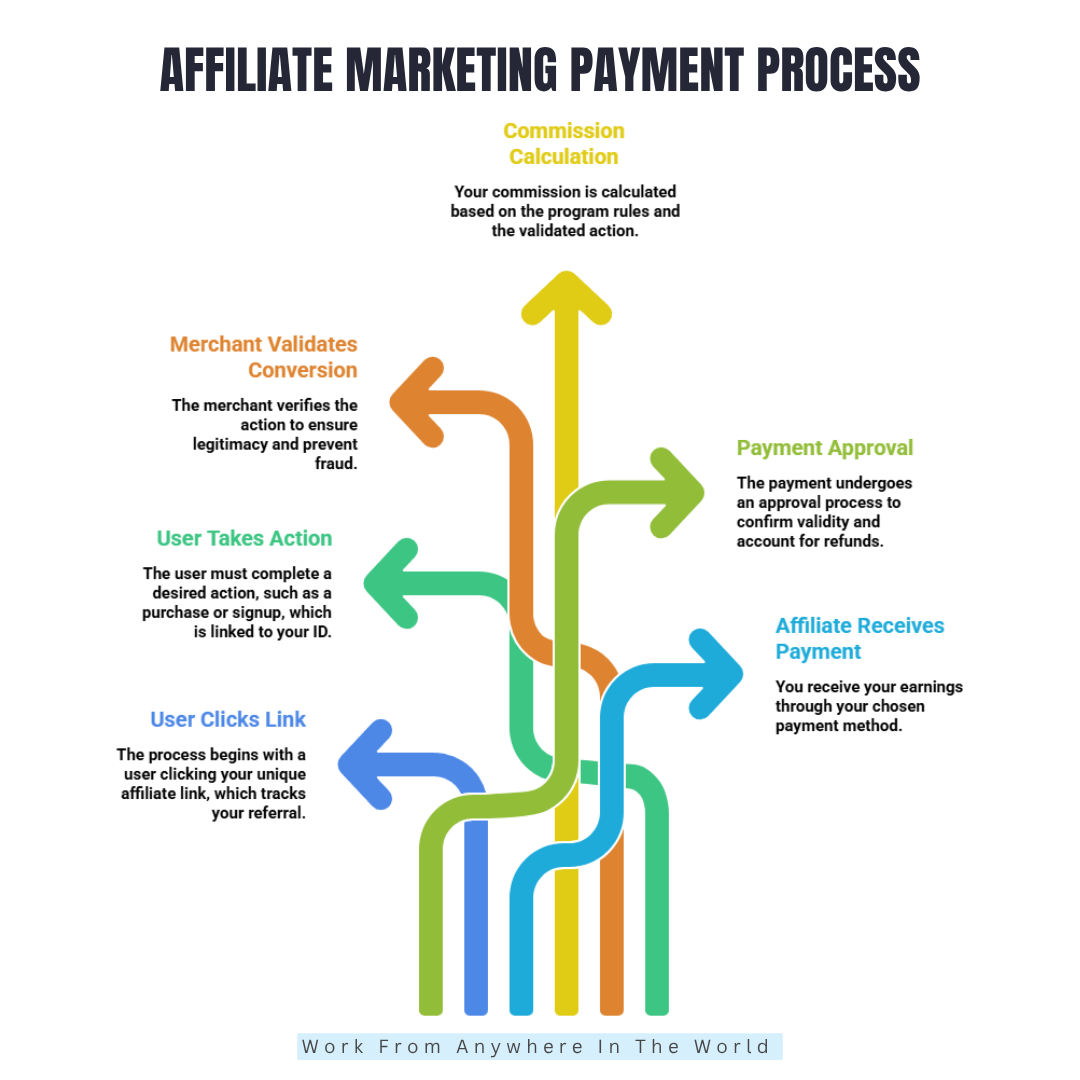
Affiliate Marketing Payment Process: Step by Step
1. User Clicks Your Affiliate Link
The affiliate process starts when a user clicks your unique affiliate link. This link includes a tracking code that identifies you as the referrer and ensures you are compensated for any actions that follow.
Affiliate links are placed in blog posts, social media posts, emails, or YouTube videos. Once clicked, the user is redirected to the merchant’s site, and the click is recorded in real-time.
Tracking is essential because without it, you cannot be held accountable for any conversions. Advanced systems use cookies, session IDs, or device tracking to maintain accuracy. The first click lays the foundation for your potential earnings and is vital for the affiliate payment cycle.
2. User Takes Action
After clicking your link, the user must take the desired action, called a “conversion.” This could be a purchase, a free trial sign-up, a form submission, or an app download.
The affiliate tracking system links this action back to your affiliate ID. Conversions are the basis of affiliate income, since commissions are usually action-based rather than click-based.
Merchants define rules for valid conversions, such as minimum purchase amounts or complete form submissions. Some programs track recurring actions, such as subscription renewals.
The effectiveness of your content directly influences conversions, meaning better targeting and engagement can increase your earnings. High-quality conversions help build trust and long-term income potential.
3. Merchant Validates The Conversion
Once the user completes the action, the merchant validates it to ensure legitimacy. Validation checks that purchases are genuine, payments are successful, and there’s no fraud or risk of returns.
For physical products, validation may occur after shipping or during the return period. For digital products, it involves confirming downloads or successful subscriptions.
Some merchants automate this process, while others perform manual checks. Validation ensures both affiliates and merchants are protected. Only approved conversions count toward commissions.
This step is critical because it prevents disputes and ensures accurate payouts. Without proper validation, affiliates could be paid for incomplete or fraudulent actions, affecting the program’s credibility.
4. Commission Calculation
After validation, the merchant calculates your commission based on the program rules. Commissions may be a fixed amount, a percentage of sales, or recurring for subscriptions. Some programs offer bonuses for achieving certain sales targets.
Automated systems usually update your affiliate dashboard with the amounts you’ve earned. Factors like discounts, regional variations, and product categories can influence the final payout.
Transparent reporting is essential so affiliates can accurately track earnings. Correct calculations prevent misunderstandings or disputes between merchants and affiliates.
Reliable commission tracking builds trust and motivates product promotion. This step converts verified user actions into measurable, trackable earnings that directly reward your marketing efforts.
5. Payment Approval
After the commission calculation, the payment typically goes through an approval process. Merchants or networks confirm that all transactions are valid, account for refunds, and verify payment methods.
Payment thresholds (e.g., $50 minimum) may apply. Approval timelines vary by program, ranging from days to weeks. Some programs pay monthly, others bi-weekly or quarterly.
This step safeguards both merchants and affiliates against errors, fraud, and unqualified conversions. Once approved, your earnings are officially eligible for payout, and balances are updated in the affiliate dashboard.
Proper approval processes ensure affiliates are compensated accurately and on time, maintaining confidence in the program and encouraging continued promotion of products or services.
6. Affiliate Receives Payment
Once approved, affiliates receive their earnings via selected methods such as PayPal, bank transfer, Payoneer, or digital wallets. The timing depends on the merchant’s payout schedule and processing time.
Taxes, transaction fees, or service charges may reduce the final amount. Many platforms provide payment statements or invoices for transparency.
Monitoring payments is essential for budgeting, accounting, and planning future campaigns. Affiliate dashboards often categorize commissions as pending, approved, or paid, giving you a clear view of your earnings.
The last stage of the cycle is getting paid, which turns your marketing efforts into real revenue. Reliable payment methods and schedules are critical for long-term success.
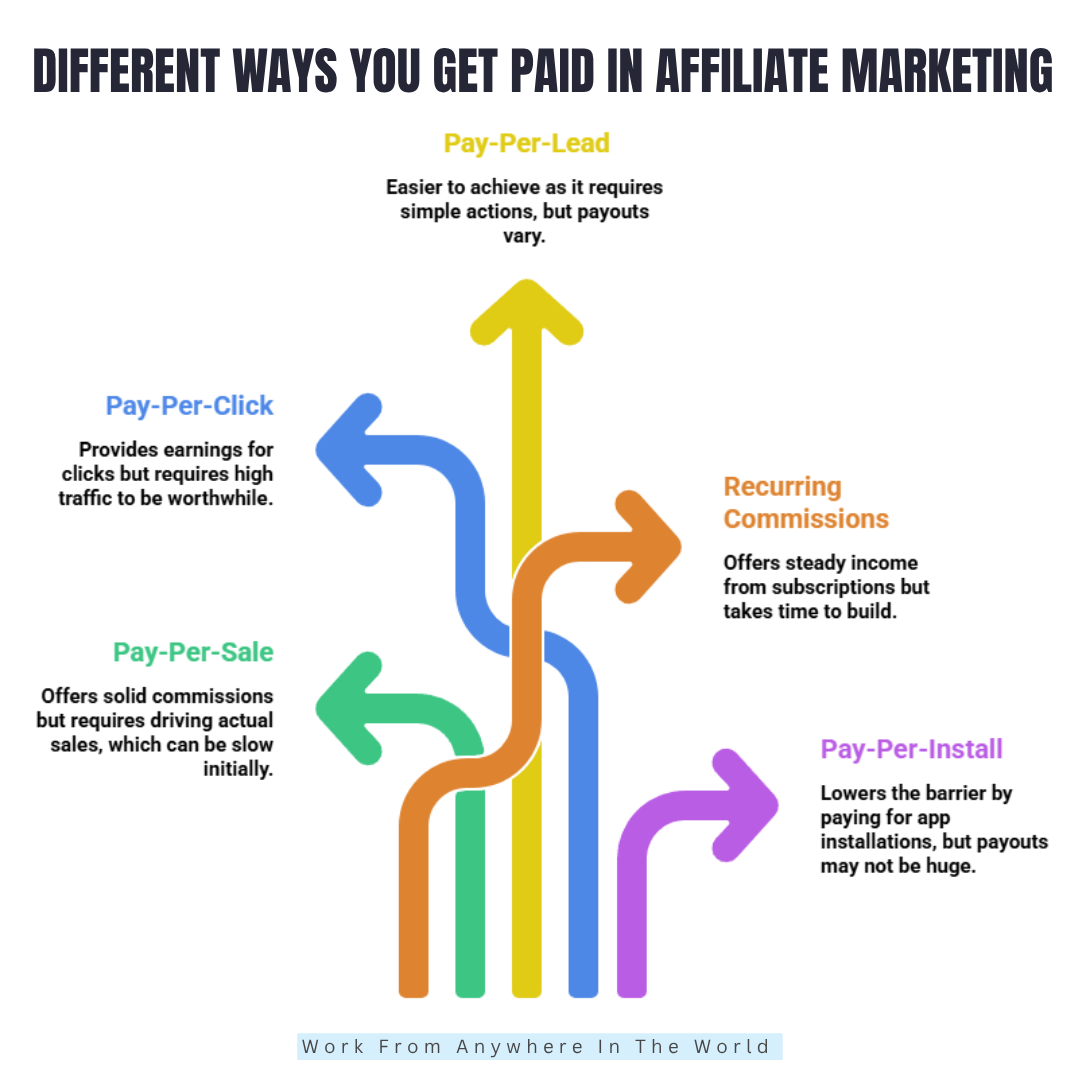
Different Ways You Get Paid In Affiliate Marketing
1. Pay-Per-Sale (PPS)
Pay-per-sale (PPS) or cost-per-sale (CPS) is the most common way affiliates earn, and honestly, it’s where most beginners start. You only get paid when someone actually buys through your link.
Simple, but not always easy. At first, it can feel slow because clicks don’t always turn into sales. I remember thinking something was wrong, but it’s normal. The upside?
Commissions can be solid, especially with higher-priced products. Once you figure out what your audience wants, this model really starts to make sense.
2. Pay-Per-Click (PPC)
Pay-per-click (PPC) sounds great in theory—you get paid just for clicks, not sales. And yes, that part is true. But in reality, the earnings per click are usually quite small.
So you need a lot of traffic to make it worthwhile. I’ve seen people get excited about this model early on, then realize it’s more of a volume game. Still, if you run a high-traffic blog or viral content, it can add up faster than you’d expect.
3. Pay-Per-Lead (PPL)
With the pay-per-lead (PPL) or cost-per-action (CPA) model, you earn when someone completes a simple action, such as signing up for a free trial or filling out a form. No purchase required, which makes it feel easier.
And in many cases, it actually is. I like this model for beginners because it reduces some of the pressure. People are more willing to try something free than spend money right away. That said, payouts vary widely by niche, so results can be unpredictable.
Wealthy Affiliate – Mini Review
If you’ve ever thought about turning your blog, passion, or niche into an online business,
Wealthy Affiliate (WA) is one of the most beginner-friendly platforms I’ve used.
It combines step-by-step training, website hosting, SEO research tools,
and an active community all in one place.
What I like most: you can start free (no credit card needed),
explore lessons, test the tools, and connect with other entrepreneurs
before upgrading. WA isn’t a “get rich quick” scheme — it’s a platform where success comes
from consistent effort and applying what you learn.
4. Recurring Commissions
This is where things start to feel exciting. Instead of earning once, you get paid repeatedly for the same customer. Usually, this applies to subscription-based products, such as software or memberships.
I didn’t fully appreciate this model at first, but over time, it has become powerful. Even a few active referrals can create a steady monthly income. It’s slower to build, but once it’s running, it feels like passive income finally kicking in.
5. Pay-Per-Install (PPI)
The pay-per-install (PPI) model pays you when someone installs an app or software through your link. No purchase needed, which lowers the barrier a lot. It’s commonly used in tech niches, especially mobile apps or tools.
I’ve noticed it works best when you can clearly show the app’s value—like how it solves a problem. Otherwise, people scroll past. The payouts aren’t always huge, but with the right audience, they can be surprisingly consistent.
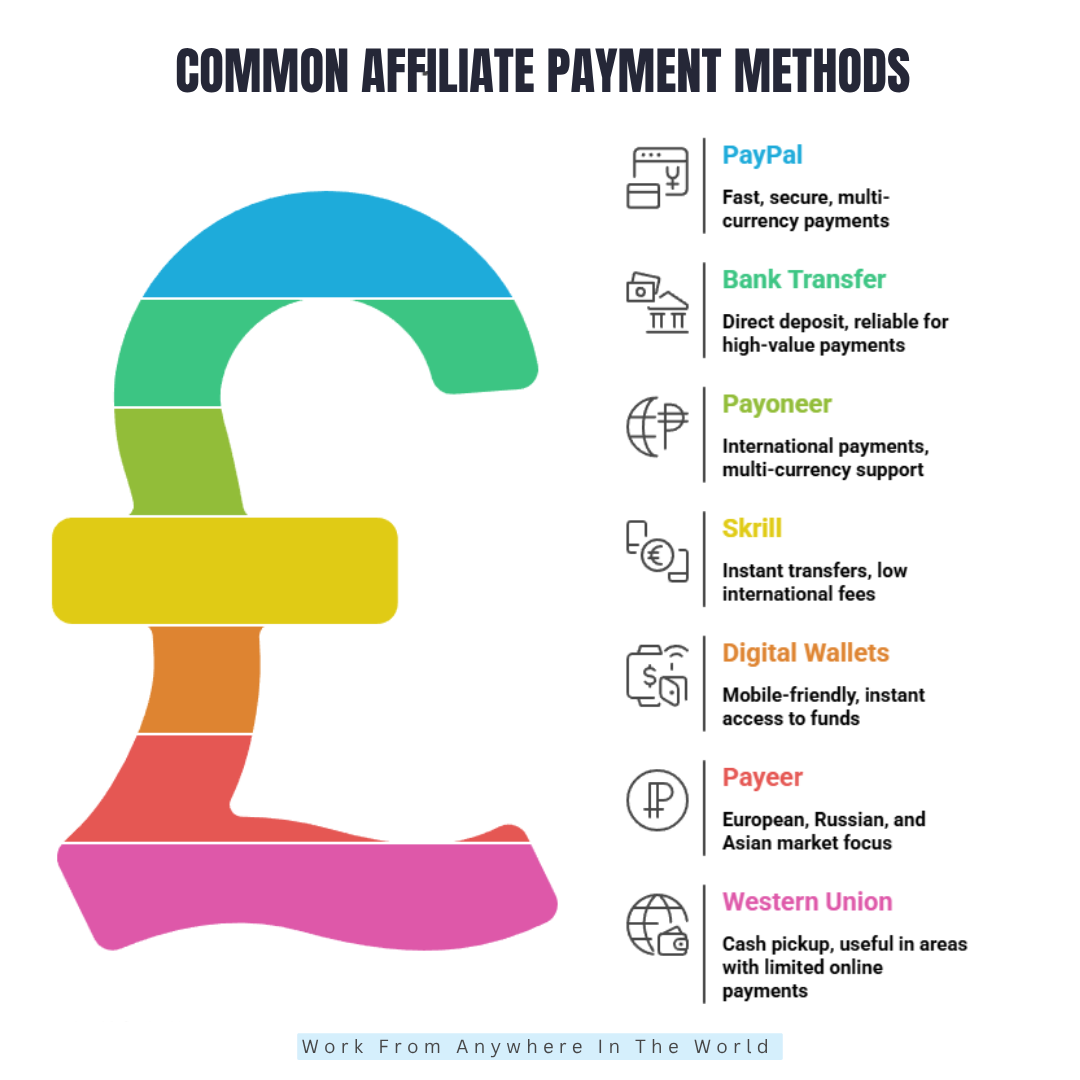
Common Affiliate Payment Methods
1. PayPal
PayPal is a widely used affiliate payment method that enables fast, secure payments. It supports multiple currencies and lets affiliates transfer funds to their bank accounts or spend online.
Many merchants prefer it for its reliability, global reach, and ease of integration with affiliate networks. PayPal is beginner-friendly, transparent, and clearly shows all pending and completed transactions.
Why People Use PayPal
- Instant or fast payments
- Supports multiple currencies
- Easy integration with affiliate networks
- Secure and reliable
How To Receive Payments
- A validated PayPal account connected to your email
- Bank account linked for withdrawals.
- Compliance with local regulations and tax documentation, if required
- Minimum payout threshold set by the affiliate program
2. Bank Transfer
Bank transfers, or wire transfers, let affiliates receive payments directly into their bank accounts. It’s secure, reliable, and ideal for high-value or recurring commissions.
Affiliates value its direct deposit, multi-currency support, and clear accounting records. Payments usually take a few business days. Professional affiliates and merchants widely use this method for large-scale, transparent payouts.
Why People Use Bank Transfer
- Direct deposit into their bank account
- Reliable for high-value payments
- Useful for accounting and tax records
- Supports multiple currencies
How To Receive Payments Via Bank Transfer
- Active bank account in your legal name
- Correct account number and routing/IBAN code
- SWIFT/BIC code for international transfers
- Minimum payout threshold set by the affiliate program
3. Payoneer
Payoneer is a popular method for international affiliates, enabling multi-currency payments and withdrawals to local bank accounts or Payoneer cards.
It reduces international transfer fees and speeds up payments compared to traditional wires. Secure and widely accepted,
Payoneer integrates easily with affiliate networks, making it ideal for freelancers and marketers working with US, EU, or global merchants.
Why People Use Payoneer
- Multi-currency support
- Fast international payments
- Direct withdrawal to local bank accounts
- Can use a prepaid card for online/offline purchases
How To Receive Payments Via Payoneer
- Verified Payoneer account
- Linked local bank account
- Submitted identity and tax verification documents
- Minimum payout threshold set by the affiliate program
4. Skrill
Skrill is an online payment system for affiliate payouts, allowing instant transfers and multi-currency support. It can link to bank accounts or prepaid cards.
Popular in regions where PayPal is restricted, Skrill offers low international fees, fast access to funds, and easy tracking. Affiliates can monitor balances, pending payments, and transaction history directly in their Skrill dashboard.
Why People Use Skrill
- Fast and secure online payments
- Multi-currency support
- Low transaction fees
- Easy integration with affiliate networks
How to Receive Payments via Skrill
- Verified Skrill account
- Linked bank account or prepaid card for withdrawals
- Identity verification (ID/passport)
- Minimum payout threshold per affiliate program
5. Digital Wallets
Digital wallets enable affiliates to receive payments instantly on their smartphones. Funds can be spent online, transferred to a bank, or used in-store. They’re convenient in regions with slower banking and ideal for micropayments or mobile-first campaigns.
Digital wallets provide secure, traceable transactions, reduce international fees, and simplify payment management, making them popular among small-scale affiliates and mobile marketers.
Why People Use Digital Wallets
- Instant access to funds
- Mobile-friendly and convenient
- Easy tracking and reporting
- Avoids international fees
How To Receive Payments Via Digital Wallets
- Verified digital wallet account
- Linked bank account for withdrawals (if needed)
- Compliance with KYC and local regulations
- Minimum payout threshold defined by the affiliate program
6. Payeer
Payeer is an online payment system popular in Europe, Russia, and Asia. It supports multiple currencies, instant transfers, and can link to bank accounts or prepaid cards.
Known for low fees and global accessibility, Payeer offers fast, secure, and easily trackable payments. It’s ideal for affiliates needing flexible international payouts or micro-transactions without relying on PayPal or traditional banks.
Why People Use Payeer
- Multi-currency support
- Fast international payments
- Low fees compared to banks
- Secure and easy to track
How To Receive Payments Via Payeer
- Verified Payeer account
- Linked bank account or prepaid card (optional)
- Identity verification (passport/ID)
- Minimum payout threshold set by the affiliate program
7. Western Union
Affiliates of Western Union can accept payments in cash or directly into a bank account from anywhere in the world. It’s ideal for regions with limited access to online payments.
Payments are fast, often available the same day. Merchants use it for international micropayments or restricted banking areas. It provides secure, traceable transfers, making it a reliable option for immediate cash access.
Why People Use Western Union
- Instant or same-day payments
- Cash pickup available worldwide
- Useful where online payments are limited
- Secure and traceable
How To Receive Payments Via Western Union
- Valid government-issued ID
- Correct recipient details (name, country)
- The affiliate program must support Western Union.
- Minimum payout threshold as per program rules
FAQs
1. How Do I Get Paid In Affiliate Marketing?
You get paid when someone completes an action through your affiliate link—like a purchase, sign-up, or subscription—depending on the program. PayPal, Payoneer, or bank transfers are the available payment methods.
2. How Much Money Can I Make?
Earnings depend on product price, commission rate, traffic, and strategy. Beginners may earn $50–$200/month, while experienced affiliates can reach $1,000–$10,000+ monthly or more with high-ticket products.
3. When Do I Receive Payment?
Most programs have a minimum payout and holding period, usually 7–30 days, to confirm purchases and avoid refunds. After approval, the funds are sent via your chosen payment method.
4. Which Affiliate Programs Pay The Most?
High-ticket products, software subscriptions, hosting, and finance-related programs often offer the highest commissions. Choose trusted niches and products with recurring or large payouts for maximum earnings.
Conclusion
Affiliate marketing is simple, but not effortless. You don’t need much money or technical skills to get started, but you do need patience and consistency.
Focus on helping people, not just selling products. That mindset changes everything. Your first earnings might feel small, but it’s proof that the system works.
And once it clicks, it can grow faster than you expect. Start small, stay consistent, and keep improving—that’s how real income happens.
I trust you enjoyed this article on How To Get Paid In Affiliate Marketing. Please stay tuned for more insightful blogs on affiliate marketing, online business, and working from anywhere in the world.
Take care!
— JeannetteZ 🌍✨
💬 Your Opinion Is Important To Me
Do you have thoughts, ideas, or questions? I’d love to hear from you. Please leave your comments below or email me directly at Jeannette@WorkFromAnywhereInTheWorld.com.
📚 More Work From Anywhere Reads
🚀 Ready to Build a Business You Can Run from Home
Or from Anywhere in the World?
Imagine creating income on your terms — from home, a cozy café, or wherever life takes you.
With the right tools, training, and community support, it’s entirely possible.
Start your own online business for free — no credit card needed.
Disclosure
This post may contain affiliate links. As an Amazon Associate and participant in other affiliate programs, I earn from qualifying purchases at no extra cost to you. Please read my full affiliate disclosure.