

Semrush Tutorial: 12 Powerful Steps To Smarter SEO
Understanding how to use Semrush can make a real difference in your SEO strategy. This Semrush tutorial introduces the platform’s essential tools and shows you how to use them effectively.
You’ll discover valuable keywords, understand your competitors, and identify opportunities to improve your website’s visibility. Each tool provides useful insights to guide your SEO decisions.
Semrush offers keyword research, competitor analysis, technical SEO audits, backlink analysis, rank tracking, and AI search visibility. Understanding how these features work together helps you make informed decisions instead of relying on guesswork.
Whether you run a blog, manage an online store, or grow a business website, this guide shows you how to put Semrush to work. You’ll learn 12 practical workflows to strengthen your SEO strategy, monitor your progress, and make better use of your research.
What Is Semrush?
Semrush is a comprehensive digital marketing platform that helps businesses improve their online visibility. It provides tools to research keywords, conduct SEO competitive analysis, monitor search rankings, and identify growth opportunities.
For beginners, the platform may seem overwhelming because it offers so many tools and reports. However, you don’t need to master everything at once to start improving your SEO strategy.
A practical Semrush workflow follows five stages:
Research → Analyze → Optimize → Track → Improve
The Semrush SEO Toolkit brings together keyword research, competitor analysis, backlink analysis, rank tracking, on-page optimization, and technical SEO audits. These features help you understand your website’s performance and identify areas that need attention.
Our guide on how to use Semrush for blogging explores practical ways to apply these insights. It explains how bloggers can use Semrush to improve their content strategies and attract more organic traffic.
Semrush also offers AI search visibility tools that help businesses understand how their brands appear in AI-generated answers. These insights complement traditional SEO research and provide another way to evaluate online visibility.
By combining traditional search data with AI visibility insights, Semrush helps you develop a more informed digital marketing strategy. You can prioritize improvements, monitor changes, and adjust your approach as search technology evolves.
12 Essential Semrush Steps From Research To Rank Tracking
Learning Semrush is easier with a structured workflow. Instead of exploring every feature at once, focus on the tools that support your immediate SEO goals.
The following 12 steps guide you through the essential features, from setting up your first project to researching keywords and analyzing competitors. You’ll also learn how to improve your website’s technical performance and monitor search rankings.
Each step builds on the previous one, helping you understand how different Semrush tools work together. This approach makes it easier to turn research findings into practical improvements.
Whether you’re new to SEO or already familiar with the basics, these steps provide a useful framework. You can return to individual tools whenever you need to research new opportunities or evaluate your progress.
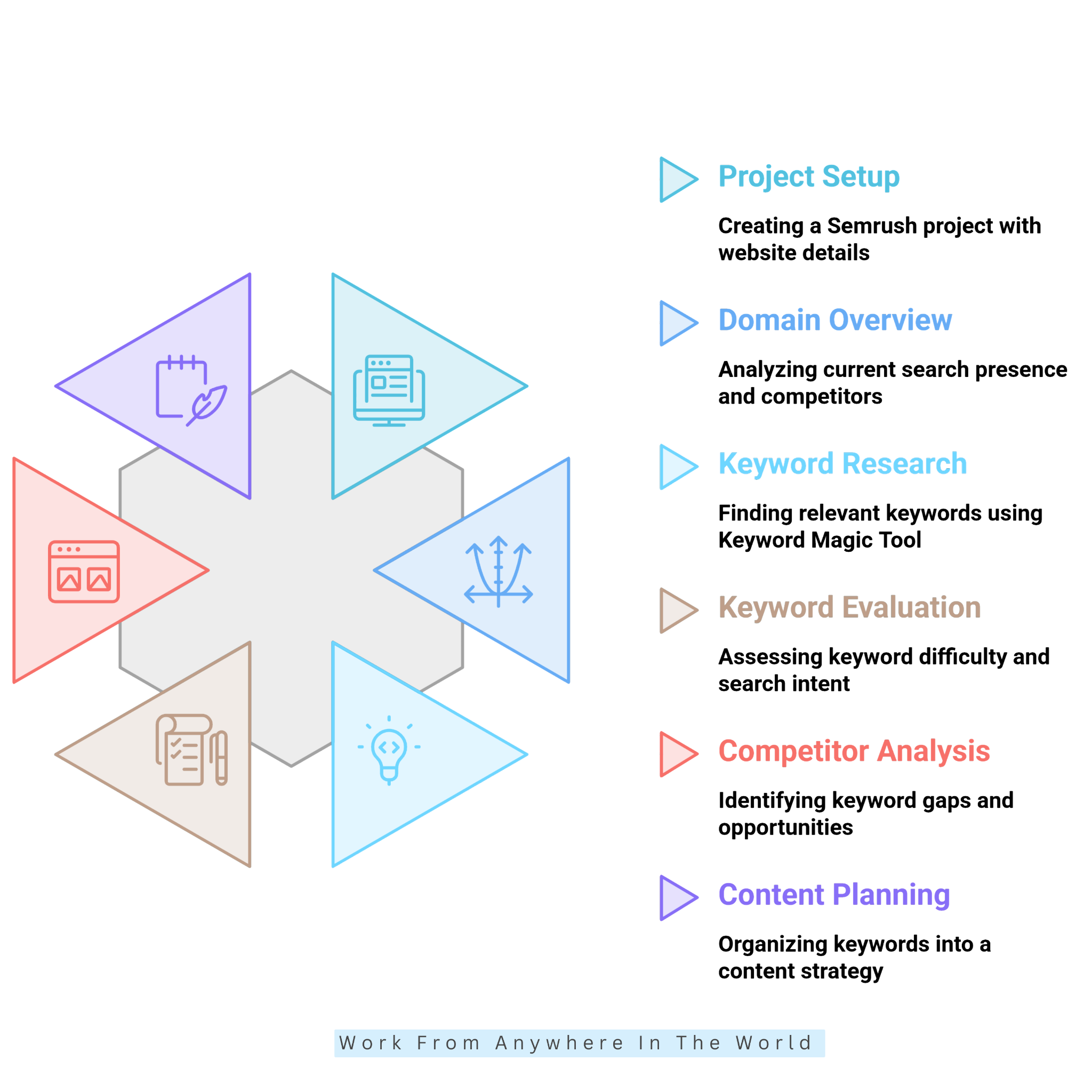
Step 1: Create Your Semrush Project And Add Your Website
Start by creating a new project in Semrush and entering your website’s domain. This gives you a central location to organize your SEO tools and monitor your website’s performance.
Next, configure the SEO tools you want to use, including Site Audit and Position Tracking. Our comprehensive Semrush review explores the platform’s features in greater detail.
These settings matter because search rankings and keyword performance often differ by country and region. For websites serving multiple markets, you may also want to track rankings in several locations.
Once your tools are configured, you can review technical issues, monitor keyword positions, and identify areas for improvement. Keeping this information together makes it easier to evaluate your SEO progress.
Taking time to configure your project correctly provides a reliable foundation for the remaining steps. It also helps you avoid unnecessary adjustments as you begin analyzing your website.
Step 2: Analyze Your Website With Domain Overview
Open Semrush’s Domain Overview tool and enter your website’s domain. The report summarizes your organic search performance, including estimated traffic, top keywords, and backlinks.
Start by reviewing the keywords your website ranks for and its estimated organic traffic. These figures help you understand your current search visibility and identify potential opportunities.
Look for keywords that already perform well and areas where your website can grow. You can also review competitors to compare their search performance with yours.
For a deeper understanding of your competition, explore SEO competitive analysis. This approach helps you identify competitors, compare their strengths, and find opportunities to improve your rankings.
Don’t worry about understanding every metric immediately. Focus on identifying useful patterns and getting familiar with the information Semrush provides.
New websites may have limited data, especially when they have few rankings or backlinks. Use the available information as a starting point for evaluating your future SEO progress.
Step 3: Research Keywords With Keyword Magic Tool
Open Semrush’s Keyword Magic Tool and enter a broad keyword related to your website or business. Select your target country to generate relevant keyword suggestions.
Use filters such as search volume, keyword difficulty, search intent, and word count to narrow your results. You can also explore question-based keywords to discover what your audience wants to know.
Focus on relevance rather than the highest search volume. A lower-volume keyword may offer better opportunities when it closely matches your audience’s needs.
Explore related keyword groups and long-tail variations to understand how people search for your topic. Learning how to identify long-tail keywords will help you discover more specific content opportunities.
Effective keyword research isn’t about collecting hundreds of search terms. It’s about finding relevant keywords with realistic ranking potential that help you create useful content for your readers.
Step 4: Evaluate Keyword Difficulty And Search Intent
Once you’ve created your keyword list, examine each promising term more closely. Review its search volume, keyword difficulty, search intent, and search engine results page (SERP) features.
Keyword difficulty estimates how challenging it may be to rank for a particular search term. Broad short-tail keywords often face stronger competition, while more specific searches may offer better ranking opportunities.
Search intent reveals what people hope to accomplish when entering a query. Informational searches often favour helpful guides, while commercial searches may lead to product reviews or comparisons.
Next, search your target keyword on Google and review the top results. Compare their formats, topics, and depth to understand what searchers expect.
Semrush’s Keyword Overview tool provides additional insights into these metrics. Use this information to identify keywords that balance relevance, competition, and realistic ranking potential.
Step 5: Analyze Competitors And Find Keyword Gaps
Start by identifying several websites competing for the same audience and search topics. Focus on relevant competitors, not just large, well-known brands.
Open Semrush’s Keyword Gap tool and enter your domain alongside your competitors’. The report compares keyword rankings and highlights opportunities you may be missing.
Look for relevant keywords where competing websites rank, but yours has little or no visibility. These gaps may reveal new article ideas, opportunities to improve existing pages, or topics worth exploring.
Compare several competitors to develop a broader understanding of your market. Our guide to SEO competitive analysis explains how to evaluate competing websites and identify useful opportunities.
Avoid copying your competitors’ content or strategies. Instead, use their keyword performance to understand search demand and create more helpful, original content for your audience.
Step 6: Turn Keyword Research Into A Content Plan
Once you’ve gathered your keyword data, organize related search terms into logical topics. Group keywords with similar search intent rather than creating separate articles for every minor variation.
Choose a primary topic and identify supporting subtopics and relevant long-tail keywords. This approach helps you develop comprehensive content while reducing unnecessary overlap between pages.
For example, a broad topic such as SEO may include keyword research, technical SEO, on-page optimization, link building, and local SEO. Each subject may deserve its own article when it addresses a distinct search intent.
Next, decide which content format best matches each keyword. Informational searches often suit tutorials, while commercial searches may benefit from comparisons, reviews, or product pages.
Semrush’s Keyword Strategy Builder helps organize related keywords into topics and pages. You can use these suggestions to plan new articles and improve existing content.
For an example of applying these principles, explore our guide to content strategy for eCommerce blogs. It offers a practical starting point for organizing blog content around your audience’s interests.
Step 7: Run A Site Audit To Find Technical SEO Issues
Open Semrush’s Site Audit tool and enter your website’s domain. Configure the crawl settings and start the audit to identify technical problems that may affect your search performance.
The audit checks for broken links, redirect issues, duplicate content, HTTPS problems, and missing metadata. It also examines crawling, indexability, and internal linking.
Once the audit finishes, review the findings by severity and potential impact. Focus first on problems affecting important pages, search engine accessibility, and the user experience.
Some issues, such as broken internal links or missing page descriptions, may be straightforward to correct. Online store owners can follow our eCommerce SEO audit checklist for additional guidance on evaluating their websites.
Technical SEO creates a stronger foundation for your content strategy. When search engines can access, crawl, and understand your pages effectively, your website is better positioned to perform in search results.
Step 8: Improve Existing Pages With SEO Data
Before creating new articles, examine pages that already receive search visibility. Semrush helps identify existing keywords, ranking positions, and opportunities to improve your content.
Pay particular attention to pages ranking just outside Google’s top results. Targeted improvements may help these articles become more competitive without requiring entirely new content.
Compare each page with the current search results to understand what readers expect. Look for missing information, outdated examples, unclear explanations, and opportunities to improve the structure.
Review headings, metadata, and internal links to strengthen the page’s relevance and usability. Our on-page SEO guide explains additional techniques for optimizing existing content.
Semrush’s On-Page SEO Checker provides recommendations based on your pages and competing search results. Use these suggestions to prioritize improvements that support your SEO goals.
Effective content optimization isn’t about adding unnecessary words or repeating keywords. It’s about creating a more complete, helpful resource that satisfies your readers’ needs.
Step 9: Track Your Keywords With Position Tracking
Once your important pages and keywords are ready, open Semrush’s Position Tracking tool. Set up a campaign to monitor how your website ranks for selected search terms.
Choose your target search engine, country, location, and device. Add your priority keywords and relevant competitors to compare their ranking performance with yours.
For international websites, consider tracking keywords in different countries or regions. Search rankings often vary by location, even when people use the same search terms.
Focus on meaningful keyword groups rather than tracking every phrase you’ve researched. Monitor visibility, average position, estimated traffic, and relevant search engine results page (SERP) features.
Review your ranking trends regularly to identify improvements and potential problems. Rising positions may indicate progress, while declining rankings deserve further investigation.
Use these findings to guide your next SEO decisions. You may also explore our guide to the best rank-tracking software to discover other tools for monitoring keyword positions and evaluating search performance.
Wealthy Affiliate – Mini Review
If you’ve ever thought about turning your blog, passion, or niche into an online business,
Wealthy Affiliate (WA) is one of the most beginner-friendly platforms I’ve used.
It combines step-by-step training, website hosting, AI-powered tools,
keyword research, and an active community all in one place.
What I like most is that you can start for free (no credit card needed), explore the platform,
test the tools, and connect with other entrepreneurs before upgrading.
WA isn’t a “get rich quick” scheme — success comes from consistent effort
and applying what you learn over time.
Step 10: Analyze Backlinks And Identify Opportunities
Open Semrush’s Backlink Analytics tool to examine the websites linking to your domain. Review referring domains, backlink trends, and linking pages to understand your website’s backlink profile.
Compare your results with competing websites to identify potential opportunities. Look for relevant sources that regularly link to content similar to yours.
Next, use Semrush’s Backlink Gap tool to compare your domain with competitors. It helps identify websites linking to your competitors but not to your own site.
These websites may offer outreach opportunities when you have valuable content worth sharing. Focus on relevance, editorial quality, and genuine connections rather than collecting large numbers of backlinks.
Original research, detailed tutorials, and expert insights are more likely to attract meaningful links. Our guide on how to get backlinks for free explores practical strategies for earning them.
Remember that successful link building takes time and consistent effort. Prioritize trustworthy websites and natural links that provide value to readers.
Step 11: Measure AI Search Visibility For GEO
Generative Engine Optimization (GEO) focuses on improving how your content appears in AI-generated answers. It complements traditional SEO by showing another way people discover information online.
Open Semrush’s AI Visibility Toolkit and enter your website’s domain in Visibility Overview. The report shows how your brand appears across supported AI search platforms.
Review your AI Visibility Score, brand mentions, cited pages, and relevant topics. These insights help you identify where your website appears in AI-generated answers and where visibility may be limited.
Next, compare your results with competing websites. Look for topics and prompts where competitors receive mentions or citations, but your website does not.
Use these findings to improve existing content with clear explanations, accurate information, original insights, and credible sources. Organize your pages so readers can easily find answers to important questions.
Remember that GEO does not replace traditional SEO. Both approaches benefit from useful content, strong website structure, and reliable information that meets your audience’s needs.
Step 12: Repeat The Research, Optimization, And Measurement Cycle
Successful SEO requires ongoing attention, not a single round of improvements. Use Semrush regularly to research opportunities, evaluate your website, and measure progress.
Begin by reviewing your keyword rankings, website performance, and competitor activity. Identify pages that are improving and others that may need additional attention.
Next, update existing content, investigate technical issues, and explore new keyword opportunities. Prioritize changes that offer meaningful benefits to your readers and support your website’s goals.
Give search engines time to discover and evaluate your improvements. Review your reports periodically rather than reacting to every small ranking fluctuation.
Remember that search trends, competitors, and search engine results pages change over time. A strategy that works today may need adjustments as your audience and the search landscape evolve.
The greatest value of Semrush comes from connecting research, content optimization, technical audits, and performance tracking. By repeating this process, you create a consistent approach to improving your website’s search visibility.
Pros And Cons Of Semrush
Semrush provides a comprehensive collection of tools for keyword research, competitor analysis, website audits, and performance tracking. These features make it useful for bloggers, businesses, and digital marketers looking to improve their online visibility.
However, its extensive capabilities come with certain limitations, particularly regarding pricing and ease of use. Understanding the advantages and disadvantages will help you decide whether Semrush is suitable for your website, experience, and budget.
Pros Of Semrush
Semrush offers several advantages for bloggers, website owners, and digital marketers who want to strengthen their SEO strategies. Its integrated tools make it easier to research opportunities, monitor performance, and identify areas for improvement.
From detailed keyword insights to competitor analysis and technical audits, Semrush brings essential SEO activities together in one platform. The following benefits highlight why it is a popular choice for managing and improving website visibility.
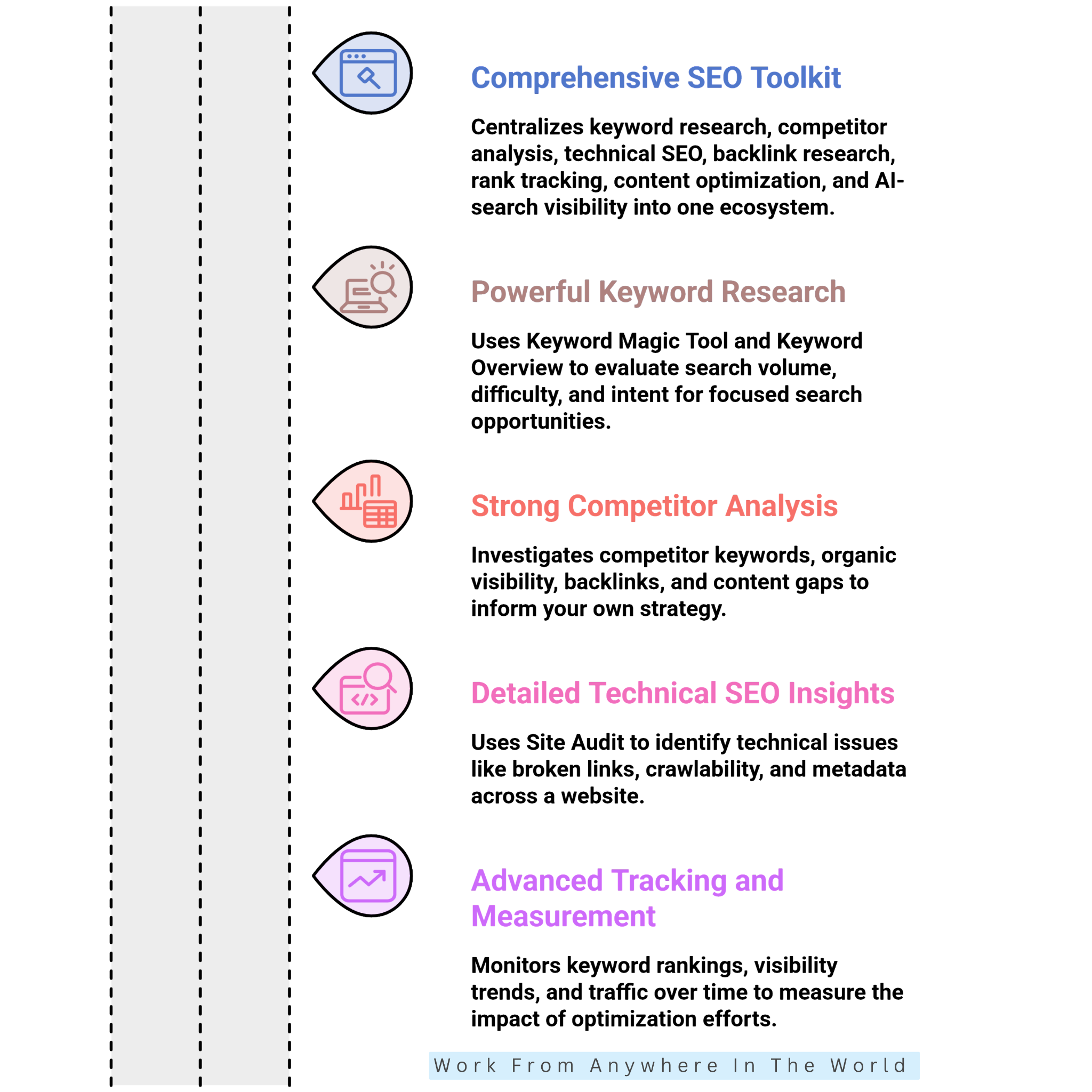
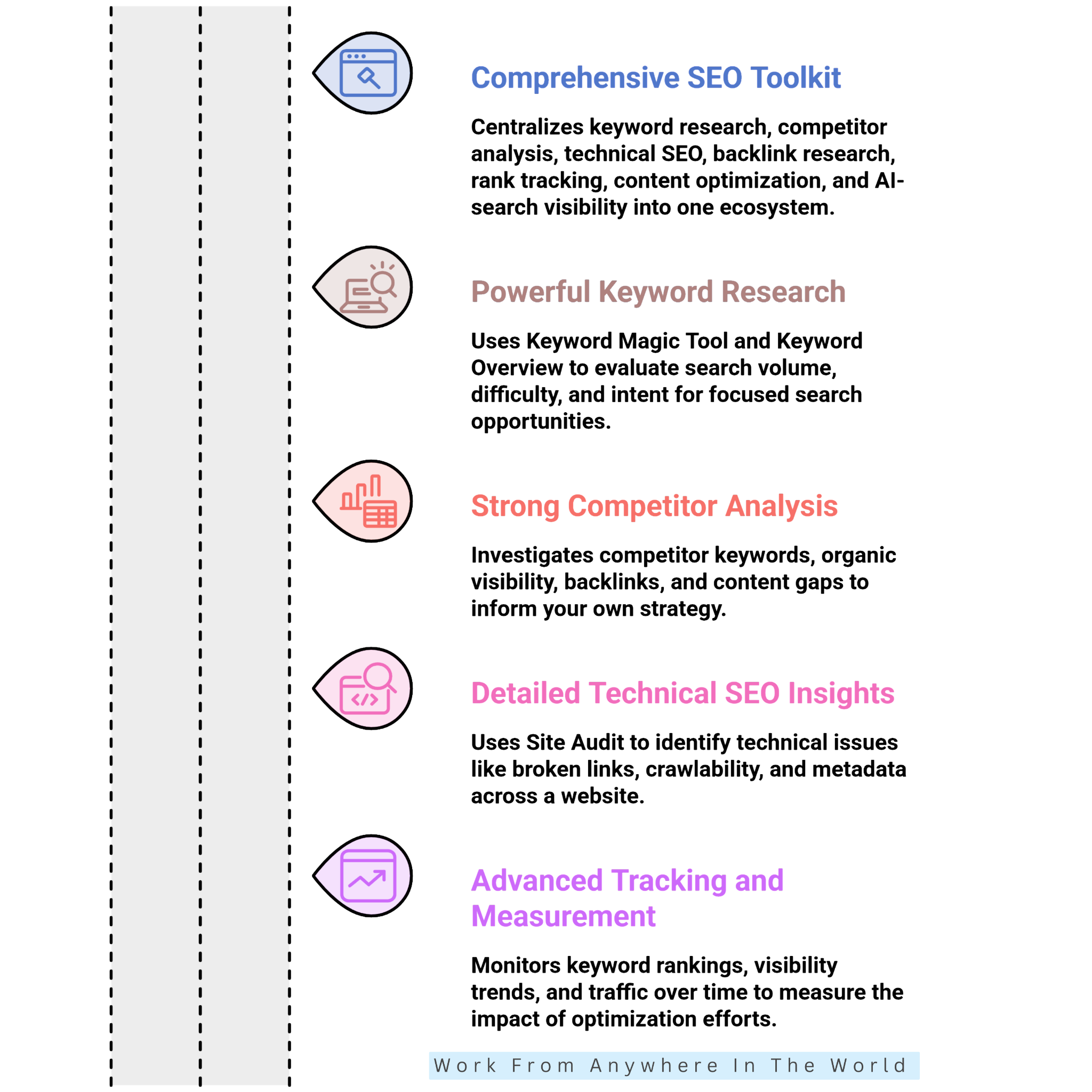
1. Comprehensive SEO Toolkit
Semrush combines keyword research, competitor analysis, technical audits, backlink research, rank tracking, content optimization, and AI search visibility in one platform. This makes it easier to manage different aspects of your SEO strategy.
Instead of researching keywords in one tool and tracking rankings in another, you can connect these activities within Semrush. This centralized approach helps keep your research and performance data organized.
Having multiple SEO tools in one place is particularly useful for marketers managing several websites or campaigns. It simplifies the workflow and reduces the need to switch between different platforms.
2. Powerful Keyword Research
Semrush offers extensive keyword research tools, including Keyword Magic Tool and Keyword Overview. These tools help you discover relevant search terms, related phrases, and long-tail keyword opportunities.
You can evaluate search volume, keyword difficulty, search intent, and SERP features before choosing your target keywords. This information helps you identify opportunities that match your audience’s interests and your website’s goals.
The greatest advantage is the ability to evaluate keywords from several perspectives rather than simply collecting suggestions. This makes it easier to prioritize topics, plan useful content, and improve existing articles.
3. Strong Competitor Analysis
Semrush helps you understand competing websites by examining their keywords, organic search visibility, backlinks, and top-performing pages. These insights reveal opportunities that may not be apparent from your own website data.
Comparing several competitors helps identify popular topics, keyword gaps, and recurring search patterns within your market. Use this information to find areas where your website can provide additional value.
The goal isn’t to copy another website’s strategy but to learn from its strengths and weaknesses. Competitor analysis helps you make informed decisions about which content to create, improve, or prioritize.
4. Detailed Technical SEO Insights
Semrush Site Audit helps identify technical and on-page SEO issues that may affect your website’s search performance. It examines problems involving broken links, redirects, crawlability, indexability, and duplicate content.
The tool also checks HTTPS implementation, metadata, and internal linking. These insights provide a clearer understanding of potential problems that might otherwise go unnoticed.
Technical audits are particularly valuable for larger websites with hundreds or thousands of pages. Checking every page manually becomes increasingly difficult as your content library grows.
Semrush organizes its findings to help you identify and prioritize necessary improvements. This structured approach makes ongoing website maintenance more manageable and supports a healthier technical SEO foundation.
5. Advanced Tracking And SEO Measurement
Semrush helps you measure SEO performance through tools such as Position Tracking and visibility reports. You can monitor keyword rankings, search visibility, estimated traffic, and relevant SERP features over time.
These reports provide valuable insights into how your website performs after content updates and SEO improvements. Tracking changes helps you recognize positive trends and identify areas requiring further attention.
Regular performance monitoring also makes it easier to evaluate your SEO strategy. You can identify pages gaining visibility, investigate declining rankings, and decide where to focus your next improvements.
Cons Of Semrush
Although Semrush offers an impressive range of SEO tools, it also has limitations worth considering. Its pricing, extensive features, and learning curve can challenge beginners and smaller businesses.
Some tools also require additional subscriptions or have usage restrictions, depending on your plan. Understanding these drawbacks will help you decide whether Semrush fits your experience, budget, and SEO requirements.
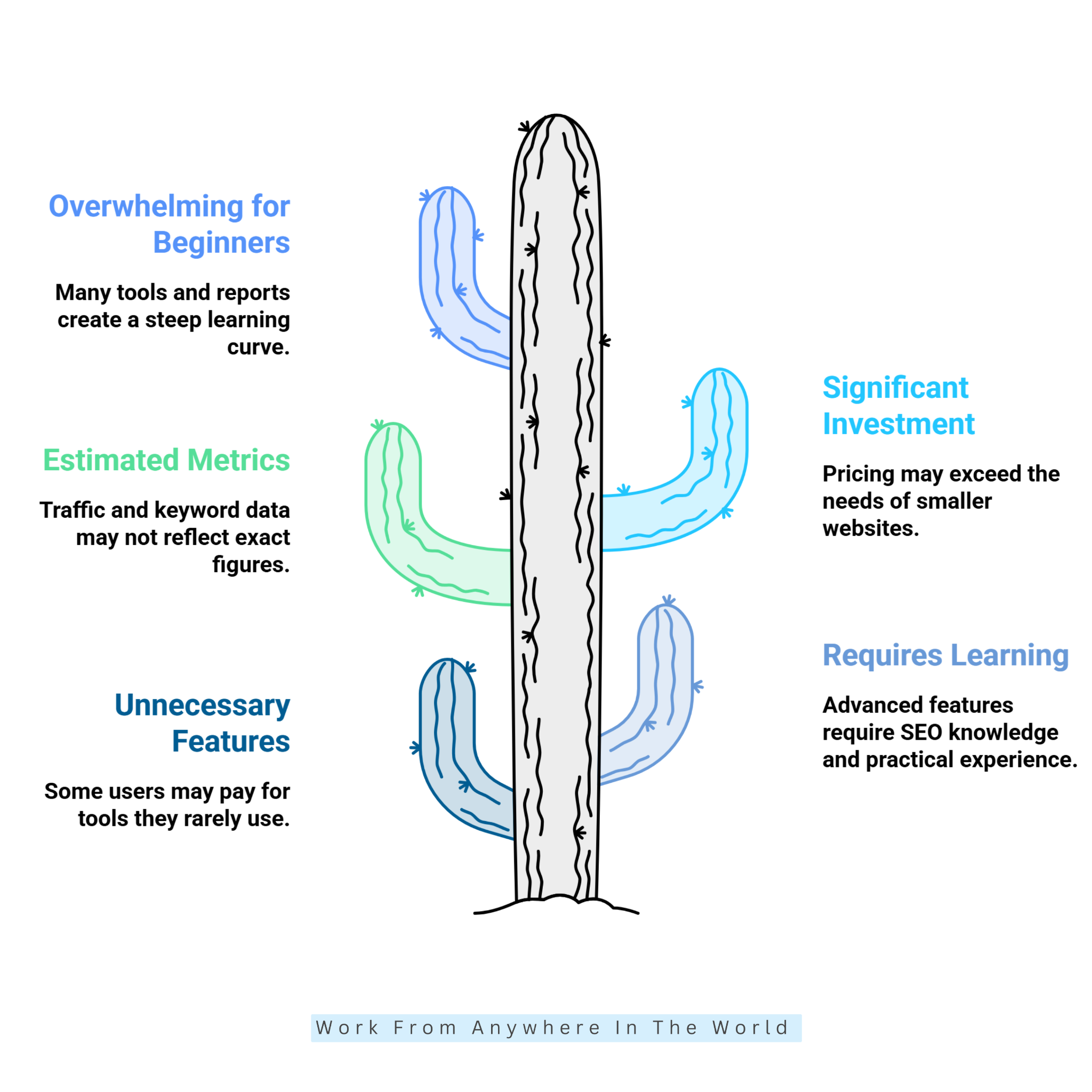
1. Can Feel Overwhelming For Beginners
Semrush offers an extensive collection of tools, reports, metrics, and filters. Beginners may initially find it difficult to navigate the platform and understand which features are most relevant to their SEO goals.
The amount of information available can also make interpreting reports challenging. Learning how to evaluate keyword data, competitor insights, and technical recommendations takes time and practice.
A practical approach is to explore a few essential tools before moving on to advanced features. Start with keyword research, Site Audit, competitor analysis, and Position Tracking to build your confidence.
As you become familiar with these tools, gradually explore additional capabilities. This approach makes the learning process more manageable while helping you develop useful SEO skills.
2. Can Be A Significant Investment
Semrush offers extensive SEO capabilities, but its subscription costs may be challenging for beginners and smaller businesses. The investment becomes more worthwhile when you regularly use several of its tools.
Large agencies managing multiple websites and campaigns may benefit from its comprehensive features. However, bloggers and small website owners might only need a few of the available tools.
Before subscribing, consider which features support your SEO goals and how frequently you’ll use them. Comparing your requirements with the available plans will help you determine whether Semrush offers sufficient value for your budget.
3. Many Metrics Are Estimates
Semrush provides valuable SEO insights, but many of its metrics are estimates rather than exact measurements. Search volume, competitor traffic, and certain competitive indicators rely on data modelling and third-party sources.
These estimates help identify trends, compare keyword opportunities, and evaluate competing websites. However, they should not be treated as precise figures representing actual website traffic or search activity.
For a more accurate understanding of your own website’s performance, combine Semrush insights with Google Search Console and Google Analytics. These tools provide first-party data that complements Semrush’s broader competitive research.
Using these resources together helps you make more informed SEO decisions. You’ll gain a clearer picture of your website’s actual performance alongside estimated market trends.
4. Advanced Features Require Learning
Semrush provides sophisticated SEO tools, but understanding their results requires knowledge and experience. Technical audits, backlink analysis, international SEO, and AI search visibility involve more than simply reading reports.
For example, identifying a technical issue doesn’t necessarily explain its importance or how urgently it needs attention. Similarly, competitor and backlink data require careful interpretation before making strategic decisions.
Beginners may initially spend considerable time understanding these insights before putting them into practice. Learning how different metrics relate to your website’s goals helps you make better use of the platform.
As your SEO knowledge develops, interpreting advanced reports becomes easier. This experience helps you turn complex information into practical improvements and get greater value from Semrush.
5. Some Features May Be More Than You Need
Semrush offers an extensive range of SEO and digital marketing tools, but not every website requires all these capabilities. Smaller blogs may primarily benefit from keyword research, basic website audits, and rank tracking.
Larger businesses and marketing agencies often have more complex requirements. They may benefit from advanced competitor analysis, backlink research, and tools for managing multiple campaigns.
Having access to numerous features doesn’t necessarily improve your SEO results. Unnecessary tools may complicate your workflow and distract you from more important tasks.
Before choosing a subscription, identify your website’s priorities and the tools you’ll use regularly. A focused approach helps you get practical value from Semrush without adding unnecessary complexity.
Frequently Asked Questions
Q1: Can Semrush Track Keyword Rankings?
Yes. Semrush’s Position Tracking tool monitors selected keywords and shows changes in rankings, search visibility, estimated traffic, and SERP features over time.
You can also track rankings for specific locations and devices. This helps you evaluate your SEO progress and identify pages that may need further optimization.
Q2: Does Semrush Support GEO?
Yes. Semrush offers AI search visibility features that help brands monitor their presence in generative AI answers. These tools provide insights into brand mentions, citations, and competitor visibility across supported platforms.
Generative Engine Optimization (GEO) complements traditional SEO by focusing on visibility in AI-generated responses. Available features depend on your Semrush subscription.
Q3: Is Semrush Suitable For Beginners?
Yes, although its extensive collection of tools may initially feel overwhelming. Beginners can start with keyword research, competitor analysis, and basic website audits before exploring advanced features.
Semrush also provides educational resources and tutorials to help users understand its tools. Learning one feature at a time makes the platform easier to navigate.
Q4: Can I Use Semrush For Free?
Semrush offers limited free access to certain tools and reports. However, usage restrictions apply, and many advanced features require a paid subscription.
Free access may be sufficient for exploring the platform and performing occasional research. Visit the official Semrush website for current plan details and feature availability.
Q5: How Often Should I Use Semrush?
The ideal frequency depends on your website’s size, publishing schedule, and SEO goals. Keyword rankings and important performance indicators may benefit from weekly reviews, while broader audits can be scheduled periodically.
Regular monitoring helps you identify meaningful changes without reacting to every ranking fluctuation. Focus on using the information to guide practical improvements.
Q6: Can Semrush Help Improve Existing Blog Posts?
Yes. Semrush helps identify keyword opportunities, content gaps, technical problems, and changes in search performance. These insights can guide updates to articles that already have search visibility.
Updating outdated information, strengthening internal links, and addressing search intent can make existing content more useful and competitive. However, better rankings are never guaranteed.
Conclusion
This Semrush tutorial demonstrates how a connected SEO workflow helps you make informed decisions about your website. By combining keyword research, competitor analysis, content optimization, and technical audits, you can develop a more organized SEO strategy.
Regular performance tracking helps you recognize improvements and identify areas requiring further attention. As your experience grows, backlink analysis and AI search visibility tools offer additional opportunities to strengthen your approach.
Remember that successful SEO isn’t about collecting data or chasing every keyword opportunity. It’s about using meaningful insights to create valuable content, improve the user experience, and build a website that serves its audience.
I trust you enjoyed this Semrush Tutorial: 12 Powerful Steps to Smarter SEO. Stay tuned for more helpful articles on affiliate marketing, online business, and working from anywhere in the world.
Take care!
— JeannetteZ 🌍✨
💬 Your Opinion Is Important To Me
Do you have thoughts, ideas, or questions? I’d love to hear from you. Please leave your comments below or email me directly at Jeannette@WorkFromAnywhereInTheWorld.com.
📚 More Work From Anywhere Reads
🚀 Ready to Build a Business You Can Run from Home
Or from Anywhere in the World?
Imagine creating income on your terms — from home, a cozy café, or wherever life takes you.
With the right tools, training, and community support, it’s entirely possible.
Start your own online business for free — no credit card needed.
Disclosure
This post may contain affiliate links. As an Amazon Associate and participant in other affiliate programs, I earn from qualifying purchases at no extra cost to you. Please read my full affiliate disclosure.