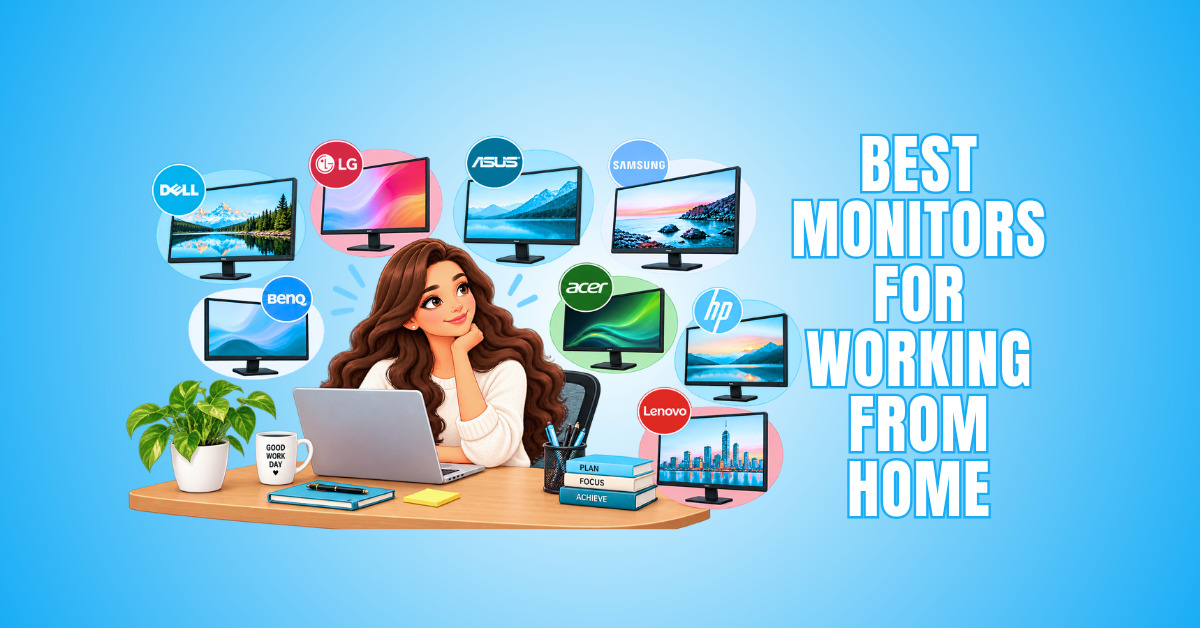
15 Best Monitors For Working From Home
The best monitors for working from home should make everyday tasks easier, whether you’re reading documents, managing spreadsheets, joining video meetings, researching online, or switching between several applications.
The right monitor can give you more room to work while making text, images, and other content easier to view. Screen size, resolution, and display quality can all influence how comfortably you work throughout the day.
Your profession also matters. A writer may have very different priorities from a designer, programmer, accountant, or someone who regularly works with several applications at once.
Desk space and connectivity deserve attention too. A larger screen isn’t always the better choice if it overwhelms your workspace or doesn’t connect conveniently with the computer and other equipment you already use.
This guide explains what to consider before choosing a monitor and compares 15 options from major international brands. The selection includes business, creative, ultrawide, compact, and premium displays for different home-office needs.
What To Consider When Choosing The Best Monitor For Working From Home
Choosing a monitor for your home office involves more than comparing screen sizes. The way you work, the applications you use, and the amount of available desk space can all influence which monitor will suit you best.
A larger display can provide more room for documents, spreadsheets, and multiple windows, while higher resolution can make text and detailed images appear sharper. However, bigger and higher resolution aren’t automatically better for every workspace.
Connectivity is equally important. The ports on your monitor need to work with your computer and other equipment, while features such as USB-C can help simplify some home office setups.
Your daily tasks should also guide your decision. Creative work may require accurate colour reproduction, while office work might place greater importance on readable text, comfortable positioning, and convenient connectivity.
Before comparing the best monitors for working from home, consider the following eight features. They can help you narrow down the options and identify what will genuinely improve your everyday workspace.
1. Screen Size And Workspace
Screen size affects both how much you can see at once and how comfortably the monitor fits into your workspace. Before choosing a size, consider your desk dimensions, viewing distance, and the type of work you do most often.
A 24-inch monitor can work well on a compact desk and still provide enough room for everyday tasks such as email, documents, and web browsing. It can also be a practical choice when you don’t need several windows open side by side.
A 27-inch display provides additional screen space and can suit many home-office tasks. The extra room can make it easier to work with spreadsheets, research, documents, or multiple applications without constantly switching between windows.
Larger 32-inch and ultrawide monitors provide even more digital workspace and can be particularly useful for multitasking. However, they require more physical desk space and enough viewing distance to use the entire screen comfortably.
Measure your available space before deciding that a larger display is automatically better. The right monitor size for working from home should give you useful screen space without overwhelming your desk or forcing you to sit too close.
Key Points
- Match the monitor size to your available desk space.
- Consider how much digital workspace your tasks require.
- A 24-inch display can suit compact workspaces.
- Larger screens provide more room for multitasking.
- Allow enough viewing distance for comfortable use.
2. Display Resolution And Clarity
Display resolution affects how much detail appears on the screen and how sharp text, images, and other content look. The best choice depends partly on the monitor size and the type of work you regularly perform.
Full HD can be sufficient for everyday tasks such as email, web browsing, and basic document work. It can also make sense on smaller monitors where extremely high resolution may provide less noticeable benefit.
A 1440p display provides additional detail and working space compared with Full HD. It can be a practical middle ground for people who regularly work with documents, spreadsheets, research, or several applications throughout the day.
A 4K monitor offers substantially higher resolution and can be particularly useful for photography, video editing, design work, and other tasks where fine visual detail matters. Sharper text can also benefit people who spend long periods reading or working with detailed documents.
Don’t choose resolution by numbers alone. Consider screen size and resolution together, along with your applications and viewing preferences, to find a display that provides the clarity and usable workspace you need.
Key Points
- Resolution affects text and image clarity.
- Full HD can suit basic everyday tasks.
- 1440p provides additional detail and workspace.
- 4K can benefit detailed and creative work.
- Consider screen size and resolution together.
3. Panel Type And Image Quality
The panel type influences several aspects of a monitor’s image quality, including viewing angles, contrast, colour reproduction, and overall visual consistency. Understanding the basic differences can help you choose a display that suits the work you do.
IPS panels are widely used for professional and home-office monitors because they generally provide wide viewing angles and consistent colours. They can work well for everyday office tasks as well as many types of creative work.
VA panels typically provide stronger contrast and deeper blacks than IPS displays. This can make them appealing for people who work with darker content or also use their monitor for entertainment after the working day.
OLED displays can provide excellent contrast, deep blacks, and strong image quality. However, their characteristics and potential for image retention mean they may not be necessary for someone primarily working with documents, email, and other static office applications.
Creative professionals should pay particular attention to monitor colour accuracy and colour-space coverage. For general office work, clear text, consistent image quality, and comfortable everyday viewing may be more important than advanced colour performance.
Key Points
- Panel type affects several aspects of image quality.
- IPS panels provide wide viewing angles and consistent colours.
- VA panels generally offer stronger contrast.
- OLED can provide excellent contrast and deep blacks.
- Creative work may require greater colour accuracy.
4. USB-C And Laptop Charging
USB-C connectivity can simplify a home-office workstation by allowing compatible devices to handle several functions through a single cable. Depending on the monitor and laptop, one connection may carry video, data, and power.
This can be particularly useful for laptop users who regularly connect and disconnect their computer from a desk setup. Fewer cables can make the workspace easier to manage and reduce the need for separate adapters or docking accessories.
However, not every USB-C port provides the same capabilities. Some support video and data but provide limited power, while others include USB Power Delivery that can charge a connected laptop.
Check the monitor’s USB-C Power Delivery rating and compare it with your laptop’s power requirements. A monitor that doesn’t provide enough power may charge the laptop slowly or require you to continue using its regular charger.
Also consider the other ports and USB connections available on the monitor. The right combination can allow the display to function as a convenient connection point for your laptop and everyday home office equipment.
Key Points
- USB-C can reduce the number of cables on your desk.
- Compatible connections may carry video, data, and power.
- USB-C capabilities vary between monitors.
- Check Power Delivery against your laptop’s requirements.
- Additional ports can simplify a laptop workstation.
5. Ergonomics And Adjustability
Monitor positioning can make a noticeable difference when you spend several hours working at your desk. A display that can be adjusted to suit your body and workspace is easier to position than one with a fixed stand.
Height adjustment allows you to raise or lower the screen, while tilt helps you change the viewing angle. Swivel can be useful when you need to turn the monitor without moving the entire stand.
Some monitors also include pivot adjustment, allowing the screen to rotate into portrait orientation. This can be useful for reading long documents, coding, writing, or working with content that benefits from additional vertical space.
VESA mounting compatibility provides another option if you prefer to use a monitor arm or wall mount. A monitor arm can also free up desk space and provide greater flexibility when positioning the display.
Consider how the monitor will work with your desk and office chair rather than evaluating it separately. Good adjustability can help you create a viewing position that suits your workspace and everyday working habits.
Key Points
- Look for height and tilt adjustment.
- Swivel makes it easier to reposition the screen.
- Pivot can provide a useful portrait orientation.
- VESA support allows monitor-arm mounting.
- Consider the monitor, desk, and chair together.
6. Connectivity And Ports
A monitor needs the right connections for the computer and other equipment you use every day. Before buying, check both your devices and the ports available on the monitor rather than assuming everything will connect easily.
HDMI is widely used for computers and other devices, while DisplayPort is common on many desktop systems and professional monitors. The connections you need will depend on your computer, graphics hardware, and overall workstation.
USB-C can provide a convenient laptop connection, as discussed above. However, it should be considered alongside the monitor’s other ports rather than being the only connection you check.
Additional USB ports can provide convenient connections for keyboards, mice, storage devices, webcams, and other peripherals. Some monitors also include Ethernet, audio connections, or multiple video inputs.
Think about your current equipment as well as anything you may add later. A useful selection of monitor ports and connections can make your workspace easier to manage and reduce your reliance on separate hubs and adapters.
Key Points
- Check your computer’s connections before choosing a monitor.
- HDMI and DisplayPort are common video connections.
- Consider USB-C alongside the other available ports.
- Extra USB ports can accommodate everyday peripherals.
- Multiple connections can reduce the need for adapters.
7. Refresh Rate And Responsiveness
Refresh rate describes how many times a monitor updates the image on the screen each second. It can influence how smooth scrolling, cursor movement, animations, and other on-screen motion appear.
A 60Hz monitor is generally sufficient for everyday office work such as documents, spreadsheets, email, web browsing, and video meetings. These tasks don’t usually require particularly high refresh rates.
Higher refresh rates can make scrolling through webpages and documents feel smoother. Moving windows and navigating applications may also appear more fluid, which some people appreciate during everyday computer use.
A higher refresh rate becomes more important if the monitor will also be used for gaming, video, or other fast-moving content. In those situations, smoother motion may be a more noticeable benefit.
Consider how you’ll actually use the display before making monitor refresh rate a priority. For many home-office users, resolution, screen size, connectivity, and adjustability will have a greater influence on everyday work.
Key Points
- Refresh rate affects how smoothly motion appears.
- 60Hz is generally sufficient for everyday office tasks.
- Higher refresh rates can make scrolling feel smoother.
- Gaming and fast-moving content benefit more from higher rates.
- Balance refresh rate with other important monitor features.
8. Colour Accuracy And Coverage
Colour accuracy becomes particularly important when your work involves photography, graphic design, video editing, branding, or other visual content. In these fields, inaccurate colours can affect how your finished work appears on other screens or in print.
Colour-space coverage indicates how much of a particular colour range a monitor can reproduce. Specifications such as sRGB, Adobe RGB, and DCI-P3 can therefore be useful when comparing displays for different types of creative work.
Factory calibration can provide more accurate colour performance when the monitor is first used. However, professionals who depend on precise colour may still choose to calibrate their displays regularly with dedicated calibration equipment.
Consistency matters as well. Colours and brightness should remain reasonably uniform across the screen, particularly when you’re editing photographs, creating graphics, or working with other detailed visual content.
For general office tasks, professional-level monitor colour accuracy may be less important. Clear text, suitable resolution, useful connectivity, and a display that works well with your everyday tasks may deserve greater priority.
Key Points
- Colour accuracy matters most for visual and creative work.
- Check relevant colour-space coverage.
- Factory calibration can improve out-of-box accuracy.
- Screen consistency is important for detailed visual work.
- General office users may not need professional colour specifications.

15 Best Monitors For Working From Home
Once you know which features matter most, you can start comparing monitors based on how well they fit your work and available space. The best choice will depend on what you do each day rather than specifications alone.
Someone working primarily with documents and spreadsheets may value sharp text and practical connectivity. Creative professionals may place greater importance on resolution, colour accuracy, and consistent image quality.
Your computer and desk setup matter as well. A monitor that works beautifully for a desktop computer may not provide the connections a laptop user needs, while an ultrawide display may simply be too large for a compact workspace.
Budget doesn’t necessarily determine how useful a monitor will be. A straightforward display with the right size, resolution, and connections may serve you better than a premium model filled with features you rarely use.
The following 15 best monitors for working from home cover a range of working styles and home-office needs. Each has different strengths, making it easier to compare the features that matter most to you.
1. Dell UltraSharp U2725QE — Best Overall
The Dell UltraSharp U2725QE is a premium 27-inch 4K monitor for professionals who need sharp text, detailed visuals, and advanced connectivity. Its IPS Black panel provides strong contrast, while the 120Hz refresh rate makes scrolling and moving between applications smoother.
Thunderbolt 4, USB ports, networking, and laptop charging allow the monitor to function as a central workstation hub. This can simplify a laptop-based setup and reduce the number of separate cables and accessories on your desk.
The adjustable stand supports height, tilt, swivel, and pivot positioning for comfortable long-term use. It suits professionals working with spreadsheets, documents, coding, research, presentations, and creative applications who want one versatile, high-quality display.
Key Points
- 27-inch 4K display with an IPS Black panel.
- 120Hz refresh rate for smoother everyday use.
- Thunderbolt 4, USB, networking, and laptop charging.
- Height, tilt, swivel, and pivot adjustments.
- Suitable for a wide range of professional tasks.
2. LG 34WQ75C-B — Best For Multitasking
The LG 34WQ75C-B is a 34-inch curved UltraWide monitor for professionals who regularly work with several applications at once. Its 3440 × 1440 resolution and 21:9 aspect ratio provide generous horizontal workspace for documents, spreadsheets, browsers, email, and communication apps.
USB-C supports up to 90W Power Delivery, while the built-in KVM switch, Ethernet port, USB hub, and speakers add useful workstation functionality. These features can help simplify a home-office setup, particularly when working with multiple devices.
The IPS panel provides wide viewing angles and consistent everyday image quality. It is particularly useful for developers, writers, researchers, project managers, and analysts who want the workspace of two monitors without a central bezel.
Key Points
- 34-inch curved UltraWide display.
- 3440 × 1440 resolution and 21:9 aspect ratio.
- USB-C with up to 90W Power Delivery.
- Built-in KVM, Ethernet, USB hub, and speakers.
- Excellent for multitasking across several applications.
3. EIZO FlexScan EV Series — Best For Long Workdays
The EIZO FlexScan EV Series focuses on professional usability, ergonomics, and long-term workplace comfort. The range includes different screen sizes, resolutions, connectivity options, and ergonomic designs to suit different home-office setups.
Depending on the model, features can include extensive ergonomic adjustment, USB connectivity, and technologies designed to support comfortable viewing. This makes the series particularly suitable for office professionals, analysts, programmers, researchers, and technical users who spend long hours working with text and detailed information.
Because FlexScan is a product family rather than a single monitor, specifications vary by model and generation. Check the current models available in your region to find the combination of features that best suits your workspace.
Key Points
- Professional monitor series with multiple configurations.
- Different screen sizes and resolutions available.
- Strong emphasis on ergonomics and comfortable viewing.
- Suitable for long periods of detailed screen-based work.
- Specifications vary by individual model.
4. GIGABYTE M27U — Best For Work And Gaming
The GIGABYTE M27U is a versatile 27-inch 4K monitor for professionals who also use their workspace for gaming or entertainment. Its 4K resolution keeps text, spreadsheets, websites, graphics, and detailed applications sharp.
Its high refresh rate provides smoother scrolling and motion than a conventional 60Hz office display. USB connectivity and KVM support are also useful for people who switch between a work computer and another system.
Developers, designers, freelancers, students, and other home-office users may appreciate this flexibility. Its gaming features may be unnecessary for basic office work, but they add value for anyone who wants one monitor for productivity, entertainment, and gaming.
Key Points
- 27-inch 4K display.
- High refresh rate for smoother scrolling and motion.
- USB connectivity and KVM support.
- Useful when switching between two systems.
- Suitable for both professional work and gaming.
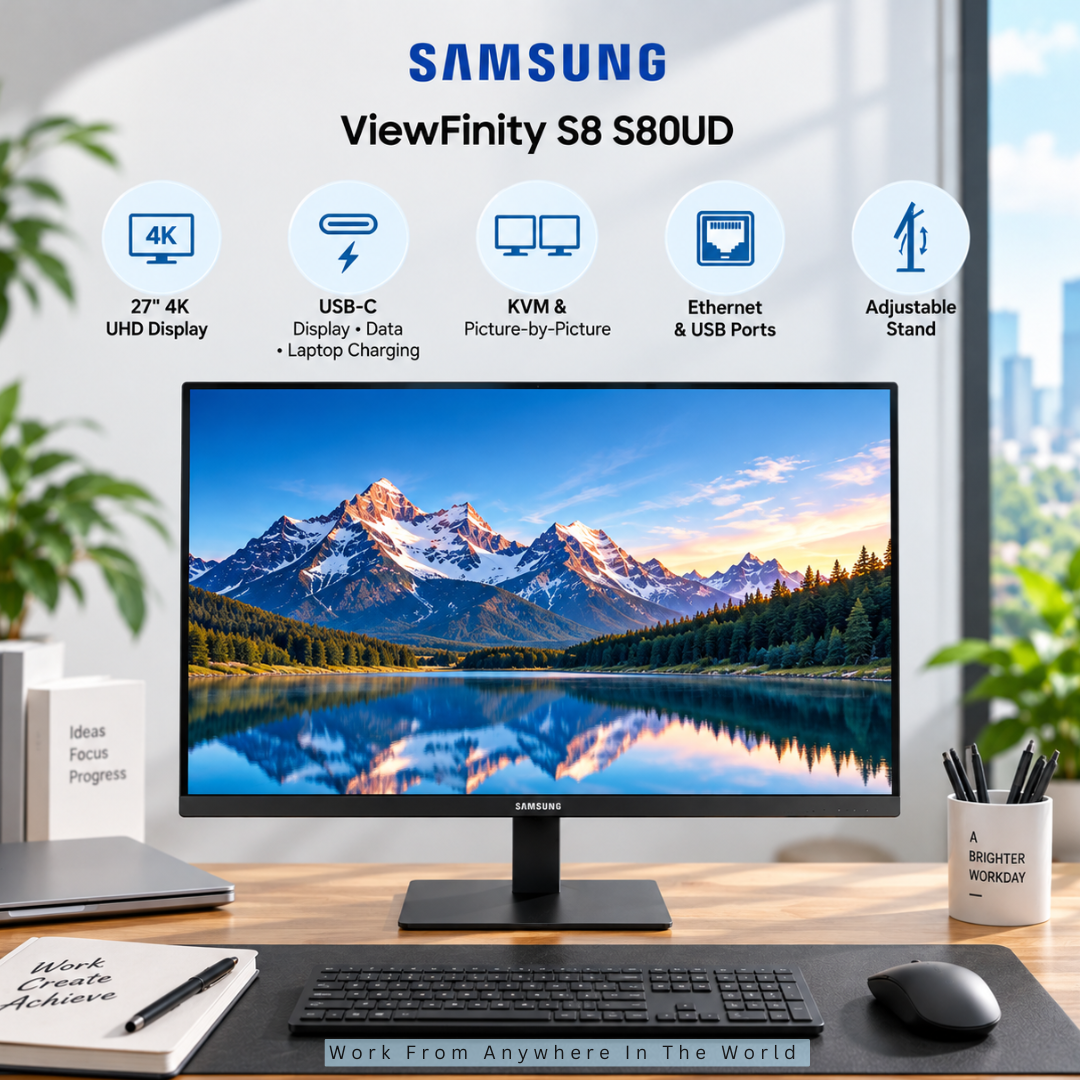
5. Samsung ViewFinity S8 S80UD — Best For Laptop Workstations
The Samsung ViewFinity S8 S80UD combines a 27-inch 4K display with connectivity designed for professional workstations. Its high resolution keeps text and detailed interfaces sharp for spreadsheets, documents, presentations, research, and creative applications.
USB-C supports display, data, and laptop charging through a single connection. KVM, picture-by-picture, Ethernet, USB ports, and an adjustable stand provide additional flexibility for professionals who switch between computers or connect several devices.
The monitor suits remote employees, consultants, developers, analysts, writers, and business professionals who want more than a basic display.
Its combination of 4K clarity, device management, networking, and ergonomic adjustment makes it particularly useful for a laptop-centred workstation.
Key Points
- 27-inch 4K display.
- USB-C for display, data, and laptop charging.
- KVM and picture-by-picture functionality.
- Ethernet and additional USB connections.
- Adjustable stand for flexible positioning.
6. ASUS ProArt Display PA279CRV — Best For Creative Work
The ASUS ProArt Display PA279CRV is a 27-inch 4K monitor designed for professionals who combine everyday productivity with creative work.
Its IPS panel offers 99% Adobe RGB and 99% DCI-P3 coverage, along with Calman verification and factory calibration for colour-sensitive projects.
USB-C supports video, data, and up to 96W Power Delivery, while DisplayPort, HDMI, USB ports, and daisy-chaining provide additional flexibility. Its ergonomic stand also supports height, tilt, swivel, and pivot adjustments.
The detailed 4K display works well for documents, spreadsheets, presentations, and research as well as photography, design, and video editing. It is a strong choice for professionals who need accurate colour and high resolution for both creative and everyday work.
Key Points
- 27-inch 4K IPS display.
- 99% Adobe RGB and 99% DCI-P3 coverage.
- Factory calibrated and Calman verified.
- USB-C with up to 96W Power Delivery.
- Height, tilt, swivel, and pivot adjustments.
7. BenQ PD2706U — Best For Creative Professionals
The BenQ PD2706U is a 27-inch 4K professional monitor designed for detailed creative work. Its high resolution provides sharp text, graphics, photographs, and video, making it useful for graphic designers, photographers, video editors, marketers, architects, and content creators.
Its colour-focused design supports visual work, while its connectivity options accommodate both laptop and desktop workflows. The 27-inch screen also provides generous workspace without requiring the desk space of a larger professional display.
The PD2706U handles everyday tasks such as documents, spreadsheets, web browsing, and video meetings as well. For professionals who regularly move between creative software and standard productivity applications, it offers a practical single-monitor solution.
Key Points
- 27-inch 4K professional display.
- Designed for colour-sensitive creative work.
- Suitable for laptop and desktop workflows.
- Practical size for many home-office desks.
- Handles both creative and everyday applications.
Wealthy Affiliate – Mini Review
If you’ve ever thought about turning your blog, passion, or niche into an online business,
Wealthy Affiliate (WA) is one of the most beginner-friendly platforms I’ve used.
It combines step-by-step training, website hosting, AI-powered tools,
keyword research, and an active community all in one place.
What I like most is that you can start for free (no credit card needed), explore the platform,
test the tools, and connect with other entrepreneurs before upgrading.
WA isn’t a “get rich quick” scheme — success comes from consistent effort
and applying what you learn over time.
8. HP Series 7 Pro 727pm — Best For Business Professionals
The HP Series 7 Pro 727pm is a business-focused 27-inch 4K monitor designed for professionals who want sharp visuals and modern connectivity.
Its high resolution provides clear text and detailed images for documents, spreadsheets, presentations, web applications, and business software.
USB-C connectivity and laptop charging can help reduce cable clutter, while the ergonomic stand provides flexibility for comfortable positioning throughout the working day. These features make it particularly suitable for a streamlined laptop-based workstation.
The 727pm suits remote employees, consultants, financial professionals, educators, administrators, and managers who primarily use productivity applications. It focuses on practical business features rather than specialized gaming capabilities.
Key Points
- 27-inch 4K business monitor.
- Sharp display for documents and detailed applications.
- USB-C connectivity and laptop charging.
- Ergonomic stand for flexible positioning.
- Designed primarily for professional productivity.
9. ViewSonic VG2756-4K — Best For Office Connectivity
The ViewSonic VG2756-4K is a 27-inch 4K IPS business monitor designed for professionals who want sharp visuals and convenient connectivity. Its high resolution provides detailed text and images for documents, spreadsheets, presentations, research, and office applications.
USB-C supports data, video, and up to 90W laptop charging, while built-in Ethernet and a USB hub help simplify a laptop-based workstation. HDMI and DisplayPort provide additional connection options for other computers and devices.
The ergonomic stand supports height, tilt, swivel, and pivot adjustments. This combination of 4K resolution, docking features, and adjustability makes the VG2756-4K a practical primary display for a professional home office.
Key Points
- 27-inch 4K IPS display.
- USB-C with up to 90W laptop charging.
- Built-in Ethernet and USB hub.
- HDMI and DisplayPort connectivity.
- Height, tilt, swivel, and pivot adjustments.
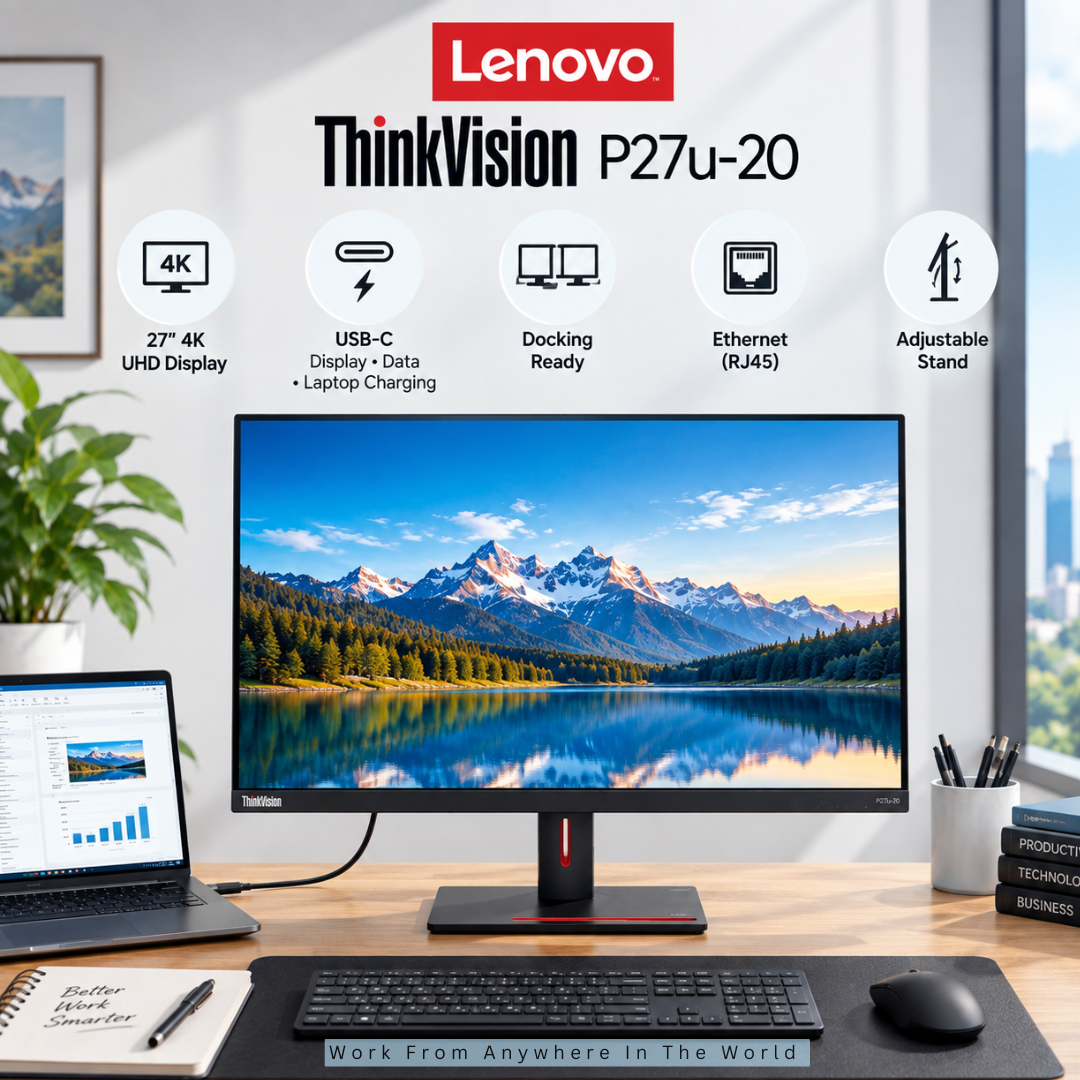
10. Lenovo ThinkVision P27u-20 — Best For Business And Creative Work
The Lenovo ThinkVision P27u-20 is a 27-inch 4K IPS monitor designed for professionals who need detailed visuals and strong workstation connectivity.
Its high resolution provides sharp text and images for documents, spreadsheets, coding, research, and creative applications.
Thunderbolt 4, Ethernet, a USB hub, KVM functionality, and laptop Power Delivery allow it to serve as a central connection point for a home-office workstation.
It also offers factory-calibrated colour accuracy and wide Adobe RGB and DCI-P3 coverage, making it useful for creative work as well as everyday productivity.
The 27-inch screen provides generous workspace without overwhelming most desks. Its adjustable stand supports height, tilt, swivel, and pivot positioning, making it a versatile option for professionals who spend long hours at their computers.
Key Points
- 27-inch 4K IPS display.
- Factory-calibrated wide colour coverage.
- Thunderbolt 4 and laptop Power Delivery.
- Ethernet, USB hub, and KVM functionality.
- Height, tilt, swivel, and pivot adjustments.
11. Philips 27B1U7903 — Best For Image Quality And Connectivity
The Philips 27B1U7903 is a professional 27-inch 4K monitor that combines detailed image quality with extensive connectivity. Mini LED backlighting and wide colour coverage make it particularly useful for photography, design, content creation, and other visually detailed work.
Thunderbolt 4 can carry video, data, Ethernet, and laptop power through a compatible connection. Daisy-chaining and additional ports also help create a flexible workstation without relying heavily on separate docking equipment.
For everyday work, the 4K display keeps documents, spreadsheets, research, and detailed applications clear and easy to view. An adjustable stand adds flexibility for professionals who spend long periods working at their desks.
Key Points
- 27-inch 4K professional display.
- Mini LED backlighting and wide colour coverage.
- Thunderbolt 4 with laptop Power Delivery.
- Ethernet and daisy-chaining support.
- Adjustable stand for flexible positioning.
12. AOC Q27P2Q — Best For Everyday Productivity
The AOC Q27P2Q is a practical 27-inch QHD monitor for everyday professional work. Its 2560 × 1440 resolution provides useful workspace for documents, spreadsheets, presentations, and research.
The IPS panel provides wide viewing angles and consistent image quality. Its adjustable stand supports height, tilt, swivel, and pivot positioning for a comfortable setup.
USB, HDMI, and DisplayPort connections provide flexibility for common office equipment. The three-sided frameless design also works well when using two monitors side by side.
The Q27P2Q suits remote employees, freelancers, writers, researchers, students, and administrative professionals. It focuses on practical productivity rather than premium creative or gaming features.
Key Points
- 27-inch QHD IPS display.
- 2560 × 1440 resolution.
- Fully adjustable stand.
- USB, HDMI, and DisplayPort connections.
- Suitable for multi-monitor setups.
13. Apple Studio Display — Best For Mac Users
The Apple Studio Display is a premium 27-inch 5K monitor designed primarily for Mac users. Its 5120 × 2880 Retina display provides exceptionally sharp text and detailed visuals for writing, coding, photography, design, and other professional work.
A built-in 12MP Center Stage camera with Desk View supports video meetings. The three-microphone array and six-speaker system also reduce the need for separate conferencing equipment.
Thunderbolt 5 provides laptop charging and connectivity for compatible Mac setups. Two USB-C ports accommodate peripherals, while additional displays can be daisy-chained through the second Thunderbolt 5 port.
The Studio Display is particularly appealing to professionals already working within the Mac ecosystem. People who need broader multi-platform flexibility may find another monitor a better fit.
Key Points
- 27-inch 5K Retina display.
- Designed to pair particularly well with Mac.
- Built-in 12MP Center Stage camera.
- Three microphones and six-speaker audio system.
- Thunderbolt 5 and USB-C connectivity.
14. MSI Modern MD272UPH — Best For Versatile Productivity
The MSI Modern MD272UPH is a 27-inch 4K IPS monitor designed for both professional and creative work. The detailed display works well for documents, spreadsheets, research, design applications, and other everyday tasks.
USB-C supports video, data, and up to 98W Power Delivery on current models. HDMI, DisplayPort, multiple USB ports, and built-in speakers provide additional flexibility for a home-office workstation.
Wide colour coverage and DisplayHDR 400 also make it useful for creative applications. The adjustable stand supports height, tilt, swivel, and pivot positioning for different working preferences.
For freelancers, designers, programmers, content creators, and remote professionals, it provides a useful balance of productivity and creative features without moving into MSI’s gaming-focused range.
Key Points
- 27-inch 4K IPS display.
- USB-C with up to 98W Power Delivery.
- HDMI, DisplayPort, and multiple USB connections.
- Wide colour coverage and DisplayHDR 400.
- Height, tilt, swivel, and pivot adjustments.
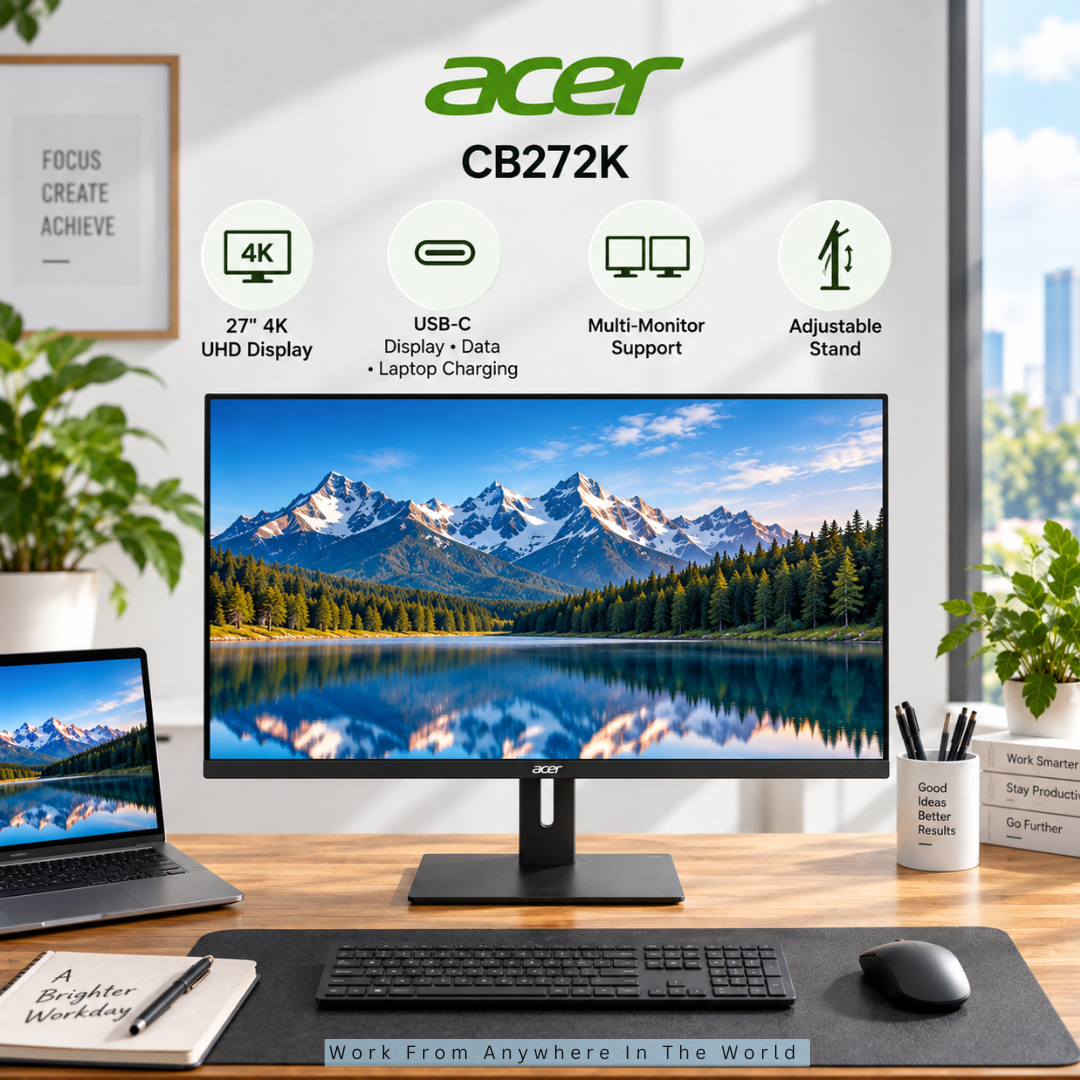
15. Acer CB272K — Best For Everyday 4K Productivity
The Acer CB272K is a 27-inch 4K IPS monitor for professionals who want a clear, spacious display without specialized features. It provides plenty of room for documents, spreadsheets, research, presentations, and everyday business applications.
USB-C connectivity with Power Delivery can simplify a laptop-based workstation. HDMI and DisplayPort provide additional options, while the adjustable stand helps you find a comfortable viewing position.
The CB272K also works well as part of a dual-monitor setup. It suits remote employees, freelancers, writers, students, and researchers who prioritize a practical 4K workspace and everyday flexibility.
Key Points
- 27-inch 4K IPS display.
- USB-C connectivity with Power Delivery.
- HDMI and DisplayPort connections.
- Adjustable stand for comfortable positioning.
- Suitable for single- or dual-monitor setups.
Frequently Asked Questions
Q1: Is A 4K Monitor Worth It For Working From Home?
Yes, a 4K monitor can be worthwhile if you regularly work with detailed documents, large spreadsheets, photographs, design software, or other visually demanding applications.
However, 1440p can provide excellent clarity for everyday office work. Your screen size, computer, and daily tasks should all influence the decision.
Q2: Do I Need A USB-C Monitor For Working From Home?
Not necessarily. USB-C is particularly convenient for laptop users because a compatible connection can carry video, data, and power through a single cable.
Check the monitor’s Power Delivery capability against your laptop’s requirements. Not every USB-C monitor provides the same charging power.
Q3: Is 1440p Or 4K Better For A Work Monitor?
Both can work well. A 1440p monitor provides a good balance of clarity and usable workspace for documents, spreadsheets, research, and other everyday tasks.
A 4K display provides greater detail and can be particularly useful for photography, design, video editing, and other work where visual precision matters.
Q4: What Refresh Rate Is Best For A Home-Office Monitor?
A 60Hz refresh rate is sufficient for most everyday office tasks. Documents, email, spreadsheets, web browsing, and video meetings generally don’t require a particularly high refresh rate.
Higher refresh rates can make scrolling and on-screen movement appear smoother. They can also be useful if you use the same monitor for gaming or entertainment.
Q5: Is An Ultrawide Monitor Good For Working From Home?
Yes, particularly if you regularly work with several applications at once. The additional horizontal space lets you position documents, browsers, spreadsheets, and communication tools side by side.
An ultrawide monitor can also provide an alternative to two separate displays. Just make sure your desk has enough space for the larger screen.
Q6: What Size Monitor Is Best For A Home Office?
There isn’t one ideal size for every home office. A 24-inch monitor can suit a compact workspace, while a 27-inch display provides additional room without taking over most desks.
Larger and ultrawide monitors provide more space for multitasking but require more physical room. Consider your desk size, viewing distance, and daily tasks before deciding.
Conclusion
Choosing the right monitor can make working from home more comfortable and organized. The best monitors for working from home are those that match your daily tasks, available desk space, computer, and preferred setup.
A 27-inch display can suit many professionals, while an ultrawide monitor provides additional room for multitasking. Creative professionals may place greater importance on colour accuracy and detailed image quality.
Connectivity and ergonomics matter just as much as screen size and resolution. Consider how the monitor connects to your equipment and whether you can position it comfortably for everyday use.
Focus on the features that genuinely support the way you work. The largest, most expensive, or most feature-packed monitor isn’t necessarily the best choice for your home office.
I trust you enjoyed this article on the 15 Best Monitors For Working From Home. Please stay tuned for more insightful blogs on affiliate marketing, online business, and working from anywhere in the world.
Take care!
— JeannetteZ 🌍✨
💬 Your Opinion Is Important To Me
Do you have thoughts, ideas, or questions? I’d love to hear from you. Please leave your comments below or email me directly at Jeannette@WorkFromAnywhereInTheWorld.com.
📚 More Work From Anywhere Reads
🚀 Ready to Build a Business You Can Run from Home
Or from Anywhere in the World?
Imagine creating income on your terms — from home, a cozy café, or wherever life takes you.
With the right tools, training, and community support, it’s entirely possible.
Start your own online business for free — no credit card needed.
Disclosure
This post may contain affiliate links. As an Amazon Associate and participant in other affiliate programs, I earn from qualifying purchases at no extra cost to you. Please read my full affiliate disclosure.