
How To Find A Business Idea: 10 Essential Steps
How to find a business idea is a common question for people who want to start a business but are unsure where to begin. A promising idea can develop from everyday problems, existing skills, personal interests, or opportunities you notice around you.
Some business ideas begin with something you already know well. Others emerge from customer needs, gaps in existing markets, changing trends, or conversations that reveal problems people would like solved.
Research can help you narrow those possibilities. Understanding potential customers, competitors, and market demand gives you useful information for deciding whether an idea deserves further attention.
Online tools can also help you explore trends, search behaviour, common questions, and emerging interests. These resources can provide additional insight as you compare different possibilities.
This guide explains how to find a business idea step by step, provides ideas for inspiration, and introduces useful tools that can help with your research.
How To Find A Business Idea: 10 Practical Steps
Finding the right business idea often starts with looking at what you already know and what people around you need. Everyday problems, existing skills, and personal interests can all provide useful starting points.
A promising idea should also have a potential audience. Research can help you understand whether people are looking for a particular solution and what alternatives are already available.
You do not need to develop the entire business before deciding whether an idea is worth pursuing. Exploring several possibilities first can help you compare their strengths, challenges, and requirements.
The following 10 practical steps can help you generate, research, and evaluate business ideas before deciding which opportunity deserves further attention.
1. Identify Problems Worth Solving
Many business ideas begin with a problem that people regularly experience. Pay attention to frustrations, inconveniences, or tasks that seem unnecessarily difficult in your own life and the lives of people around you.
Consider whether an existing product or service already solves the problem effectively. Customer complaints and reviews can reveal situations where current solutions fall short or leave particular needs unmet.
A problem does not need to affect everyone to create a business opportunity. A smaller group of customers with a specific need may provide a more focused starting point than trying to appeal to a very broad audience.
Key Points
- Notice recurring problems and frustrations.
- Look for needs that are not being fully met.
- Consider who experiences the problem.
- Focus on problems you can realistically address.
2. Consider Your Skills And Experience
Your online business skills can provide useful clues when searching for a business idea.. Professional experience, hobbies, practical abilities, and knowledge developed over the years may all have business potential.
Think beyond formal qualifications. Skills such as writing, gardening, cooking, organizing, repairing, designing, teaching, or working with technology could lead to products or services people are willing to purchase.
You do not need to know everything before starting. Identifying what you already do well can provide a practical foundation for exploring opportunities.
Key Points
- List your professional and practical skills.
- Consider knowledge gained through hobbies and experience.
- Identify skills that could solve customer problems.
- Recognize areas where additional learning may be needed.
3. Explore Your Interests
Personal interests can be another source of business ideas. Familiarity with a subject may help you understand the products, services, challenges, and communities surrounding it.
Interest alone, however, does not guarantee that an idea will work as a business. Consider whether potential customers have a genuine need and whether you would enjoy the responsibilities involved in serving that market.
Look for areas where your interests overlap with useful skills or identifiable customer problems. These intersections can provide promising ideas to investigate further.
Key Points
- Identify subjects you genuinely enjoy.
- Consider problems within those areas.
- Look for connections between interests and skills.
- Evaluate customer demand separately from personal enthusiasm.
4. Research Your Target Market
Once you have a potential idea, learn more about the people who might buy the product or service. Understanding your target market can help you determine whether the opportunity matches a genuine customer need.
Research factors such as customer priorities, purchasing habits, common challenges, and existing alternatives. Surveys, online communities, industry information, reviews, and conversations with potential customers can all provide useful insight.
Avoid assuming that other people will want something simply because you do. Gathering information from potential customers can help you view the idea from their perspective.
Key Points
- Identify who might buy your product or service.
- Learn about their needs and priorities.
- Research existing purchasing behaviour.
- Use customer insights to refine your idea.
5. Look For Gaps In Existing Markets
A new business does not always need an entirely original concept. Opportunities can exist when current businesses serve customers well in some areas but overlook particular needs in others.
Read customer reviews and discussions to discover recurring complaints or requests. You might notice demand for greater convenience, different product options, better customer service, or solutions designed for a specific audience.
A market gap should still be researched carefully. Sometimes a product or service is unavailable because demand is limited rather than because nobody has recognized the opportunity.
Key Points
- Look for underserved customer needs.
- Pay attention to recurring complaints.
- Consider ways existing solutions could be improved.
- Confirm that a genuine market exists.
6. Study Your Competitors
Competitive analysis can help you understand what customers already have available. Examine businesses offering similar products or services and consider how they attract and serve their customers.
Look at their products, customer reviews, marketing, websites, pricing approaches, and overall positioning. This research may reveal strengths you can learn from as well as gaps that could provide opportunities.
The goal is not to copy another company. Use competitor research to understand the market and determine how your business idea could provide something useful or distinctive.
Key Points
- Identify direct and indirect competitors.
- Study what they offer customers.
- Read reviews for useful customer insights.
- Look for meaningful ways to differentiate your idea.
7. Consider Your Available Resources
A business idea should be realistic for your current circumstances. Consider the money, equipment, workspace, skills, technology, and time required to develop and operate it.
Some ideas can begin with relatively few resources, while others require substantial equipment, inventory, licences, or facilities. Understanding these requirements early can help you avoid choosing an idea that is difficult to pursue.
You may also be able to start with a smaller version of an idea. Limiting your initial products or services can reduce complexity while you learn how the business works.
Key Points
- Estimate the resources your idea requires.
- Consider your available time and workspace.
- Identify equipment or skills you may need.
- Explore whether you can begin on a smaller scale.
8. Explore Current And Emerging Trends
Trends can reveal changes in customer interests, technology, lifestyles, and industries. Following relevant digital marketing trends may also help you recognize new problems or needs that could lead to business opportunities.
Use trends as a source of information rather than automatically building a business around whatever is currently popular. Some trends disappear quickly, while others reflect broader changes that may continue for years.
Consider how a trend relates to an existing customer need. An opportunity based on genuine usefulness may have more potential than one that depends entirely on short-term attention.
Key Points
- Follow developments relevant to your interests.
- Distinguish broader changes from short-lived trends.
- Consider the customer need behind a trend.
- Avoid choosing an idea solely because it is popular.
9. Validate Your Business Idea
Before investing heavily in an idea, gather evidence that potential customers are interested. Validation can help you identify weaknesses and refine the concept while changes are still relatively easy to make.
Talk with potential customers, conduct surveys, create a simple landing page, or present an early version of your product or service. Focus on what people do as well as what they say, since genuine interest is more informative than polite encouragement.
Feedback may show that the original idea needs adjusting. Changing the target audience, features, format, or offer can sometimes turn an uncertain concept into a more practical opportunity.
Key Points
- Ask potential customers for feedback.
- Test interest before making a large investment.
- Pay attention to genuine customer behaviour.
- Refine the idea based on what you learn.
10. Test Your Idea On A Small Scale
A small test allows you to experience how the business idea works without immediately building a full operation. You might offer one service, produce a limited number of products, or work with a small group of initial customers.
Use the test to learn about demand, pricing, customer questions, expenses, and the amount of time involved. You may discover practical issues that were difficult to anticipate during the planning stage.
The results can help you decide whether to continue, modify the idea, or explore another opportunity. An unsuccessful test can still provide valuable information before you commit additional resources.
Testing on a small scale can also help you develop important entrepreneur skills as you evaluate feedback, make decisions, and adjust your approach.
Key Points
- Begin with a manageable version of the idea.
- Observe how potential customers respond.
- Track costs, time, and practical challenges.
- Use the results to decide what to do next.
15 Business Ideas To Inspire You
Once you understand how to generate and evaluate business ideas, exploring different possibilities can help you see how those principles apply in practice.
Business opportunities can come from many areas, including online services, creative work, education, technology, and specialized skills. Each option has different requirements and potential customers.
You do not need to choose an idea simply because it appears popular. Consider how well each opportunity matches your skills, interests, available resources, and the type of business you want to build.
Some ideas can be started on a small scale, while others may require additional training, equipment, or investment. Researching these requirements can help you compare your options more realistically.
The following 15 business ideas provide inspiration as you explore different possibilities and consider which opportunities may be worth investigating further.
1. Start A Digital Marketing Agency
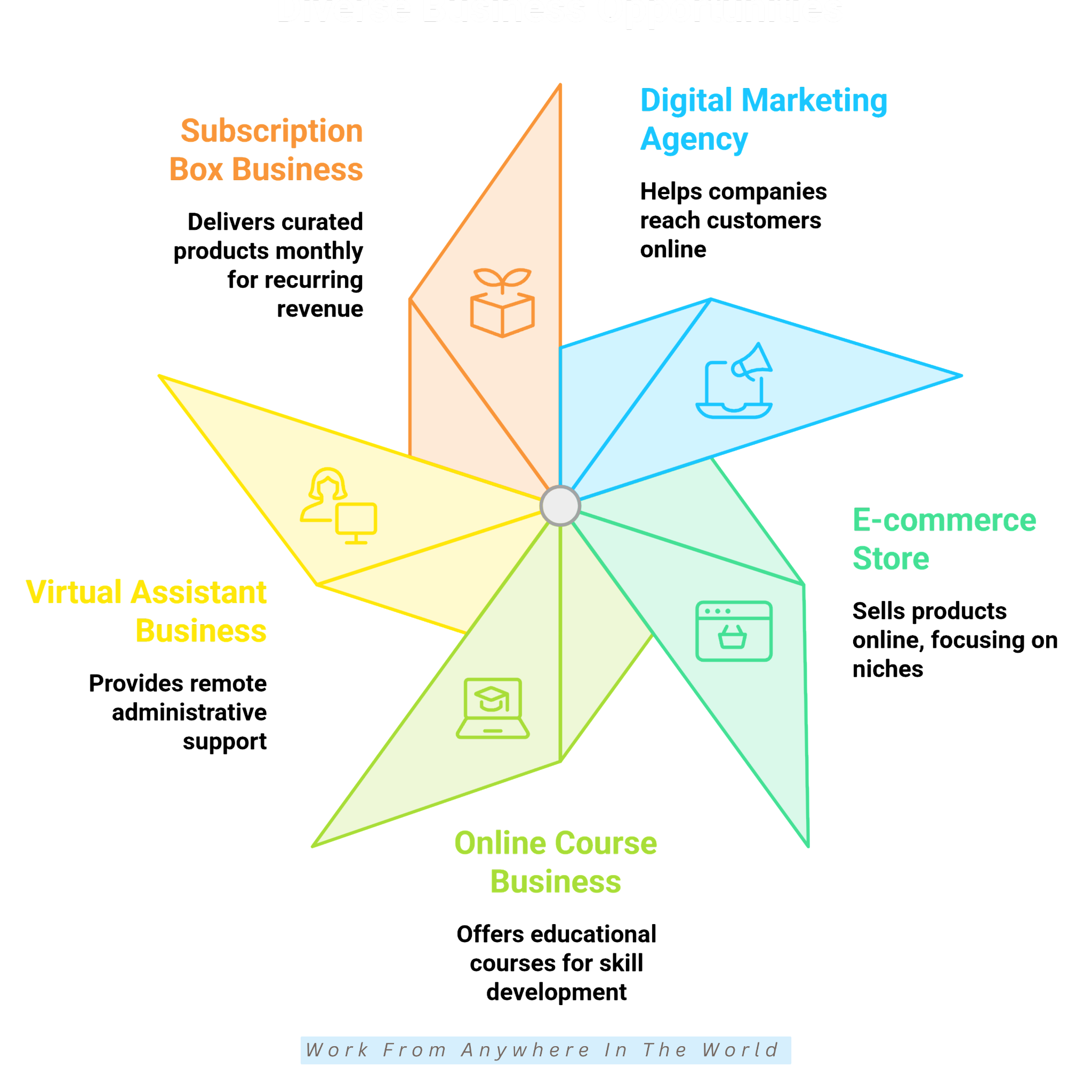
A digital marketing agency helps businesses reach and communicate with customers online. Services may include SEO, content marketing, social media management, email marketing, and paid advertising.
You can begin by specializing in one or two services that match your existing skills. Focusing on a particular industry or client type can also make it easier to develop relevant experience.
For example, a local restaurant might need help improving its search visibility, managing social media, or promoting special events. An online business may need content creation or email marketing support instead.
Starting independently can keep the initial business relatively manageable. As the client base develops, you can decide whether to expand your services or work with freelancers and other specialists.
Key Points
- Choose services that match your skills.
- Consider focusing on a specific type of client.
- Build a portfolio that demonstrates your work.
- Expand your services as the business develops.
2. Launch An eCommerce Store
An eCommerce store allows you to sell products directly to customers online. Exploring different eCommerce business ideas can help you identify a niche, define your audience, and select your products.
Potential niches include eco-friendly products, pet accessories, fitness products, handmade goods, or specialized home accessories. Researching customer demand can help you determine whether there is sufficient interest before choosing what to sell.
For example, an online store specializing in sustainable kitchen products could appeal to shoppers looking for practical alternatives to conventional household items. A clearly defined niche can also make marketing and branding more focused.
Platforms such as Shopify and WooCommerce can simplify many aspects of creating and managing an online store. You can then concentrate on areas such as product selection, customer service, branding, and marketing.
Key Points
- Choose a clearly defined product niche.
- Research customer demand before selecting products.
- Understand the audience you want to serve.
- Choose an eCommerce platform that suits your needs.
3. Create An Online Course Business
An online course can turn specialized knowledge or practical experience into a digital product. Topics may include graphic design, programming, cooking, photography, language learning, or other skills people want to develop.
Start with a subject you understand well and identify the specific audience you want to teach. A focused course that addresses a particular need can be easier for potential students to understand and evaluate.
For example, a photographer could create a course that teaches beginners how to take better photographs with their smartphones. Lessons might include lighting, composition, camera settings, and basic editing techniques.
Courses can be promoted through a website, blog, email marketing, social media, or YouTube. As you learn what students need, you can update existing material or develop additional courses on related topics.
Key Points
- Choose a subject you know well.
- Define the audience and learning objective.
- Organize lessons into a clear progression.
- Use relevant channels to reach potential students.
4. Start A Virtual Assistant Business
A virtual assistant business provides remote administrative or specialized support to businesses and entrepreneurs. Services can be tailored to your existing skills and the types of clients you want to serve.
Common tasks include email management, appointment scheduling, customer support, bookkeeping, travel planning, and social media assistance. You can begin with a small selection of services and expand as you gain experience.
For example, a real estate professional might hire a virtual assistant to manage appointments and respond to routine inquiries. This support can free up time for responsibilities that require the client's direct attention.
A computer, reliable internet connection, and suitable software may be enough to begin offering many virtual assistant services. As your business develops, you may eventually manage a virtual team or specialize in a particular industry.
Key Points
- Choose services that match your skills.
- Define the clients you want to support.
- Establish clear responsibilities and expectations.
- Consider specializing as you gain experience.
5. Develop A Subscription Box Business
A subscription box business provides customers with a recurring selection of products centred around a particular interest or need. Categories can include skincare, snacks, coffee, books, pet supplies, gardening products, and many others.
Choosing a clearly defined niche can make the subscription more distinctive. Research potential customers to understand what they would enjoy receiving regularly and what might encourage them to continue subscribing.
For example, an indoor plant subscription could include a different plant, care instructions, and useful accessories. A consistent theme helps customers understand what makes the subscription valuable.
Product sourcing, packaging, shipping, and inventory management all need careful planning. You should also consider how frequently customers receive their boxes and whether different subscription options would be useful.
Key Points
- Choose a clearly defined subscription niche.
- Research what customers would value regularly.
- Plan sourcing, packaging, and shipping carefully.
- Provide a consistent customer experience.
6. Become A Digital Decluttering Consultant
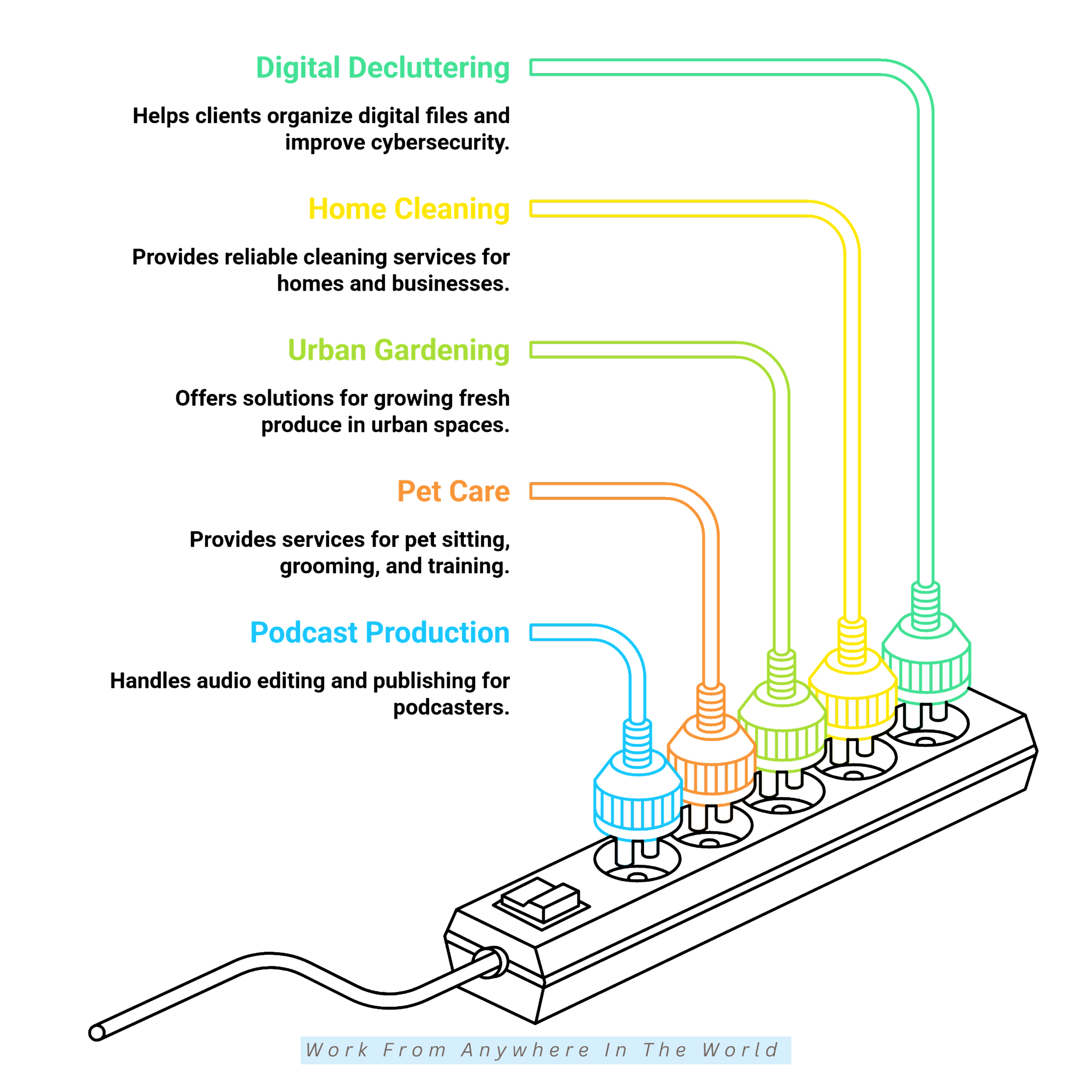
A digital decluttering consultant helps individuals or businesses organize their digital information. Services may include organizing files, reducing inbox clutter, restructuring cloud storage, and creating more manageable digital systems.
Start by identifying the types of digital organization you are comfortable providing. You might focus on email organization, file management, cloud storage, or helping clients establish straightforward naming and filing systems.
For example, a freelance designer with years of scattered project files might need a clearer folder structure for active projects, completed work, client documents, and archived material.
Because digital information can contain confidential or sensitive material, privacy and security should be considered carefully. Clearly defining what you will access and how client information will be handled can help establish appropriate boundaries.
Key Points
- Define the digital organization services you offer.
- Focus on systems clients can maintain themselves.
- Establish clear privacy and access boundaries.
- Tailor solutions to each client's needs.
7. Start A Home Cleaning Business
A home cleaning business provides services to homeowners, renters, and other clients who need help maintaining their living spaces. You can begin with general cleaning and add specialized services as your experience develops.
Additional services might include deep cleaning, move-in or move-out cleaning, post-renovation cleaning, or environmentally conscious cleaning options. Consider which services are practical based on your equipment, skills, and local demand.
For example, offering weekly or biweekly cleaning services could provide customers with ongoing support while giving the business a more predictable schedule than relying entirely on one-time bookings.
Trust is particularly important when working inside people's homes. Local SEO for small businesses can also help nearby customers discover your cleaning services when they search online.
Clear communication, reliable service, appropriate insurance, and professional practices can help customers feel more comfortable hiring you.
Key Points
- Research demand within your local area.
- Decide which cleaning services you will provide.
- Consider recurring and one-time services.
- Build trust through reliable, professional service.
8. Start An Urban Gardening Business
An urban gardening business can help people grow plants in apartments, condominiums, balconies, and other spaces where traditional gardens may not be practical. Products and services can be adapted to different amounts of available space.
Potential offerings include vertical gardens, balcony planters, container gardens, indoor growing systems, and customized setups. You could also provide installation, maintenance, or gardening workshops.
For example, an apartment resident might want a compact herb garden that fits on a balcony or sunny windowsill. Helping customers select suitable plants and growing methods can make gardening more accessible in limited spaces.
Before choosing what to offer, research local growing conditions and your potential customers' needs. Learning how to start a gardening business can also help you explore the planning and practical considerations involved.
Key Points
- Focus on gardening solutions for smaller spaces.
- Offer products or services that suit your skills.
- Consider local and seasonal growing conditions.
- Tailor solutions to the customer's available space.
Wealthy Affiliate – Mini Review
If you’ve ever thought about turning your blog, passion, or niche into an online business,
Wealthy Affiliate (WA) is one of the most beginner-friendly platforms I’ve used.
It combines step-by-step training, website hosting, AI-powered tools,
keyword research, and an active community all in one place.
What I like most is that you can start free (no credit card needed), explore the platform,
test the tools, and connect with other entrepreneurs before upgrading.
WA isn’t a “get rich quick” scheme — success comes from consistent effort
and applying what you learn over time.
9. Start A Pet Care Business
A pet care business can provide practical services for owners who need additional support caring for their animals. The services you offer can depend on your experience, skills, and local demand.
Possible options include pet sitting, dog walking, grooming, training, and pet photography. Some services may require specialized training, insurance, licences, or suitable facilities, so research the requirements in your area.
For example, someone who works long hours may need a reliable dog walker or pet sitter during the day. Other owners may need occasional care when travelling or managing a particularly busy schedule.
Trust is especially important when people place their pets in someone else's care. Applying practical small business success secrets can also help you strengthen customer relationships and build a more sustainable pet care business.
Key Points
- Choose pet services that match your experience.
- Research local demand and requirements.
- Establish clear services and expectations.
- Build trust through reliable, responsible care.
10. Start A Podcast Production Agency
A podcast production agency provides technical and creative support to podcasters, businesses, and other content creators. Understanding podcasting vs vlogging can also help you see how podcast production differs from other forms of content creation.
Services might include audio editing, noise reduction, show notes, transcripts, publishing, thumbnails, and promotional clips. You can offer individual services or create packages based on different production needs.
For example, a business coach who records weekly interviews might outsource editing and publishing to maintain a consistent production schedule. Other clients may only need help with particular stages of the process.
Begin with services that match your existing technical skills and equipment. As you gain experience, you can expand your offerings or work with other specialists when projects require additional expertise.
Key Points
- Choose podcast services that match your skills.
- Create clearly defined service packages.
- Develop an efficient production workflow.
- Expand your services as your experience grows.
11. Offer Personalized Travel Planning
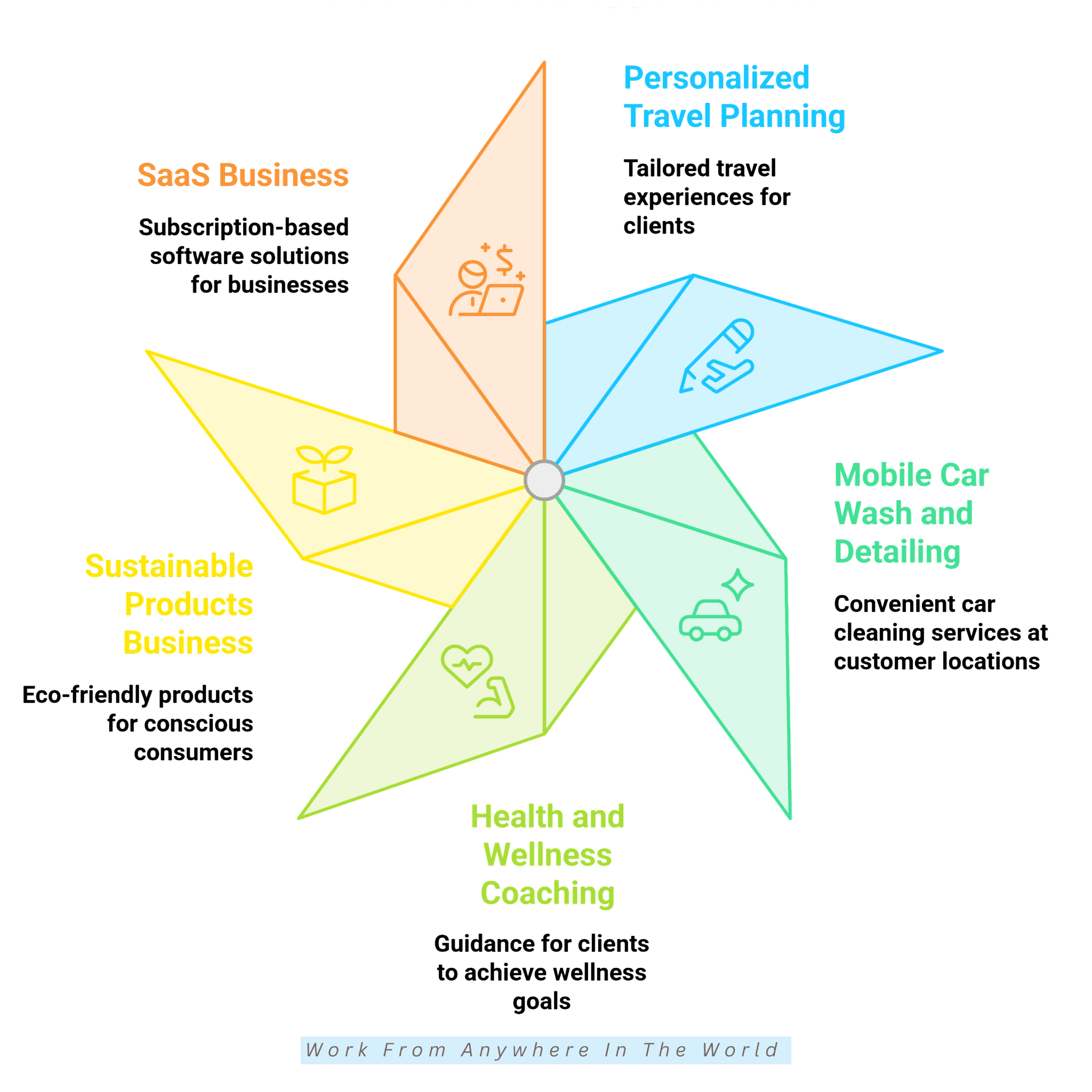
A personalized travel planning business helps clients organize trips around their interests, preferences, budgets, and available time. The service can provide additional support for travellers who prefer customized itineraries.
Services might include researching accommodations, attractions, transportation options, restaurants, and activities. You could specialize in particular destinations or types of travel to develop more focused expertise.
For example, a couple visiting Italy might want an itinerary centred around regional food, cooking experiences, local markets, and cultural attractions. Another traveller may prefer nature, history, or family-friendly activities.
Be clear about the services you provide and whether you are offering itinerary planning or making travel bookings on a client's behalf. Booking or selling travel may involve specific licensing, registration, or consumer-protection requirements depending on your location.
Key Points
- Define the travel planning services you provide.
- Consider specializing in particular destinations or interests.
- Personalize itineraries around individual needs.
- Research applicable travel-business requirements.
12. Start A Mobile Car Wash And Detailing Business
A mobile car wash and detailing business brings vehicle cleaning services directly to customers at their homes, workplaces, or other suitable locations. This approach can reduce the need for a permanent commercial location.
Services might include exterior washing, interior cleaning, vacuuming, waxing, and more detailed vehicle care. Begin with services that match your equipment, experience, and available resources.
For example, busy professionals may appreciate having their vehicles cleaned while they are at home or work. Apartment buildings, workplaces, and vehicle fleets could also provide opportunities to serve several customers in one location.
Before starting, research local business requirements and environmental regulations related to water use, wastewater, and cleaning products. Appropriate insurance and safe handling practices should also be considered.
Key Points
- Determine which mobile services you will offer.
- Research equipment and operating requirements.
- Identify convenient locations and potential customers.
- Check local environmental and business regulations.
13. Build A Health And Wellness Coaching Business
A health and wellness coaching business can help clients develop habits that support their personal wellness goals. Depending on your training and qualifications, you might focus on areas such as stress management, sleep routines, physical activity, or general lifestyle habits.
Start by defining the type of support you are qualified to provide and the audience you want to serve. Relevant education or certification can help you develop appropriate coaching skills and establish professional credibility.
For example, a wellness coach might work with clients who want to establish more consistent daily routines. Sessions could focus on setting realistic goals, identifying obstacles, and creating manageable action plans.
It is also important to maintain clear professional boundaries. Health and wellness coaches should avoid diagnosing conditions or providing medical, nutritional, or mental health treatment unless appropriately qualified to do so.
Key Points
- Choose a coaching area that matches your qualifications.
- Define the clients and goals you want to support.
- Establish clear professional boundaries.
- Consider appropriate training or certification.
14. Start A Sustainable Products Business
A sustainable products business focuses on items designed to reduce waste, encourage reuse, or provide alternatives to conventional products. The possibilities can range from household goods and personal care products to clothing and packaging.
Before choosing products, research your potential customers and the environmental concerns that matter to them. Consider materials, manufacturing methods, packaging, durability, and what happens to the product at the end of its useful life.
For example, a kitchen-focused business might offer reusable food-storage products or other durable alternatives to disposable items. A clearly defined niche can make it easier to select products and communicate their purpose.
Be careful when making environmental claims about your products. Clear information about materials, sourcing, and product characteristics can help customers make informed choices while you work toward building a sustainable online business.
Key Points
- Choose a clearly defined sustainable product niche.
- Research materials, sourcing, and packaging.
- Consider the complete product lifecycle.
- Use clear and accurate environmental claims.
15. Create A SaaS Business
A Software-as-a-Service (SaaS) business provides customers with access to software through an ongoing subscription or another recurring payment model. SaaS products often focus on solving a specific problem for individuals or businesses.
Potential applications include project management, invoicing, customer relationship management, appointment scheduling, or other repetitive business tasks. A clearly defined problem can provide a useful starting point for developing the software.
You do not necessarily need to build a complex platform immediately. A minimum viable product (MVP) can provide the essential features needed to test the concept and gather feedback from early users.
For example, scheduling software designed for small clinics could simplify appointment booking and reduce repetitive administrative work. Feedback from users could then help determine which additional features are genuinely useful.
Key Points
- Identify a specific problem the software will solve.
- Define the customers who need that solution.
- Consider starting with a minimum viable product.
- Use customer feedback to guide future development.
7 Tools That Help You Find Business Ideas
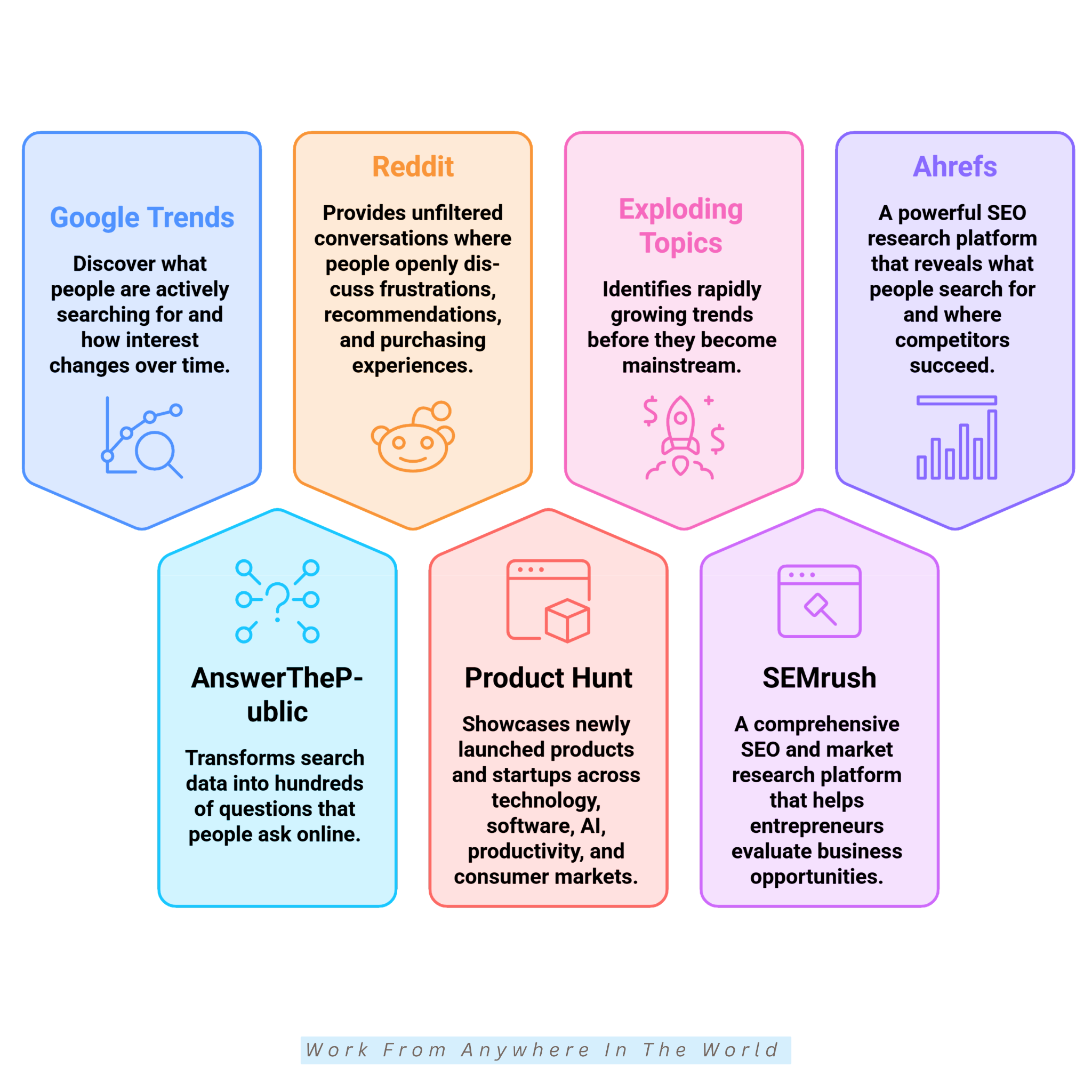
Online tools can provide useful information when you are researching potential business ideas. They can help you explore what people search for, discuss, buy, and show interest in online.
Different tools provide different types of insight. Some focus on search trends and keywords, while others reveal customer questions, emerging products, online conversations, or competitor activity.
These resources can also help you investigate an idea you already have. Comparing information from several sources may provide a clearer picture of customer interest and existing competition.
No single tool can determine whether a business idea will succeed. Use the information alongside customer feedback, market analysis, and practical testing as part of your wider research.
The following 7 tools can help you discover potential opportunities, explore demand, and research business ideas in greater detail.
1. Google Trends
Google Trends can help you explore what people are searching for and how interest in particular topics changes over time. This information can provide useful context when comparing potential business ideas.
Enter keywords related to your ideas and adjust the location and time period to see how search interest changes. Comparing several terms can also help you understand how different topics perform relative to one another.
Pay attention to Related Topics and Related Queries, which may reveal additional subjects people are searching for. You can also look for seasonal patterns that could affect demand at different times of the year.
Google Trends should not be used as proof that a business idea will succeed. Instead, combine its search-interest data with market research, competitor analysis, and customer feedback when evaluating an opportunity.
Key Points
- Compare search interest for different ideas.
- Explore trends by location and time period.
- Review related topics and queries.
- Look for seasonal patterns in search interest.
2. AnswerThePublic
AnswerThePublic can help you discover the questions and topics people search for online. Starting with a broad keyword can reveal different ways potential customers think about a subject.
Searches may be organized around terms such as what, why, how, when, and which. These questions can highlight customer concerns, interests, problems, and areas where people are looking for more information.
For example, searching for a topic such as pet grooming or coffee business may uncover questions that suggest possible products, services, or specialized niches worth researching further.
The results can also provide long-tail keyword ideas that help you explore a potential market in greater detail. Use these insights alongside other research to determine whether an opportunity has genuine customer demand.
Key Points
- Discover questions people search for online.
- Identify recurring customer concerns and interests.
- Explore potential products, services, and niches.
- Use long-tail searches to investigate ideas further.
3. Reddit
Reddit can provide useful insight into how people discuss their experiences, problems, preferences, and purchasing decisions. Communities focused on particular interests or industries can be especially helpful when researching potential business ideas.
Explore relevant communities and look for discussions about recurring frustrations, missing features, difficult tasks, or products and services people wish were available. Comment sections can provide additional perspectives beyond the original post.
Rather than basing an idea on one popular discussion, look for patterns across multiple conversations. Recurring questions or complaints may indicate a problem that deserves further research.
Reddit discussions represent individual experiences and opinions, so they should not be treated as proof of market demand. Combine what you discover with broader market research and direct customer feedback.
Key Points
- Explore communities related to your potential market.
- Look for recurring questions and frustrations.
- Read comments for additional customer perspectives.
- Verify potential opportunities with further research.
4. Product Hunt
Product Hunt can help you explore newly launched products and see how entrepreneurs are approaching problems in technology, software, AI, productivity, and other digital markets.
Browse recent launches to discover new products, features, and business models. User comments can also provide insight into what people appreciate, question, or believe could be improved.
Look beyond products receiving the most attention. Feedback, feature requests, and recurring problems may reveal gaps or customer needs that could inspire a different approach.
The goal is not to copy an existing product. Instead, use Product Hunt for inspiration and research opportunities to serve a particular audience, niche, or problem in your own way.
Key Points
- Explore recently launched products and startups.
- Review user comments and feature requests.
- Look for gaps and underserved needs.
- Use existing products for research rather than imitation.
5. Exploding Topics
Exploding Topics can help you discover products, industries, technologies, and consumer interests that are attracting increased attention. This can provide inspiration when researching emerging business opportunities.
Browse topics by category or search for subjects related to an idea you are considering. Trend data can help you see how interest has changed and whether a topic appears to be gaining momentum.
Pay attention to the pattern rather than growth alone. A sudden increase in attention may represent a short-lived trend, while more sustained growth could indicate an area worth investigating further.
Use these findings as a starting point rather than evidence that a business idea will succeed. Additional market research, competitor analysis, and customer feedback can help you evaluate whether an opportunity is practical.
Key Points
- Explore emerging products and industries.
- Research trends related to potential ideas.
- Compare short-term interest with sustained growth.
- Validate promising trends with additional research.
6. Semrush
Semrush provides SEO, keyword, and competitor research tools that can help you investigate potential business ideas. Search data can provide insight into what people are looking for and how competitive particular topics may be.
Start with keywords related to the business idea you are considering. You can explore search volume, keyword difficulty, related terms, and search intent to better understand potential customer interest.
Competitor research can provide another perspective. Reviewing the keywords and content that attract visitors to established websites may reveal popular topics, customer needs, and areas worth investigating further.
Keyword data alone cannot determine whether a business idea has commercial potential. Combine your findings with customer research, competitor analysis, and practical testing before making a decision.
Key Points
- Research keywords related to potential business ideas.
- Explore search volume, competition, and intent.
- Study competitors for additional market insights.
- Combine SEO data with broader market research.
7. Ahrefs
Ahrefs provides SEO and competitor research tools that can help you investigate potential business ideas. Its search data can reveal what people look for online and which topics attract consistent interest.
Use Keywords Explorer to research terms related to your idea and discover related searches. Search volume, keyword difficulty, and search intent can provide additional context about interest and competition.
You can also use Site Explorer to research established websites in a potential market. Reviewing their popular pages and organic keywords may help you understand which topics and customer needs receive attention.
Strong search performance does not necessarily mean a business opportunity will be profitable. Use Ahrefs data alongside market research, customer feedback, and practical testing when evaluating an idea.
Key Points
- Research keywords related to your business idea.
- Explore related searches and customer interests.
- Study established competitors and popular content.
- Use SEO data as one part of your wider research.
Frequently Asked Questions
Q1: Should I Choose A Business Based On My Passion?
Passion can provide motivation and make it easier to stay interested in what you are building. However, personal enthusiasm alone does not guarantee sufficient customer demand.
Look for an idea that combines your interests or skills with a genuine customer need. Researching the market can help you determine whether that combination has business potential.
Q2: Can I Have More Than One Business Idea?
Yes. Exploring several ideas before choosing one can help you compare their advantages, challenges, costs, and potential audiences.
You do not need to develop every idea fully. Initial research can help you narrow the possibilities and decide which ones deserve more detailed evaluation.
Q3: How Long Does It Take To Find The Right Business Idea?
There is no standard timeline for finding a business idea. Some people recognize an opportunity quickly, while others explore and refine several possibilities before deciding what to pursue.
Taking additional time can be useful when it allows you to research customers, competitors, costs, and demand. The goal is to make an informed choice rather than rush the process.
Q4: What Are The Best Places To Discover New Business Ideas?
Potential ideas can come from everyday problems, customer reviews, online communities, industry publications, social media, and conversations with potential customers.
Research tools can provide additional inspiration by revealing search behaviour, emerging interests, and existing competition. Using several sources can give you a broader view of potential opportunities.
Q5: Can I Start A Business With A Small Budget?
Some businesses can begin with relatively limited resources, particularly service-based and online businesses. Learning how to start a business without money can also reveal ways to keep initial expenses manageable.
Startup requirements vary depending on the idea. Estimate essential costs such as equipment, software, licences, insurance, and marketing before deciding how much you need.
Q6: How Do I Know If A Business Idea Is Worth Pursuing?
Start by determining whether the idea addresses a genuine need and whether potential customers show meaningful interest. Research the market, competitors, required resources, and practical challenges involved.
You can then test the idea on a small scale and gather feedback from potential customers. What you learn can help you decide whether to continue, refine the concept, or explore another opportunity.
Conclusion
Learning how to find a business idea involves more than waiting for inspiration. Promising opportunities can emerge from everyday problems, existing skills, customer needs, market gaps, and changes you notice around you.
Research helps you determine whether an idea deserves further attention. Understanding potential customers, studying competitors, and exploring market demand can provide valuable information before you commit significant resources.
Testing an idea on a small scale can provide even more insight. Customer responses, practical challenges, costs, and early results can help you decide whether the concept needs to be refined.
Not every idea you explore will become a business, and that is part of the process. Each round of research can help you better understand what customers need and which opportunities are realistic for you.
Continue exploring, comparing, and testing possibilities until you find an idea that fits your skills, resources, and potential market. A thoughtful approach can help you move from an initial idea toward a more clearly defined business opportunity.
I trust you enjoyed this article on How To Find A Business Idea: 10 Essential Steps. Please stay tuned for more insightful blogs on affiliate marketing, online business, and working from anywhere in the world.
Take care!
— JeannetteZ 🌍✨
💬 Your Opinion Is Important To Me
Do you have thoughts, ideas, or questions? I’d love to hear from you. Please leave your comments below or email me directly at Jeannette@WorkFromAnywhereInTheWorld.com.
📚 More Work From Anywhere Reads
🚀 Ready to Build a Business You Can Run from Home
Or from Anywhere in the World?
Imagine creating income on your terms — from home, a cozy café, or wherever life takes you.
With the right tools, training, and community support, it’s entirely possible.
Start your own online business for free — no credit card needed.
Disclosure
This post may contain affiliate links. As an Amazon Associate and participant in other affiliate programs, I earn from qualifying purchases at no extra cost to you. Please read my full affiliate disclosure.