

How To Hire A Business Consultant: 15 Practical Tips
How to hire a business consultant becomes an important question when your business needs expertise beyond what you already have. The right guidance may help you approach challenges from a different perspective.
Business consultants offer specialized knowledge in areas such as strategy, marketing, finance, operations, and technology. The type of expertise you need will depend on your business and the problem you want to address.
Choosing a consultant involves more than reviewing qualifications or industry experience. Their communication style, approach to problem-solving, and understanding of your goals also influence how well you work together.
Taking time to define what you need before beginning your search makes the selection process more focused. It also gives potential consultants a better understanding of what you expect from the relationship.
This article explores what to consider when hiring a business consultant, from identifying your needs to evaluating experience and asking the right questions. You’ll also learn what to look for when comparing consultants and making your final decision.
15 Essential Tips On How To Hire A Business Consultant
Hiring a business consultant deserves careful thought because the person you choose may become involved in important decisions. Taking time to evaluate your options helps you find someone suited to your particular needs.
Start by understanding why you want outside support and what you expect from the relationship. This gives you a useful starting point when comparing different consultants and their areas of expertise.
Qualifications matter, but so do communication, experience, working style, and familiarity with your industry. A consultant who looks impressive on paper may not necessarily be the best match for your business.
The hiring process is also an opportunity to ask questions and establish expectations before making a commitment. Discussing responsibilities, fees, timelines, and desired outcomes early can prevent misunderstandings later.
The following 15 practical tips for hiring a business consultant cover the key areas to consider. Each tip focuses on a different part of the selection process.
They can also help you compare your options and find someone whose expertise and approach suit your business needs. A thoughtful choice can lead to a more productive working relationship.
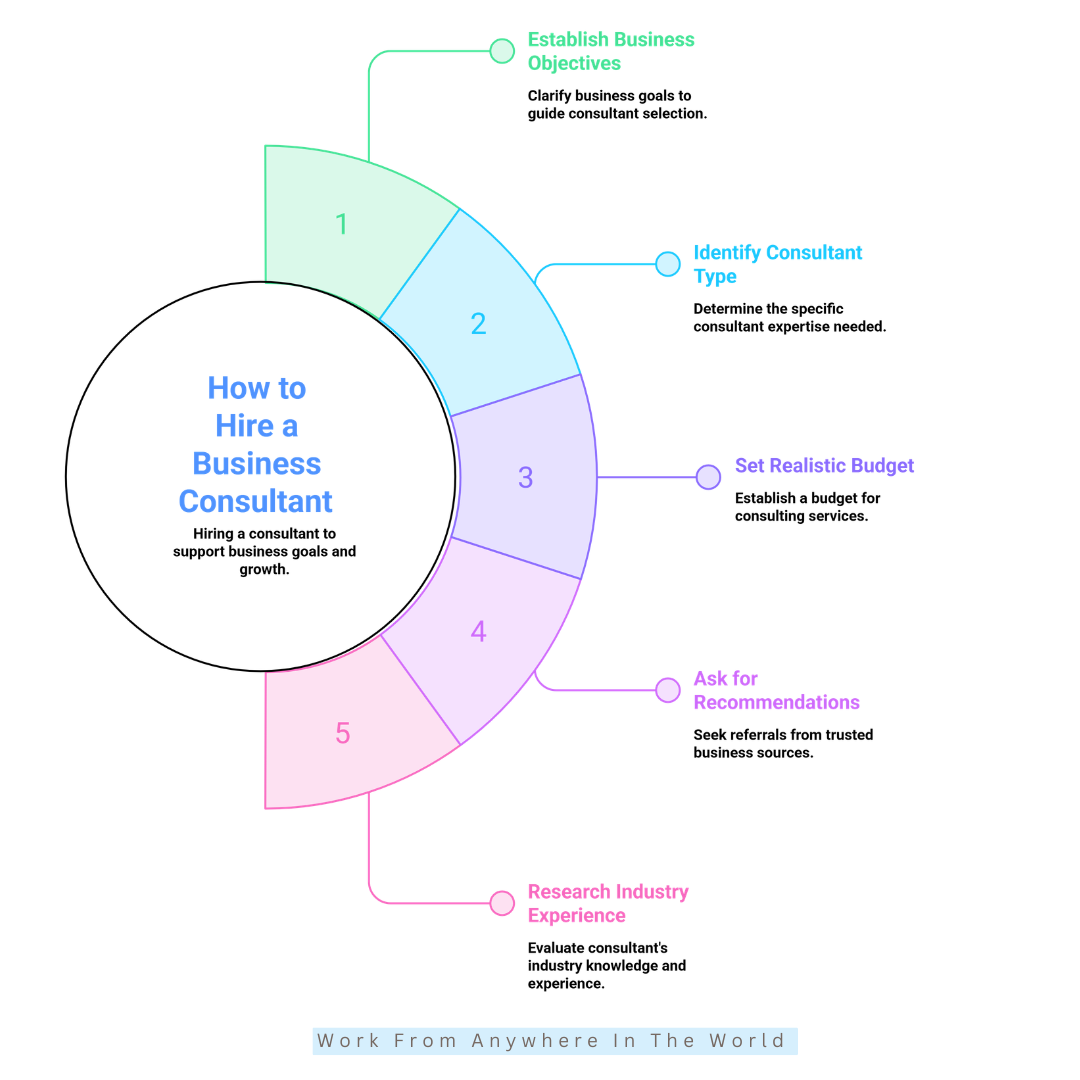
1. Establish Business Objectives
Knowing what you want to accomplish makes it easier to determine what kind of consulting support you need. Different business challenges may require very different areas of expertise.
Perhaps you want to improve marketing, streamline operations, increase sales, or prepare your business for expansion. Setting smart goals gives your search a clearer direction.
Taking time to establish your business objectives also gives potential consultants useful context when discussing the project. They can better understand the challenge, your expectations, and the type of results you hope to achieve.
These priorities remain useful once the work begins. They provide a reference point for reviewing progress and determining whether the consulting relationship is moving in the right direction.
Key Points
- Define the main business problem
- Decide what outcome you hope to achieve
- Identify the expertise your project requires
- Set a realistic timeframe for the work
2. Identify The Consultant Type
Business consulting covers many specialties, and the title “business consultant” can mean very different things. Understanding these distinctions makes it easier to narrow the field before comparing individual candidates.
A marketing consultant may focus on positioning, campaigns, or customer acquisition. Financial consultants concentrate on areas such as budgeting and financial planning, while operations consultants examine processes and efficiency.
Technology, human resources, management, and strategy are other common specialties. Some consultants work across several areas, while others develop deeper knowledge within one particular field.
Consider whether your project requires broad business guidance or specialized knowledge. Choosing the appropriate type of consultant helps ensure that the people you consider have experience relevant to the work involved.
Key Points
- Explore the different consulting specialties
- Compare each consultant’s areas of expertise
- Decide between broad or specialized support
- Match the consultant’s specialty to your project
3. Set A Realistic Budget
Consulting fees vary widely depending on experience, specialization, project scope, and the amount of time involved. Establishing a budget gives you a practical range to work with when comparing potential consultants.
Consultants may charge by the hour, project, or another agreed-upon arrangement. Understanding how fees are structured makes it easier to compare proposals and determine what is included in the quoted amount.
Price should not be the only consideration. A lower fee may not represent better value if the consultant lacks relevant experience or requires considerably more time to complete the work.
Consider what the project is worth to your business and what you reasonably expect from the engagement. Your budget should reflect both what you can afford and the importance of the work involved.
Key Points
- Establish a realistic spending range
- Compare different consulting fee structures
- Confirm what each fee includes
- Consider the overall value provided
4. Ask For Recommendations
Personal recommendations can be a useful starting point when searching for a business consultant. Business owners, colleagues, and professional contacts may know someone they have worked with successfully.
A recommendation may also provide details that are difficult to learn from a consultant’s website. You might hear about their communication style, reliability, working methods, and how they handled challenges.
Ask about the person’s actual experience rather than relying solely on the recommendation. A consultant who was an excellent fit for one business may not necessarily be an excellent fit for a different project or industry.
Professional associations, networking groups, and business communities can also broaden your search. These connections may introduce you to consultants you would not otherwise discover.
Key Points
- Ask trusted contacts for recommendations
- Learn about their firsthand experiences
- Consider whether the consultant fits your project
- Explore relevant professional networks
5. Research Industry Experience
Industry experience can help a consultant understand the environment in which your business operates. Familiarity with your market may also reduce the time needed to learn about common challenges and customer expectations.
Look at the types of businesses and projects the consultant has worked with previously. Case studies, professional profiles, project examples, and client testimonials may provide useful background.
Relevant experience does not necessarily mean the consultant must have worked with a business identical to yours. Skills gained in a related industry may transfer well, particularly when the challenges or customer groups are similar.
Consider the depth of their experience and the number of years they have worked in the field. Recent, relevant projects may tell you more about their capabilities than a long list of older credentials.
Key Points
- Review experience with similar businesses
- Look for relevant case studies
- Consider experience in related industries
- Focus on recent, applicable projects
6. Review Case Studies And Previous Results
A consultant’s previous work can provide useful insight into how they approach business challenges. Case studies are particularly helpful when they explain the situation, the work completed, and the results achieved.
Look for examples involving problems similar to the one your business is facing. The industry need not be identical if the consultant has successfully handled comparable challenges elsewhere.
Pay attention to how results are presented. Specific outcomes and supporting details are more informative than broad claims about helping businesses improve performance or achieve success.
Testimonials can provide another perspective on the working relationship. Comments about responsiveness, collaboration, reliability, and problem-solving may reveal qualities that are not apparent from performance results alone.
Key Points
- Review case studies from previous projects
- Look for challenges similar to yours
- Examine how results are supported
- Read testimonials about the client experience
7. Verify Credentials And Professional Qualifications
Professional qualifications can provide useful background when you are evaluating a business consultant. Depending on their specialty, these may include certifications, formal education, professional training, or industry memberships.
Look for credentials that are relevant to the work you need completed. Qualifications in areas such as finance, marketing, project management, technology, or leadership may be valuable for particular consulting projects.
Credentials should be considered alongside practical experience rather than treated as proof of ability. A consultant may have impressive qualifications but limited experience applying that knowledge to situations similar to yours.
Check important credentials when they influence your hiring decision. Professional organizations, certification bodies, and other issuing institutions may provide ways to confirm whether a qualification is current and legitimate.
Key Points
- Look for qualifications relevant to the project
- Consider credentials alongside practical experience
- Check specialized training and industry memberships
- Verify important certifications when appropriate
8. Conduct Detailed Interviews
A detailed interview gives you an opportunity to learn more about a consultant than their website or professional profile may reveal. It also allows both sides to decide whether the working relationship feels suitable.
Discuss the project, your expectations, and any challenges that may affect the work. Notice whether the consultant takes time to understand the situation before suggesting possible approaches.
Pay attention to the questions they ask as well as the answers they provide. Thoughtful questions may indicate that they are interested in understanding your business rather than offering the same solution to every client.
The conversation is also a good time to discuss availability, working methods, project management, and communication preferences. These practical details may become important once the project begins.
Key Points
- Prepare relevant questions before the interview
- Discuss expectations and project requirements
- Notice how well the consultant listens
- Ask about their preferred working methods
9. Evaluate Communication And Listening Skills
Strong communication matters throughout a consulting relationship. Even an experienced consultant needs to explain ideas in a way that makes sense to the people who will be involved in the project.
Notice how the consultant communicates during your early conversations. Their responses should address your questions directly rather than relying on vague explanations or unnecessary jargon.
Listening is equally important. A consultant who takes time to understand your concerns, asks follow-up questions, and considers different viewpoints is better positioned to understand the situation.
Communication expectations should also be discussed before the project begins. Knowing how often you will receive updates and how questions or concerns will be handled can prevent misunderstandings later.
Key Points
- Look for straightforward, understandable communication
- Notice how carefully the consultant listens
- Pay attention to their follow-up questions
- Discuss communication expectations in advance
10. Request A Detailed Proposal
A detailed proposal shows how a consultant intends to approach your project before you make a commitment. It also gives you something concrete to review when comparing different candidates.
The proposal should explain the scope of work, expected deliverables, timeline, fees, and communication arrangements. Any responsibilities belonging to you or your team should also be identified.
Look for details that reflect the conversations you have already had. A proposal tailored to your situation suggests that the consultant understands the project rather than relying on a standard package.
Review anything that seems vague or open to interpretation before moving forward. Discussing these points early can reduce confusion about responsibilities, deadlines, and what the engagement includes.
Key Points
- Request a proposal tailored to your project
- Review the scope, timeline, and deliverables
- Confirm fees and communication arrangements
- Discuss unclear details before proceeding

Wealthy Affiliate – Mini Review
If you’ve ever thought about turning your blog, passion, or niche into an online business,
Wealthy Affiliate (WA) is one of the most beginner-friendly platforms I’ve used.
It combines step-by-step training, website hosting, AI-powered tools,
keyword research, and an active community all in one place.
What I like most is that you can start free (no credit card needed), explore the platform,
test the tools, and connect with other entrepreneurs before upgrading.
WA isn’t a “get rich quick” scheme — success comes from consistent effort
and applying what you learn over time.
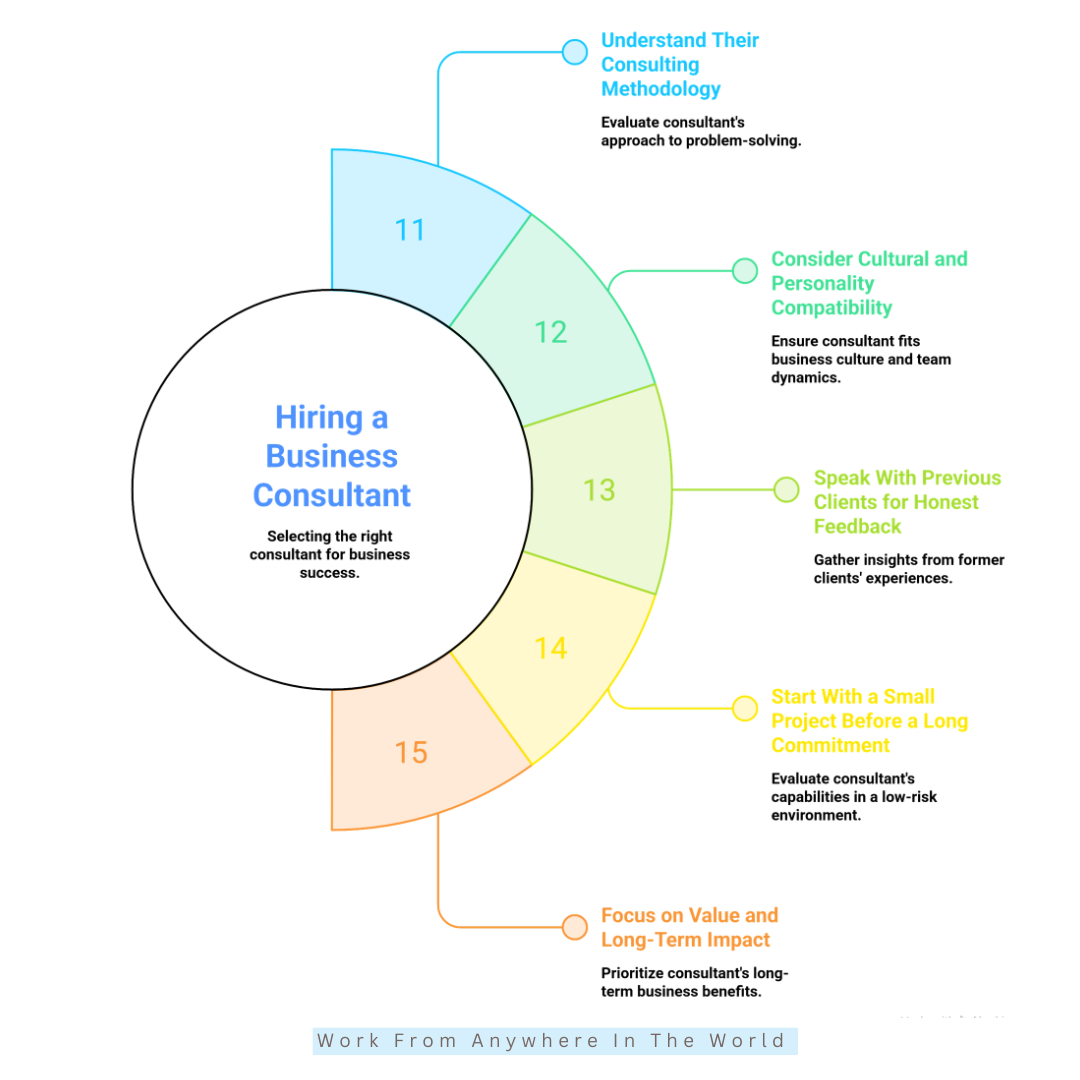
11. Understand Their Consulting Methodology
Consultants use different methods to assess problems and develop recommendations. Understanding the consulting methodology they follow gives you a better idea of what working together may involve.
Some consultants rely heavily on research, interviews, and data analysis. Others may use workshops, collaborative planning, or hands-on involvement throughout the project.
Ask how they gather information and determine which issues deserve attention. It is also useful to understand how recommendations are developed and how progress will be evaluated.
Consider whether their approach suits your business and the people involved in the project. A highly collaborative process, for example, may require more participation from you or your team.
Key Points
- Ask how the consultant approaches projects
- Understand how information will be gathered
- Review how recommendations are developed
- Consider the involvement required from your team
12. Consider Cultural And Personality Compatibility
A consultant may have excellent qualifications and experience but still not be the right fit for every business. Personality and working style can influence how comfortably people collaborate throughout the project.
Consider how the consultant interacts with you and others during early conversations. Respectful communication, openness to different viewpoints, and a willingness to understand how your business operates are all worth noticing.
Company culture matters as well, particularly when the consultant will work closely with employees or managers. Someone who understands the existing environment may find it easier to introduce new ideas without creating unnecessary friction.
Compatibility does not mean choosing someone who agrees with everything you say. A good consultant should still be willing to question assumptions and offer a different perspective when it benefits the project.
Key Points
- Consider personality and working style
- Notice how the consultant interacts with others
- Look for respect for your company culture
- Value constructive differences in perspective
13. Speak With Previous Clients
Previous clients can provide a perspective that you may not find in testimonials or case studies. Speaking with them gives you an opportunity to ask about the consulting relationship in more detail.
Ask what it was like to work with the consultant throughout the project. Their comments may reveal how reliably the consultant communicated, handled challenges, and responded when circumstances changed.
It is also worth asking whether the project met expectations and whether the client was satisfied with the results. Find out whether they would hire the same consultant again for a similar project.
Listen for both positive experiences and any difficulties the client encountered. Balanced feedback can give you a more realistic picture of what you might expect from the relationship.
Key Points
- Request references from previous clients
- Ask about the overall working relationship
- Discuss how challenges were handled
- Find out whether they would hire the consultant again
14. Start With A Small Project
A smaller initial project gives you an opportunity to experience how a consultant works before considering a longer engagement. It also limits the commitment while you determine whether the relationship works well in practice.
The first project could involve a business audit, strategic assessment, marketing review, or another clearly defined task. Choose something meaningful enough to demonstrate how the consultant approaches their work.
Pay attention to communication, organization, and the quality of the recommendations provided. You can also see how well the consultant responds to questions, feedback, and unexpected issues.
Once the project is complete, consider whether the experience met your expectations. A successful first engagement may provide a natural starting point for discussing larger or longer-term projects.
Key Points
- Begin with a manageable initial project
- Choose a meaningful, defined assignment
- Evaluate the consultant’s working approach
- Review the experience before expanding the relationship
15. Focus On Long-Term Value
Consulting fees matter, but the lowest price does not always provide the best value. Consider what the consultant brings to the project and whether their expertise is likely to justify the investment.
Look at the quality and relevance of their recommendations rather than focusing only on immediate results. Some improvements may continue benefiting the business after the consulting engagement has ended.
Long-term value may also come from knowledge transferred to you or your team. New processes, skills, or ways of approaching problems can remain useful well beyond the original project.
Consider the overall contribution when comparing your options. The strongest choice is usually the consultant who offers the right combination of expertise, approach, and value for the work involved.
Key Points
- Look beyond the consulting fee
- Consider benefits beyond the initial project
- Value knowledge shared with your team
- Compare the overall contribution offered
Frequently Asked Questions
Q1: How Can I Measure A Consultant’s Success?
Success should be connected to the goals established before the project begins. Relevant measures might include improved efficiency, lower costs, increased sales, completed milestones, or another outcome related to the original problem.
Not every result will be immediately measurable. Consider whether the consultant also provided useful knowledge, processes, or recommendations that continue to benefit the business.
Q2: Should I Hire A Consultant For A Short-Term Or Long-Term Project?
The right arrangement depends on the type of support your business needs. A specific problem, audit, or assessment may only require a short-term engagement.
Longer relationships may be appropriate when the consultant provides ongoing strategic guidance or supports a larger project. The scope and expected outcome should help determine the appropriate timeframe.
Q3: What Questions Should I Ask During A Consultant Interview?
Ask about previous experience, similar projects, working methods, communication, availability, and expected timelines. You can also discuss how they approach challenges and evaluate project results.
The interview should give you a better understanding of how the consultant thinks and works. Their questions about your business can be just as revealing as the answers they provide.
Q4: When Should A Small Business Consider Hiring A Consultant?
Outside guidance may be useful when a business faces a challenge that requires expertise it does not currently have. This might involve marketing, finances, technology, operations, strategy, or another specialized area.
A consultant may also provide a fresh perspective when progress has stalled or an important decision requires additional insight. The need should be specific enough to justify bringing in outside expertise.
Q5: What Is The Difference Between A Consultant And A Business Coach?
A consultant is generally hired to provide expertise, analysis, and recommendations for particular business problems or projects. Their involvement often centres on finding solutions within their area of specialization.
A business coach typically focuses more on the business owner’s development, decision-making, and goals. The distinction can vary between professionals, so reviewing the services offered is important.
Q6: Do I Need A Contract When Hiring A Business Consultant?
A written agreement helps both parties understand the terms of the consulting relationship. It may cover the project scope, responsibilities, deliverables, fees, payment arrangements, timelines, and confidentiality.
The appropriate agreement depends on the project and your location. For significant or complex engagements, professional legal advice may be worthwhile before signing.
Conclusion
Learning how to hire a business consultant involves finding someone whose expertise matches your business’s needs. Experience matters, but communication, working style, and the overall fit deserve equal attention.
Taking time to compare consultants gives you a better understanding of what each person brings to the project. References, case studies, interviews, and proposals all provide useful information before you make a commitment.
Cost is another consideration, but it should be weighed alongside the value of the work involved. The right consultant should offer knowledge and guidance that address your immediate needs and contribute to your small business’s success.
A productive consulting relationship also depends on shared expectations and open communication. When both sides understand the project and their responsibilities, it becomes easier to work toward the desired outcome.
Choosing thoughtfully at the beginning can help create a consulting relationship that benefits your business throughout the project. The experience and knowledge gained may also remain valuable long after the engagement ends.
I trust you enjoyed this article on How To Hire A Business Consultant. Please stay tuned for more insightful blogs on affiliate marketing, online business, and working from anywhere in the world.
Take care!
— JeannetteZ 🌍✨
💬 Your Opinion Is Important To Me
Do you have thoughts, ideas, or questions? I’d love to hear from you. Please leave your comments below or email me directly at Jeannette@WorkFromAnywhereInTheWorld.com.
📚 More Work From Anywhere Reads
🚀 Ready to Build a Business You Can Run from Home
Or from Anywhere in the World?
Imagine creating income on your terms — from home, a cozy café, or wherever life takes you.
With the right tools, training, and community support, it’s entirely possible.
Start your own online business for free — no credit card needed.
Disclosure
This post may contain affiliate links. As an Amazon Associate and participant in other affiliate programs, I earn from qualifying purchases at no extra cost to you. Please read my full affiliate disclosure.